
As Bihar awaits its 2025 election verdict, Nitish Kumar — the state’s longest-serving chief minister — faces a defining moment. His development pitch, welfare blitz and political agility are up against rising youth anger, unemployment and a charged opposition campaign. Will Bihar reward his governance legacy or demand a new direction?
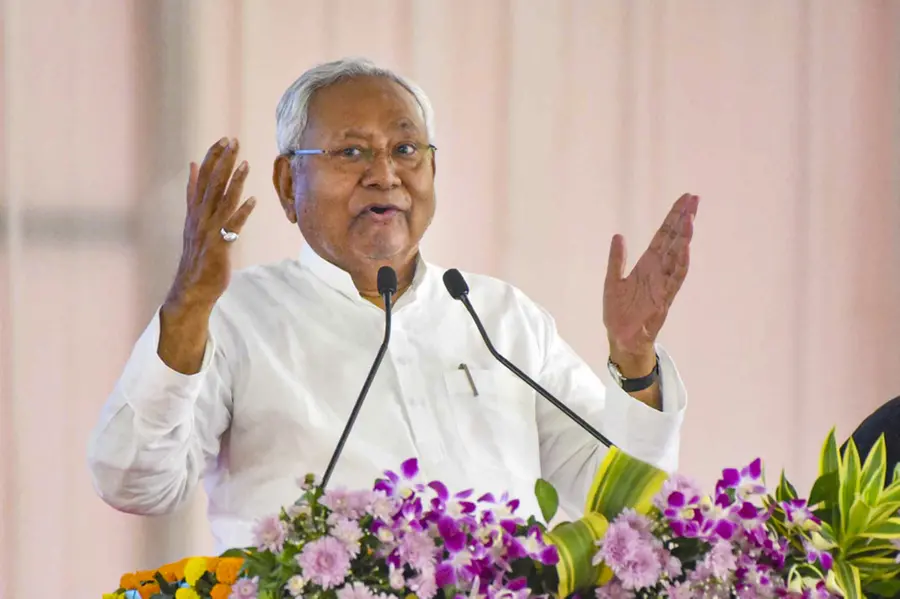
As the results of the 2025 Bihar assembly elections come in, all eyes are on Nitish Kumar — the nine-time (and counting) Chief Minister whose legacy of development is being put to the test.
Born on March 1, 1951, in Bakhtiarpur (Bihar), Nitish Kumar earned an Electrical Engineering degree from Bihar College of Engineering (now NIT Patna) in 1972, and soon entered politics through the JP Movement.
His early career included stints in the Lok Sabha and roles as Union Minister for Railways, Surface Transport, and Agriculture in the late 1990s and early 2000s.
The Development Narrative
Under Kumar’s leadership, the state has pursued an ambitious infrastructure and urban agenda. Roads, bridges, urban facilities, and power connections have been expanded across Bihar.
Key examples include his June 2025 inauguration of Bihar’s first six-lane bridge over the Ganga, which links Raghopur Diara to Patna in just five minutes, promising to unlock commerce, connectivity, and emergency services.
Ahead of the polls, he also rolled out welfare measures such as up to 125 free electricity units for eligible households — expected to serve around 1.67 crore homes.
With these moves, Kumar stakes his claim as the “architect” of Bihar’s transformation: the man who turned focus to governance, infrastructure, and tangible change rather than only identity politics.
The Political Churn & Survival Instinct
Yet, the other side of the story is his reputation for frequent alliance shifts. He moved from the BJP-led NDA (over Narendra Modi’s candidacy) to the Grand Alliance with RJD and Congress in 2015, back to NDA in 2017, again to the opposition bloc in 2022, and returned to NDA in January 2024.
These shifts earned him the moniker “Paltu Ram” in political circles — but also underline a singular survival instinct in Bihar’s volatile politics.
The Current Moment: Risk & Reward
As vote‐counting now begins, the stakes for Kumar are unusually high. With a historic turnout of ~67.13% in the two-phase election, the electorate appears energised.
On the one hand, Kumar comes to the contest with decades of administrative experience and a development story to sell; on the other, persistent issues remain: migration of youth, joblessness, lingering poverty, and the challenge of turning infrastructure gains into widespread economic growth.
The opposition INDIA alliance (with Tejashwi Yadav as its face) has fired aggressively on these fault lines—joblessness, migration out of Bihar—and launched a sharp campaign against the incumbent narrative.
Why It Matters Beyond Bihar
Bihar is India’s youngest state in terms of population, making its verdict more than local—it’s a bellwether for how welfare versus development narratives fare in modern India.
And for Kumar personally, another term would consolidate his record as Bihar’s longest-serving Chief Minister; a defeat would pose questions about whether his brand of politics has run its course.
The Verdict
At this moment, Nitish Kumar stands at the crossroads: If his infrastructure and welfare-led pitch resonates with voters, he is set to continue his long innings. If instead the younger, aspirational electorate votes out of impatience for jobs and change, then his legacy may face a much steeper test. Either way, the outcome will reverberate beyond Patna, into the national political landscape.
Published: 14 Nov 2025, 07:33 am IST
Related Topics
Disclaimer: Kindly avoid objectionable, derogatory, unlawful and lewd comments, while responding to reports. Such comments are punishable under cyber laws. Please keep away from personal attacks. The opinions expressed here are the personal opinions of readers and not that of Mathrubhumi.
