
Chinese scholars praise Bhagavad Gita as a timeless “nectar of wisdom” addressing spiritual and modern-day challenges.
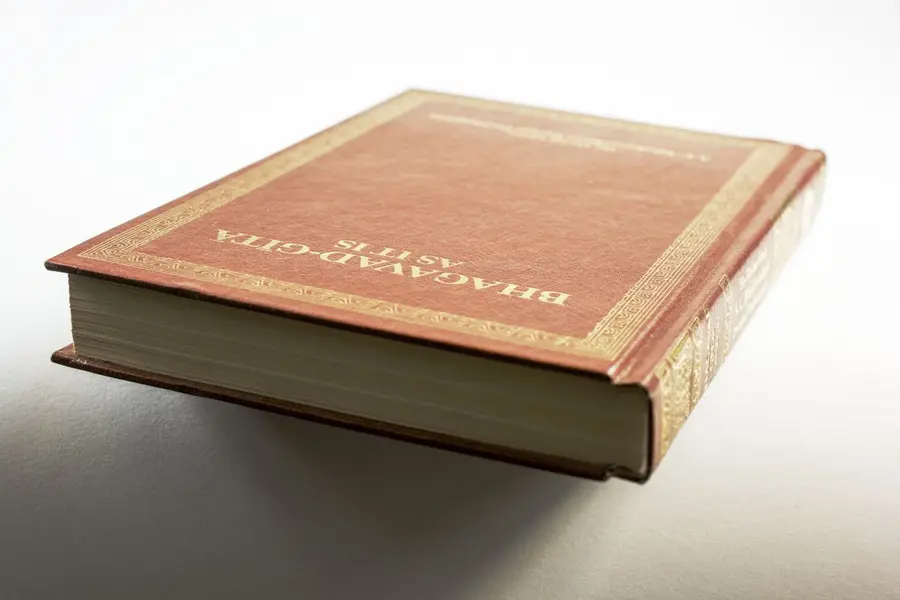
Beijing: The Bhagavad Gita has been lauded by Chinese scholars as a “nectar of wisdom” and a “miniature history of Indian civilisation,” offering insights for both spiritual and worldly challenges in today’s times. The rare public admiration for the ancient Indian scripture was expressed at a symposium titled Sangamam – A Confluence of Indian Philosophical Traditions, organised by the Indian Embassy in Beijing on Saturday.
The scholars highlighted the Gita as a philosophical encyclopedia of India, underscoring its enduring insights on balancing material life with spiritual pursuits.
Leading the discussions, 88-year-old Prof Zhang Baosheng, who translated the Bhagavad Gita into Chinese, described it as a spiritual epic reflecting India’s approach to duty, action and detachment. “Its translation was necessary because it reveals India's spiritual outlook — its ideas of duty, action and detachment — which still mould Indian life today,” he said.
Recalling his travels across India from Cape Comorin (Kanniyakumari) to Gorakhpur in the mid-1980s, Prof Zhang observed, “Everywhere, I sensed Lord Krishna's presence — a living moral and spiritual idol. The Gita is not a remote scripture but a living influence on Indian psychology, morality and social life — a ‘cultural anthropology’ of the Indian soul.”
He further added, “The Bhagavad Gita is a miniature history of Indian civilisation itself — a dialogue that captures its ethical crisis, philosophical synthesis and religious rebirth.”
Prof Wang Zhi-cheng, Director of the Centre for Oriental Philosophy Research at Zhejiang University, said that the Gita, composed on an ancient battlefield over 5,000 years ago, remains relevant in addressing modern anxieties. Calling it a “nectar of wisdom,” he said, “Krishna's answers were engraved into the 700 verses of the Bhagavad Gita. These words are not outdated maxims, but 'spiritual keys' that have crossed millennia.”
He outlined the “core” of three wisdom paths — Karma Yoga, Sankhya Yoga and Bhakti Yoga — as propounded by Krishna, which provide solutions to contemporary challenges. Highlighting Krishna’s famous teaching, he remarked, “Whenever dharma (righteousness) declines and adharma (unrighteousness) prevails, I manifest myself on earth. The wisdom of Gita is the light that 'manifests' when we are lost.”
Prof Wang added practical advice: “When you feel anxious, remember to 'let go of attachment to results,' when you feel lost, remember to 'recognise your true self,' when you feel empty, remember to 'give more'.”
Prof Yu Longyu, Director of Centre for Indian Studies, Shenzhen University, noted that Chinese scholars have found India’s philosophical and cultural heritage rich and deserving of deeper study. “In modern times, China's leading scholars often embody 'threefold learning — Chinese, Western, and Indian'. I call upon Chinese scholars to study Indian culture with dedication, contributing to China's rejuvenation, India–China harmony, and global peace,” he said.
Indian Ambassador to China Pradeep Kumar Rawat welcomed the scholars, linking the event to last year’s Embassy conference on the Ramayana. He said, “Over millennia, India's philosophical traditions have sought to answer the most fundamental questions: 'What is truth? What is the nature of reality? How do knowledge and action lead to ultimate freedom?' The darsanas, from Nyaya's logic to Yoga's discipline, from Vedanta's introspection to Buddhism's compassion, present diverse pathways to the same quest for wisdom and harmony.”
PTI
Published: 26 Oct 2025, 09:22 pm IST
Related Topics
Disclaimer: Kindly avoid objectionable, derogatory, unlawful and lewd comments, while responding to reports. Such comments are punishable under cyber laws. Please keep away from personal attacks. The opinions expressed here are the personal opinions of readers and not that of Mathrubhumi.
