
A three-layered security grid is in place for Independence Day, featuring enhanced patrolling and vigilance.
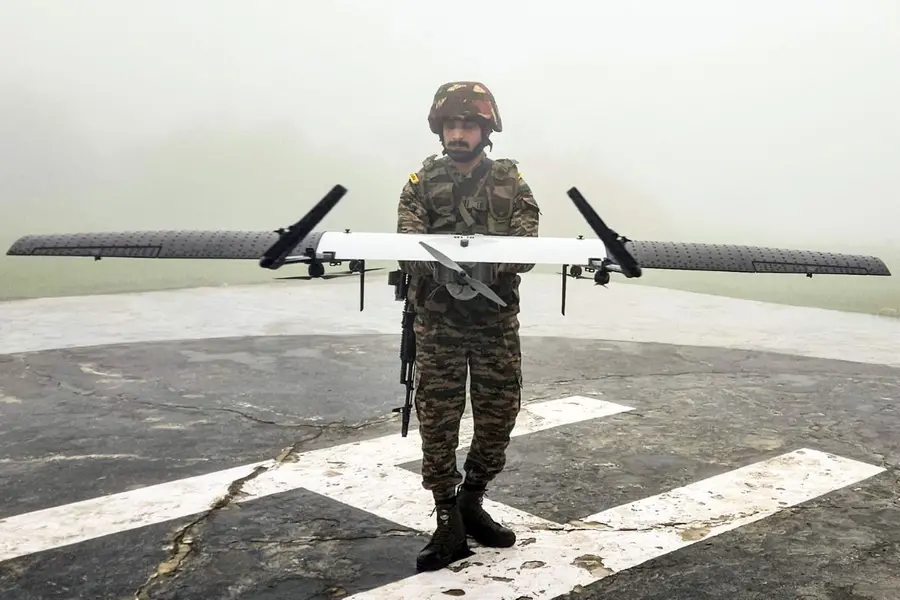
Sunderbani: The Indian Army has significantly upgraded its security apparatus along the Line of Control (LoC) in Jammu and Kashmir’s Rajouri district, introducing cutting-edge equipment to meet the demands of a rapidly evolving security environment shaped by AI-powered technologies. Officials said state-of-the-art systems such as smart fencing, robotic mules, and all-terrain vehicles have been deployed to bolster defences.
The newly inducted assets, including quadcopters, advanced surveillance tools, bulletproof vehicles, modern weaponry, and night-vision sights, were all successfully field-tested during Operation Sindoor from May 7 to May 10. The operation saw Indian armed forces carry out missile strikes on terror infrastructure in Pakistan and Pakistan-occupied Kashmir (PoK) following the April 22 Pahalgam attack, and effectively counter enemy retaliation.
Ahead of Independence Day, mediapersons were given a rare glimpse of the Army’s preparedness in the remote Sunderbani sector. The Army has activated a robust three-layered security grid, intensified patrolling, and heightened vigilance along the border to ensure peaceful celebrations.
Advanced military mobility vehicles like the Mahindra Armado and other all-terrain vehicles are adding speed, protection, and manoeuvrability to the Army’s quick-reaction teams, allowing them to operate effectively in some of the most challenging terrains with dense foliage. A live drill demonstrated swift cordon-and-search operations against infiltrating terrorists, highlighting the vehicles’ adaptability and survivability.
The Mahindra Armado (ALSV — Armoured Light Specialist Vehicle) is a lightweight, air-transportable armoured platform designed for the Army and special forces, offering rapid deployment capabilities.
Also proving to be a game-changer is the indigenous Robotic Mule, officially known as MULE (Multi-Utility Legged Equipment), developed by AeroArc under the Make in India programme. This quadruped robot can traverse snow, deserts, water, and other hostile terrains to perform crucial tasks such as transporting supplies, conducting reconnaissance, and detecting explosives. With a modular design for various battlefield roles, the MULE can even operate in swarms, forming a “mini robot army” to boost operational efficiency while reducing risk to troops. These robotic mules played a pivotal role in surveillance and logistics during Operation Sindoor.
Drones are also playing a growing role in the Army’s operations, with Mini UAVs and other advanced surveillance drones monitoring high-risk areas. Some are equipped with precision payload systems to drop grenades and improvised explosive devices (IEDs) on enemy positions, enabling strikes without direct troop exposure.
The Army also showcased its Battle Obstacle Course (BOC), an intense test of endurance, strength, and combat readiness that replicates real battlefield environments, including jungle warfare, bunker assaults, and terrain challenges. During a drill, an infantry unit demonstrated how to capture enemy bunkers by negotiating rugged terrain, breaching fortified positions, and neutralising threats. The BOC sharpens soldiers’ physical conditioning, tactical coordination, and speed, all critical for front-line duties.
Security along the LoC has been escalated for Independence Day, with the Army deploying drones, dog squads, and explosives detectors for layered security alongside regular patrols to preempt infiltration attempts. This is the first Independence Day following Operation Sindoor, during which multiple terrorist camps across the LoC were destroyed.
A defence spokesperson paid tribute to the soldiers guarding the frontier, noting they operate in extreme weather, isolation, and high-threat conditions with an unyielding commitment. “Beyond their uniforms, each soldier carries a deep sense of duty and pride in safeguarding the homeland,” he said, adding that their resilience, adaptability, and constant training epitomise the Indian Army’s dedication to remaining combat-ready. The spokesperson also highlighted the Army’s outreach to local communities, underlining efforts to build trust and ensure peace and development even in the most remote border regions.
With inputs from PTI
Published: 13 Aug 2025, 05:36 pm IST
Disclaimer: Kindly avoid objectionable, derogatory, unlawful and lewd comments, while responding to reports. Such comments are punishable under cyber laws. Please keep away from personal attacks. The opinions expressed here are the personal opinions of readers and not that of Mathrubhumi.
