
The Indian Army has rescued over 1,000 people and delivered critical relief supplies under Operation Jal Rahat as Assam floods continue to affect more than 3 lakh people and claim 78 lives.
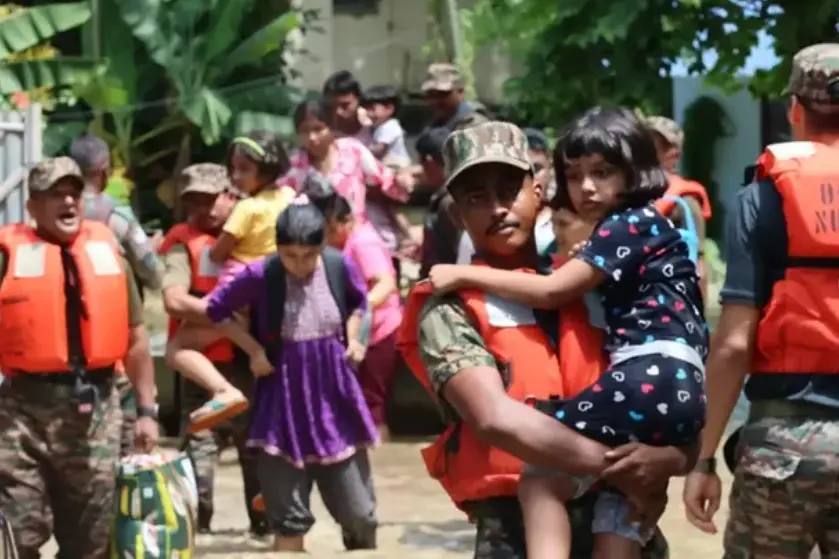
Guwahati: The Indian Army has rescued more than 1,000 people and delivered large-scale humanitarian assistance across flood-hit Assam under Operation Jal Rahat, as the state continues to battle one of its worst flood crises in recent years.
Working alongside the civil administration, the National Disaster Response Force (NDRF), State Disaster Response Force (SDRF) and other agencies, troops of the Army's Spear Corps have been carrying out rescue, relief and medical operations in some of the worst-affected areas.
According to the Indian Army, more than 200 people have received medical assistance, while troops have distributed 19 tonnes of food grains, over 30,500 food packets, and more than 43,000 litres of drinking water. Relief teams have also supplied fresh vegetables, milk, clothing, hygiene kits and other essential items to affected families.
The Army said it has also been using logistic drones to deliver supplies to remote and inaccessible locations, helping restore connectivity and reach stranded residents.
"Standing resolutely with the people of Assam, the Indian Army remains committed to bringing hope, relief and reassurance where it is needed most," the Army said in a statement shared on social media.
Over 3 lakh people affected
According to the latest official bulletin, seven districts remain affected by floods, including Sivasagar, Charaideo, Golaghat, Jorhat, Nagaon, Biswanath and Kamrup.
The floods have impacted more than 3,00,000 people across 551 villages, while over 21,500 hectares of agricultural land have been damaged.
The flood-related death toll in the state has risen to 78, with three additional deaths reported in the latest update.
Golaghat among worst-hit districts
Golaghat district remains one of the worst affected, where around 180 villages and nearly 52,000 families have suffered extensive damage.
Several villages, including Kapuhatting, N-Pamuwa, Rajanakhat, Kharjan, Mahatgaon and Kumargaon, witnessed widespread flooding, leaving homes submerged and agricultural fields devastated.
Although water levels have started receding in some areas, many displaced families continue to stay in relief camps as their homes remain damaged or filled with mud.
The Assam government has been supplying food, drinking water, medicines, animal fodder and other essential items through relief camps, while several voluntary organisations have also stepped in to support flood victims.
Residents seek long-term solutions
Despite ongoing relief operations, residents said temporary assistance alone would not solve their problems.
Many families have lost homes, farmland and livelihoods, prompting demands for a special economic package from the Centre and financial assistance of ₹10–12 lakh per affected family.
Locals also urged authorities to improve drainage infrastructure in the low-lying Kuliyapani region, saying inadequate river channels have caused severe flooding year after year.
Government and political parties step up relief
Chief Minister Himanta Biswa Sarma has visited several flood-hit areas and relief camps to review the situation and interact with displaced residents.
The BJP has also launched a relief drive, distributing 1.8 lakh Mekhela Chadors, 1.8 lakh T-shirts and 1.5 lakh mosquito nets for flood-affected families.
Separately, Assam ministers flagged off around 30 trucks carrying food, clothing and other essential supplies to the worst-hit districts as relief operations continue across the state.
Published: 30 Jul 2026, 11:49 am IST
Related Topics
Disclaimer: Kindly avoid objectionable, derogatory, unlawful and lewd comments, while responding to reports. Such comments are punishable under cyber laws. Please keep away from personal attacks. The opinions expressed here are the personal opinions of readers and not that of Mathrubhumi.
