
India plans to lease and upgrade an old Russian nuclear submarine, INS Chakra III, boosting naval power despite CAATSA sanction risks and major modernization challenges
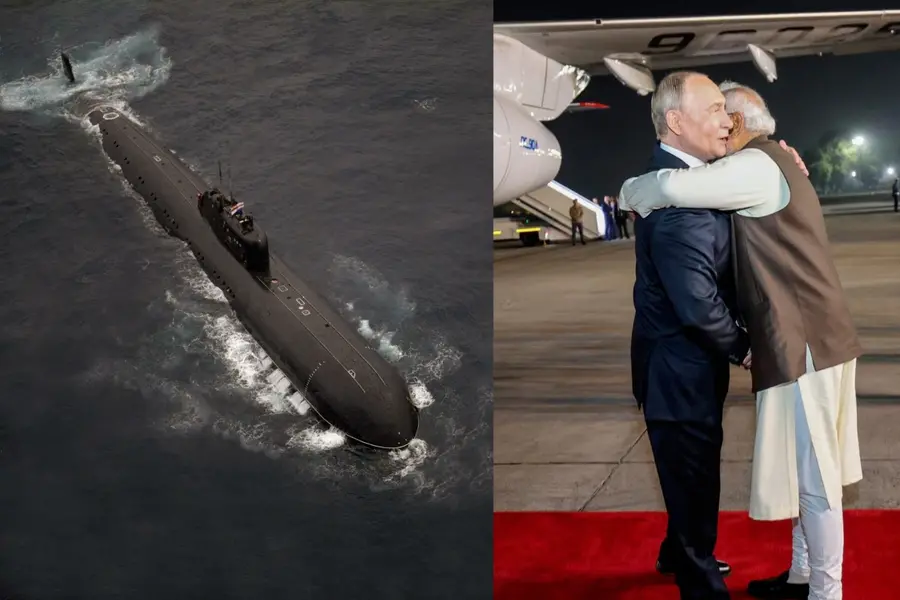
India is set to lease Russia’s 36-year-old K-391 Bratsk, which will join the Navy as INS Chakra III after a major upgrade, including vertical launch systems for advanced missiles. But this deal falls under the U.S. Countering America’s Adversaries Through Sanctions Act law(CAATSA law), meaning India faces a possible risk of sanctions for acquiring Russian military equipment.
The Indian Navy will rent a Russian nuclear submarine for 10 years, and it will join the fleet in 2028. The cost is $2 billion (₹18,000 crore). This means India is paying to use a powerful submarine instead of buying one, so the Navy gets advanced underwater strength faster and at a lower upfront cost.
Also Read

Russia has officially confirmed that the submarine deal is real and is based on a contract signed in March 2019. This means both countries had agreed long ago, and the plan is now moving forward as decided.
Indian media reported this deal using their own sources, not any official announcement. Reports from Defence Express also said that India wanted a Shchuka-B (Project 971) nuclear submarine, which is a strong and reliable Russian attack submarine. In simple words, India was looking for this specific model because it fits the Navy’s needs for power and deep-sea operations.
Also read: DRDO's gift to India: Seven homegrown defence breakthroughs
K-391 Bratsk is a Shchuka-B class submarine (NATO code: Akula-class). Shchuka-B is the entire class/family of nuclear-powered attack submarines built by Soviet Union/Russia from 1986 onwards. Bratsk is one specific boat within this class, commissioned in 1989. Think of it like Honda Civic (class) and a particular 2015 Honda Civic (individual vehicle). All Bratsk's features come from being a Shchuka-B submarine.
The earlier plan said the submarine would be delivered sometime between 2025 and 2035, and the deal was worth $3 billion (₹27,000 crore). But this agreement never happened, meaning the submarine was never delivered under that contract.
Later, insiders said the submarine India would get is K-391 Bratsk. It is very old, built in 1989. In 1998, it was removed from active service, and in 2003, it was sent to a repair center in Kamchatka. But after that, it never came back to service, remaining there for years without returning to the fleet.
Repairs did not start for five years because there was no money. Work finally began in 2008. Then in 2013, Russia decided the submarine needed to be moved to a better repair center—the Zvezdochka Ship Repair Center in Severodvinsk—because the earlier facility could not handle the job properly.
The move was necessary because the earlier repair center had lost its skilled workers and could no longer do major repairs. After many years, it was found that the center had done almost nothing—only an inventory check, not real repair work.
The K-391 Bratsk was moved along with another submarine, K-295 Samara, which was also “repaired” in Kamchatka. Both were carried in a special heavy-lift ship called Transshelf through the Northeast Passage. This was a rare and difficult operation, used to transport the submarines to a proper repair center.
In the end, all this work was wasted. In 2022, Russia decided that repairing K-391 Bratsk was no longer practical, meaning the submarine was too old and damaged to fix properly.
In early 2024, new unofficial reports from Russia said the submarine would not only be repaired, but also upgraded specially for India. This meant Russia planned to give the old submarine a fresh life with modern systems so it could meet India’s needs.
The upgrade plan is called Project 09718. It is basically a modern version of the Shchuka-B submarine, and it will include BrahMos missiles, which are based on the Russian Oniks missile. BrahMos is a joint India-Russia project, with much of its production now done in India.
The Oniks missile is already used in Russia’s newest Yasen-class attack submarines, which are being built to replace older models like the Shchuka-B and Antey classes. This alone shows how powerful and advanced the Oniks system is. These Yasen-class submarines carry the Oniks through eight vertical launch systems, and each system can hold four Oniks anti-ship missiles. They can also launch four Kalibr cruise missiles or Zircon hypersonic missiles, making them extremely powerful and flexible in combat.
But the K-391 Bratsk, like all Shchuka-B submarines, does not have these modern missile launch systems. It has only eight torpedo tubes—four 533 mm and four 650 mm. These can fire Type 65 and Type 65-76 Kit torpedoes, which are powerful enough to carry nuclear warheads.
It is still uncertain whether Oniks missiles can be launched from these torpedo tubes. When Russia talked about upgrading Shchuka-B submarines, it only mentioned adding Kalibr missiles, which can be fired from 533 mm torpedo tubes. So, the ability to use Oniks on Bratsk is still a big question mark.
Adding vertical launch systems to K-391 Bratsk would need a major redesign of the submarine. It cannot be done easily because the original design was never made to carry such systems.
This could mean that Russia may offer India not just BrahMos and Kalibr missiles, which India already uses, but possibly even the Zircon hypersonic missile in the future. This would greatly increase India’s strike power.
It is important to know that the 3M22 Zircon has a very small warhead, only about 100–150 kg. This is too small to destroy a large ship, like a destroyer or aircraft carrier. It can seriously damage only smaller ships, such as frigates. However, this small size is normal for a nuclear warhead, which Zircon is designed to carry.
India is already a nuclear-armed country, but it is not clear whether India can make small nuclear warheads like the ones used in missiles such as Zircon.
Any defence deal between India and Russia comes under the U.S. law CAATSA (Countering America’s Adversaries Through Sanctions Act), which allows the U.S. to punish countries that buy Russian weapons. But the U.S. has never used this law against India, so Delhi has mostly ignored the risk.
Published: 08 Dec 2025, 05:04 pm IST
Disclaimer: Kindly avoid objectionable, derogatory, unlawful and lewd comments, while responding to reports. Such comments are punishable under cyber laws. Please keep away from personal attacks. The opinions expressed here are the personal opinions of readers and not that of Mathrubhumi.