
Bhupender Yadav stressed that mining activity would be permitted in only 0.19 per cent of the Aravalli range, and that nearly 90 per cent of the Aravalli region remains protected.
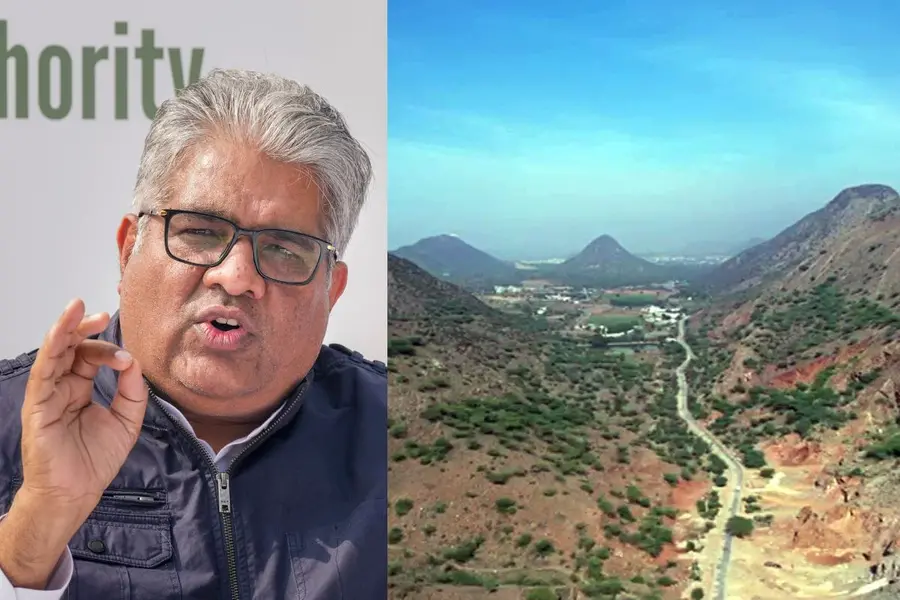
New Delhi: Union Environment Minister Bhupinder Yadav has rejected criticism of the government’s stance on the Aravalli hills, insisting that the Supreme Court’s recent definition of the range is intended to curb illegal mining and strengthen ecological safeguards.
Speaking to ANI, Yadav stressed that mining activity would be permitted in only 0.19 per cent of the Aravalli range, which amounts to less than one per cent of the total area, and that no new mines have been opened.
“Mining was already going on. Permissions were being granted on that basis. But what was happening there was anomaly and illegal mining. By clearly defining the restricted and prohibited areas, you can ensure strict compliance," he said.
Earlier, environmentalists and activists had protested across Haryana and Rajasthan after the Supreme Court accepted a new definition of the Aravalli Hills, which could open doors to mining, construction, and commercial activity in previously protected areas.
He underlined that nearly 90 per cent of the region remains protected, with any future approvals subject to scientific management plans and clearance from the Indian Council of Forestry Research and Education (ICFRE).
Highlighting conservation efforts, Yadav said 29 nurseries have already been set up across the range, with plans to expand them to every district. He emphasised that protection extends beyond tree planting to the entire ecosystem, including grasses, shrubs, medicinal plants and wildlife. Linking this to the International Big Cat Alliance, he argued that predators such as tigers can only thrive if their prey and supporting vegetation are preserved.
"Big Cat Alliance does not mean that we only do tiger conservation. We do conservation, but a tiger can live in any place only when the prey below it, the ecological system below it. And the ecological system, deer etc., will survive only when there is grass, etc. for them," he explained.
Yadav also noted that the Supreme Court had commended the government’s “Green Aravalli Wall” initiative, which aims to restore and safeguard one of the world’s oldest mountain ranges.
'Illegal mining will be completely stopped’
He rejected opposition allegations of collusion with mining interests, insisting that anomalies in past permits have been addressed and that illegal mining will be “completely stopped”.
The Minister dismissed claims of urbanisation plans, noting that the Aravallis have long been home to human settlements but remain ecologically sensitive. He pointed out that even in Rajasthan’s largest mining districts, such as Rajsamand and Udaipur, activity could be restricted to as little as 0.1 per cent of land, and only after state governments establish strict compliance frameworks.
The minister asserted that the Aravalli range needs protection in its entirety. “There is no grey area. If there is a grey area, then the matter is in court; go and present it there. Even today, the subject is in the Supreme Court. If it is there, then tell us, why are you spreading confusion among people?"
According to the minister, continuous afforestation efforts, the designation of eco‑sensitive zones, and rigorous oversight of mining and urban activity are intended to safeguard the range as both a natural heritage site and an ecological shield for the country.
ANI
Published: 22 Dec 2025, 12:44 pm IST
Disclaimer: Kindly avoid objectionable, derogatory, unlawful and lewd comments, while responding to reports. Such comments are punishable under cyber laws. Please keep away from personal attacks. The opinions expressed here are the personal opinions of readers and not that of Mathrubhumi.
