
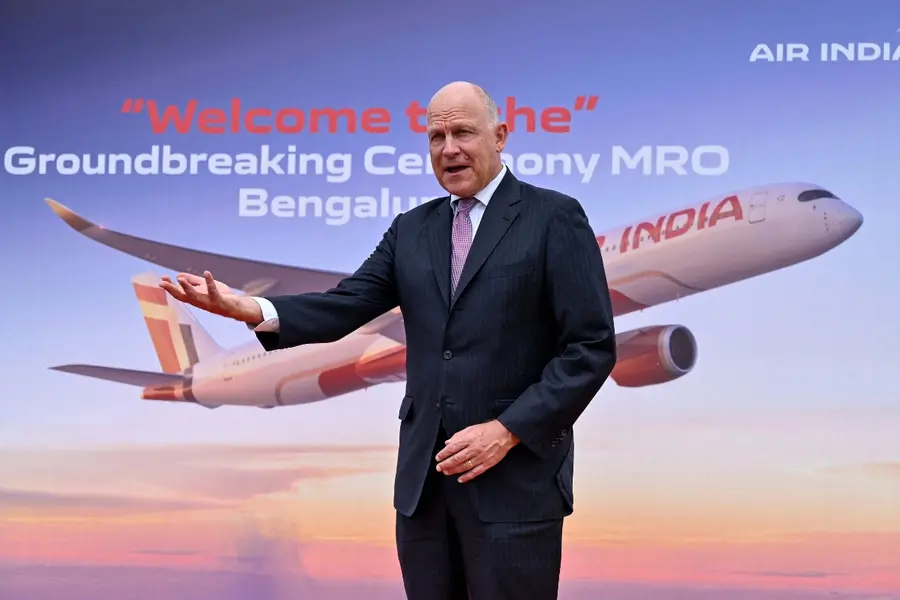
Air India CEO Campbell Wilson has announced his resignation, saying the airline is ready for its next phase after a major transformation under Tata Group ownership.
In a period where Indian aviation is rapidly evolving—with rising passenger demand, global competition, and large aircraft orders—leadership changes often signal deeper transitions.
Campbell Wilson’s exit from Air India comes at a moment when the airline is shifting from rebuilding to expansion, making his departure both symbolic and strategic.
Also Read

Why Campbell Wilson is stepping down
Wilson said it was the “right time” to hand over leadership as the airline prepares for its next growth phase.
He had informed Chairman Natarajan Chandrasekaran about his intention to step down as early as 2024 and has since been preparing the organisation for a smooth transition.
He will continue in his role until a successor is appointed, ensuring continuity in operations.
What changed under his leadership
Since the Tata Group reacquired Air India in 2022, the airline has undergone significant restructuring.
- Merger of four airlines into a unified structure
- Shift from public-sector processes to private-sector operations
- Renewal of leadership, workforce culture, and systems
- Addition of around 100 aircraft to the fleet
Upgrade of older aircraft interiors and induction of new widebody planes
Launch of training infrastructure including simulators and a flying school
These steps were aimed at rebuilding Air India into a globally competitive full-service airline.
The challenges he faced
Wilson’s tenure was not without setbacks.
- Global supply chain disruptions delayed aircraft deliveries
- Rising fuel prices increased operational costs
- Airspace closures due to geopolitical conflicts affected routes
- The fatal crash of Air India Flight 171 in 2025 marked a major crisis
- Despite these challenges, the airline continued its restructuring and expansion efforts.
Why timing matters now
Air India is preparing for a massive expansion, with nearly 600 aircraft on order, many expected to begin arriving from 2027.
Wilson indicated that the foundational phase of transformation is largely complete, and the next stage—focused on scaling operations and global positioning—may require different leadership.
What this means for Air India’s future
The leadership transition will be closely watched across the aviation industry.
- The airline is moving from recovery to aggressive growth
- Competition with global carriers and domestic rivals is intensifying
- Execution of large aircraft orders will define its next decade
- Service quality and profitability remain key focus areas
The Tata Group’s long-term vision is to position Air India as a world-class global airline with strong Indian roots.
The bigger picture
Wilson described his tenure as an honour, highlighting the progress made despite difficult conditions. His exit reflects a planned transition rather than a sudden disruption.
For passengers, the impact will depend on how smoothly the next leadership phase continues the airline’s transformation journey.
(With PTI inputs)
Published: 07 Apr 2026, 03:20 pm IST
Related Topics
Disclaimer: Kindly avoid objectionable, derogatory, unlawful and lewd comments, while responding to reports. Such comments are punishable under cyber laws. Please keep away from personal attacks. The opinions expressed here are the personal opinions of readers and not that of Mathrubhumi.