
Is Vijay Salgaonkar’s final game worth watching? Here’s our review of Drishyam: The Conclusion, starring Ajay Devgn, Tabu, Jaydeep Ahlawat and Prakash Raj
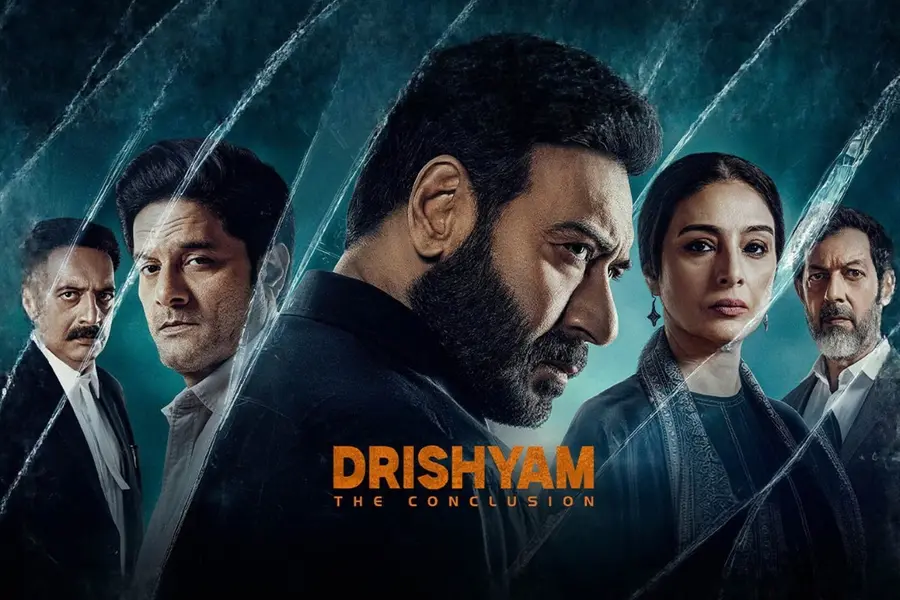
Some film franchises become popular, while a few become a part of pop culture. The ‘Drishyam’ franchise is one such film that has done both. From Vijay Salgaonkar’s calculated moves to the now-iconic ‘October 2 ko kya hua tha?’, the film series has delivered a thriller that the audiences continue to revisit, years after its release.
A decade after Ajay Devgn first stepped into the shoes of Vijay Salgaonkar in 2015’s ‘Drishyam’, ‘Drishyam: The Conclusion’ has arrived as the final chapter of the Hindi franchise. It once again brings together Devgn along with Tabu and Shriya Saran, with Abishek Pathak also returning to direct the final installment, and Jaydeep Ahlawat as the latest addition to the cast. And what better day to bring Vijay and his family back in theaters than October 2, a date which was once simply Gandhi Jayanti, but today, has become a pop-culture identity?
But nostalgia, pop-culture, and a much-loved franchise can only take a film so far. Has ‘Drishyam: The Conclusion’ managed to retain the tension and cleverness that made its predecessors work, or does the final chapter struggle under the weight of expectations?
The Hindi franchise, led by Ajay Devgn, is a remake of the Malayalam franchise starring Mohanlal by the same name. Although ‘Drishyam’ and ‘Drishyam 2’ follow the storylines of the first two Malayalam installments, ‘Drishyam: The Conclusion ’ fares a little away from the original.
In ‘Drishyam’, Vijay, a humble cable operator, goes to extraordinary lengths to protect his family after an accidental death, creating an elaborate alibi to evade the law.
In ‘Drishyam 2’, the case is reopened by IG Tarun Ahlawat (Akshaye Khanna) after new evidence comes to light, forcing Vijay to devise an even more intricate plan to protect his family and keep the truth buried.
Cut to ‘Drishyam: The Conclusion’, Meera Deshmukh (Tabu) continues to grapple with the weight of not being able to bring justice to her son, Sameer Deshmukh. She attempts to take her own life, but her husband, Mahesh (Rajat Kapoor), stops her and promises to bring justice to their son. He then meets Rajveer Singh Tomar, SP, Crime Branch, who has fresh evidence against Vijay
As the police quietly move in to gather more information and build their case against him, the Salgaonkars continue with their lives, even as Anju (Isha Dutta) remains affected by the events of the past.
Eventually, the case reaches a Goa court, where the Deshmukhs are represented by prosecutor Indrajith Shetty (Prakash Raj), a lawyer known as “lawyers ka gunda”.
From here, it becomes a battle of wits between Vijay Salgaonkar and the police. Whether the final chapter manages to live up to the legacy of the franchise is what the film must answer.
Just like its past instalments, Pathak and his co-writers Aamil Keeyan Khan and Parveez Shaikh succeed in delivering a pacy and gripping thriller. There is little time wasted in setting up the story, and before you know it, it is time for the interval. The police's secret investigation into Vijay, before the SP finally comes face-to-face with Salgaonkar, keeps you hooked, with the film steadily building anticipation around what they might uncover. It is only towards the end of the first half, when Vijay realises that the police are on his trail, that the game truly begins to change.
Devgn continues to be the star of the film. His act is solid, and it is difficult to take your eyes off him whenever he is on screen. However, every time Ahlawat enters the frame in his crisp white shirt, he manages to hold the audience's attention just as well, if not more. There isn't a moment in his performance that makes you miss Akshaye Khanna. Prakash Raj, who enters the film in the second half, also delivers a worthy performance and adds his own flavour to the proceedings.
While the men deliver memorable performances, Tabu deserves a special mention. As a mother weighed down by the helplessness of not being able to bring justice to her only son despite being a top cop, she brings an emotional depth to Meera that works particularly well.
The supporting cast, too, does justice to their respective parts, especially Kamlesh Sawant as SI Laxmikant Gaitonde. His comic timing is brilliant and provides some much-needed humour without taking away from the tension.
The film also scores with some of its scenes and dialogues, particularly when the timing is just right. One dialogue that stayed with me after leaving the theatre is when Ranveer tells Vijay, “Maine toh bas do jalebi khai hai, aapne toh do-do IG khae hai” (I ate two jalebis, while you ate two IGs).
Another amusing scene comes when Indrajith sits down with Meera, Mahesh and Tomar and asks about their educational qualifications. The exchange becomes a pointed reminder of the irony at the heart of ‘Drishyam’ — an LLB graduate, a Delhi University graduate, a Mumbai University graduate and a Harvard graduate are all trying to outsmart a man with no formal education. It is a clever little moment that not only draws laughter but also quietly underlines how well Vijay's character has been written. He may not have academic qualifications, but when it comes to thinking several steps ahead, he is in a league of his own.
Overall, ‘Drishyam: The Conclusion’ certainly fares well. It is engaging, keeps you guessing and, more importantly, keeps you thinking about what the conclusion could possibly be. The film has twists that you may not see coming and manages to retain the suspense and intrigue that have become synonymous with the franchise. While it may not reinvent the Drishyam formula, it understands exactly what audiences have come to expect from Vijay Salgaonkar's world and delivers enough surprises to keep you invested till the end. For fans of the franchise, this is a game that is worth playing.
Stars: 3.5 out of 5
Published: 02 Oct 2026, 02:58 pm IST
Related Topics
Disclaimer: Kindly avoid objectionable, derogatory, unlawful and lewd comments, while responding to reports. Such comments are punishable under cyber laws. Please keep away from personal attacks. The opinions expressed here are the personal opinions of readers and not that of Mathrubhumi.
