

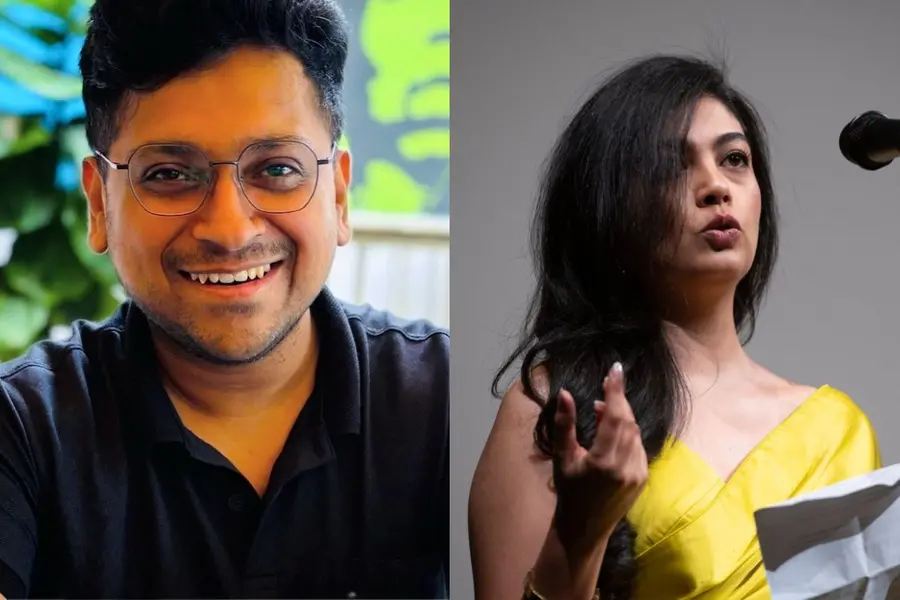
Kozhikode: Even though maverick filmmaker Vikramaditya Motwane, who kicked off 2025 with the massive success of his OTT series ‘Black Warrant’, expressed concern over the harrowing landscape of independent cinema in an interview with The Hollywood Reporter India, it’s finally good news for two budding Indie filmmakers, one with a theatrical release and the other with a world premiere at an international film festival.
‘Kaisi Ye Paheli’, the first feature by filmmaker Ananyabrata Chakravorty, is set to make its world premiere at the New York Indian Film Festival (NYIFF) on June 21 while Subhadra Mahajan’s microbudget feature debut ‘Second Chance’, which had its world premiere at the Karlovy Vary International Film Festival & Asia Premiere at Busan International Film Festival is slated to have a theatrical release across the nation on June 13.
Mathrubhumi spoke to both the independent filmmakers to know the inspiration behind their subject, casting, and more.
Chakravorty’s film ‘Kaisi Ye Paheli’, which has landed nominations for best screenplay and best debut film at the NYIFF, unfolds as a dark comedy set in a sleepy north-eastern hill town, where a lonely mother tries to reconnect with her distant son, a cop, by helping him solve a murder.
Speaking about the source behind the subject of the film, Chakravorty said that he was moved by the conflict that he experienced between old mothers and their grown-up sons. “It never gets talked about much. We have tried to address a mother's loneliness and her most basic needs through this dark-comedy murder mystery,” he said.
On casting Rajit Kapur, who last played the role of a detective 28 years ago in the ‘Byomkesh Bakshi’ series (1993), the director said that Kapur was in his optimistic wishlist as no other Indian actor has ever aced a detective’s role in such an iconic fashion. “I mean, he is THE Byomkesh Bakshi. It's an honour that he liked the script and chose to work with us, and we are delighted that our film has been nominated at the NYIFF,” he added.
When asked about which hat he likes to don the most, that of an actor’s or director’s, Chakravorty was prompt in saying that he loved screenwriting the most. “The process of cracking a good idea, creating a story, writing a screenplay and dialogue, and then rewriting everything to make the script worthy of being filmed, takes years and is extremely challenging. That said, what I love about directing is the chance to collaborate with so many talented artists across departments. However, needless to say that I also find a lot of joy in acting,” he said.
Speaking about the hardest bit of shooting his debut feature, Chakravorty said the biggest challenge was writing the script itself, followed by finding funds for it. “Managing funds is challenging, especially if you want to tell a story that does not align with the goals of mainstream studios or festivals and labs. This hurdle was overcome with the support of friends, acquaintances. Both my family and my wife’s family contributed financially to the making of this film,” he added.
Lastly, for folks aspiring to make movies, Chakraborty suggested that they study screenwriting in detail. “I am a debutant myself, so I would just want all of us to rock the scene. All debutant filmmakers must write several speculative scripts, practice making short films, and be willing to give at least a decade of their life to this pursuit,” he asserted.
Watch the teaser here:
Mahajan’s debut feature, ‘Second Chance’, shot by Swapnil S. Sonawane, the director of photography of ‘Monica O My Darling’ (2022), ‘Newton’ (2017) and ‘Superboys of Malegaon’ (2024), follows the story of Nia, who after experiencing the first major trauma of her young life, retreats to her family summer home in the Himalayas where time, nature and unlikely friendships help her heal.
Speaking to Mathrubhumi, Mahajan said that she chose to shoot the film in black and white because of the protagonist Nia, who finds light only at the end of a long and dark tunnel. "The eastern philosophy, which forms the backbone of the film, is that of finding light in darkness and darkness in light, realising that life is nothing but an interplay of the two. Therefore, I felt it best that the story be told in black and white, reflecting the yin-yang of the natural world,” she said.
When asked about working with Sonawane, she said he was cent per cent on board from the word go. “We devised a further visual language of deep focus, minimal grain, and a high contrast between light and shadow that has enhanced the black and white frames all the more,” she said.
Wasn’t editing such beautifully crafted frames difficult? I mean, which one would you choose to even discard? Would it not break your heart? Answering these questions, Mahajan said that she was blessed to find Tinni Mitra, who didn’t give it a second thought and instantly agreed to take up this project.
“Mitra has an excellent combination of refined cinematic sensibility and endless levels of patience – both of which make her a great editor. You are right, in the first cut we got carried away because we had so many stunning landscape shots! However, there were two moves that helped us come to our final edit pattern. The first was pacing the film as per the mood of our protagonist, and the second was ditching the ‘beginning, middle, and end’ chronology. This helped us to keep the film’s meditative quality while keeping the length tolerable,” she added.
Elucidating on the art of the music, the director said she always wanted minimal music in strings and piano at very few crucial points in the film. “Having listened to Quanbay’s work on Bhaskar Hazarika’s ‘Aamis’ (2019)- they were the very first musicians I approached for the background score. My brief to them was to combine anticipation amongst despair; – melancholia but with space for optimism. Thus were born the tracks ‘Hope’ and ‘Heal’, combining the coolness of the piano with the warmth of the strings.
Speaking of shooting in the Himalayas, she said that most of the film was shot in limited daylight, unpredictable weather conditions, and amid power cuts due to snowstorms. “Our coldest morning was - 20 degrees Celsius, and our highest altitude was around 10,000 feet! We shot the entire film with a team of 12 crew members, of which five (including me) were locals, so it was slightly easier for us as compared to those from other states. A lot of the locations we shot at were not accessible by car, so we had to drive to the nearest point and use a couple of porters to lug equipment and food. Five crew members (including me) fell prey to COVID in the middle of the shoot, and a few others had to drop out as they could not bear the cold or the altitude. It's sheer commitment that made us finish the film,” she said.
Speaking of casting, Mahajan said that for her, since the beginning, it was Dheera Johnson who would play Nia on screen. “I had known her for years and loved her energy, and was a fan of her dancing skills. As far as the rest of the cast is concerned, I was ready to face the consequences and dangers of dealing with non-actors as a trade-off for authenticity and realism. Needless to say, with a veteran acting coach such as Dilip Shankar by my side, I felt confident about pulling it off,” she added.
Check out the trailer here:
Published: 06 Jun 2025, 05:25 pm IST
ABOUT THE AUTHOR
Related Topics
Disclaimer: Kindly avoid objectionable, derogatory, unlawful and lewd comments, while responding to reports. Such comments are punishable under cyber laws. Please keep away from personal attacks. The opinions expressed here are the personal opinions of readers and not that of Mathrubhumi.