
With every frame he shoots, Jay Oza doesn’t just capture light — he captures emotion, rhythm, and the pulse of a story.
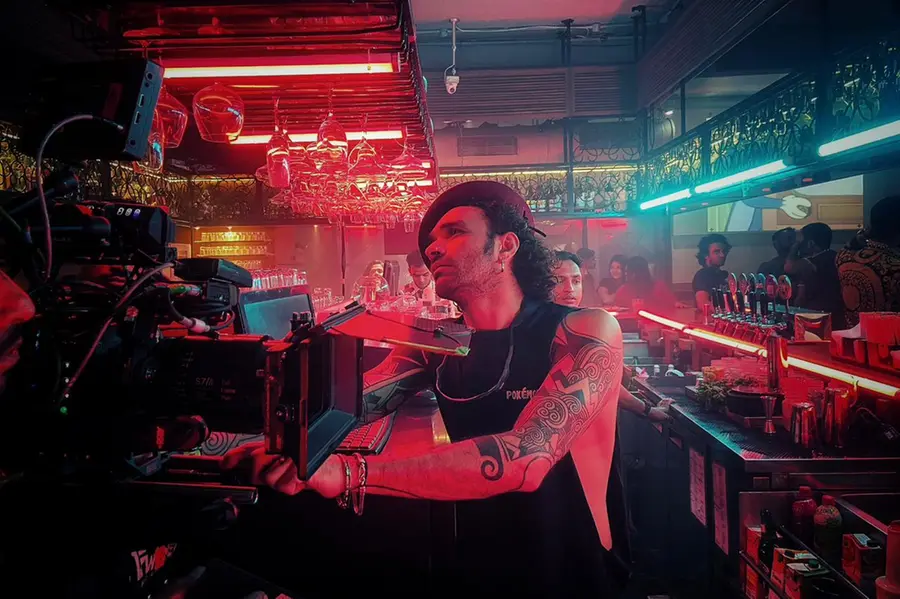
The acclaimed cinematographer, who has previously lent his visual genius to films like ‘Gully Boy’, ‘Raman Raghav’, ‘Blackmail’, ‘Ghoul’, and many others, is now in the spotlight for his latest work — Aryan Khan’s much-awaited directorial debut, ‘Ba***ds of Bollywood’, which recently premiered on Netflix.
In an exclusive chat with Mathrubhumi English, Jay takes us behind the lens to talk about his journey in the industry, the ever-evolving language of cinematography in Hindi cinema, and his collaborations with stalwarts like Zoya Akhtar, Rakeysh Omprakash Mehra, and Anurag Kashyap.
He also opened up about Aryan as a debutant director — his clarity of vision, his democratic approach on set, and how he earned the respect of his entire crew. From his favorite scene in the series to some intriguing behind-the-scenes moments, Jay gives us a rare glimpse into the craft and chaos that shaped ‘Ba***ds of Bollywood’.
Q. You've been a part of a generation that's redefining how India looks on screen—from the realism of ‘Gully Boy’ to the stylized world of ‘Ba***ds of Bollywood’. How do you see cinematography evolving in India, especially with OTT platforms and global audiences changing the visual language of Bollywood? What are the differences you've observed from when you started until now?
I don't know if it's really a difference. I think it's just the way technology is evolving that has played a big part in how imaging has changed. When I got into the industry, digital was just coming in, while we were still using celluloid. Back in the day, cameras were bulkier, and the concept of exposing film was nerve-wracking. DoPs (Director of Photography) shooting on film wouldn't sleep until the rushes came back.
With digital, what you see on the screen is what you're getting. Initially, we weren’t sure, but over time, that comfort level came in. Unlike celluloid, where everything depended on your exposure and lighting, digital gave us more control and confidence.
So, technology allowed artists to take more risks. Back then, you had to play safe, especially with celebrities—you didn’t want to mess up their exposure. Also, storytelling has evolved. The concept of heroes and narratives has changed. It's an amalgamation of all that.
For me, my first feature film was ‘Raman Raghav’. Before that, I had done long-format like ‘24’ Season One and had shot for 188 days, which gave me confidence on set. When I did ‘Raman Raghav’, I took a risk with the dark side of the frame dominating the visual tone. The subject—a serial killer—allowed for that bold contrast and low-light style.
With ‘Gully Boy’, I remember in prep with Zoya, we talked about representing a very real world. That hip-hop world was already visible to people through music videos and interviews. So, if it looked forced, it could have come across as satire. We had to make sure Alia Bhatt and Ranveer Singh looked like the characters—not themselves. That realism was key.
Q. You’ve worked on very different projects: ‘Raman Raghav’ was dark, ‘Gully Boy’ was realistic, and ‘Bads’ is glamorous. How do you shift between such different styles? What are the biggest challenges?
Looking at my filmography—from ‘Raman Raghav’ to ‘Ghoul’ (horror, dark), ‘Blackmail’ (dark comedy, mostly night scenes), and ‘Gully Boy’—you see a range. ‘Raman Raghav’ was very guerrilla style; we shot in live locations with people still in their homes. We had to adapt and work with limited resources.
‘Gully Boy’ was different—very well planned with more resources. The production and design team did an amazing job building realistic sets. Everything from color palettes to junior artist costumes was discussed in detail. We had to recreate reality with extreme accuracy, to the point where it shouldn’t feel like a film set.
For example, Mumbai’s blue tarpaulin is everywhere, especially in the monsoon. But our production designer, Suzanne, made a conscious decision to remove all the blue tarps—physically or through CGI. It changed how people saw Mumbai in the film, even if they couldn’t immediately tell why.
We built Murad’s locality in the middle of Dharavi, not a film studio, so that the surroundings matched seamlessly with the story. That kind of realism was only possible with intense prep.
When it comes to the 'Bads,' I think the world presented in this show was completely new to me. That’s one of the main reasons I was drawn to the project when I first met Aryan. During our initial meeting, I was really struck by his enthusiasm for telling the story. It was incredible to see someone so passionate and so clear about both what he had written and the direction he wanted to take it. He had clearly lived with this project for a long time, even before we met.
Q. Speaking of Aryan, how did you first get involved in the project? What was your first narration with Aryan like, and how did it evolve?
I think the first meeting was just a casual one to get to know me. Aryan was meeting multiple DOPs. When I first met him, I had zero idea about what he was planning to make. I only knew it was his debut. I couldn’t find much about his previous work either.
He shared a rough idea—he wanted a character-driven, entertaining, aspirational show. He didn’t have strict visual references but was very clear about the emotional and tonal goals. It needed to feel relatable but also a step above—maybe not surreal but hyperreal. He wanted people to watch it and say, “I want to be there,” or “I know someone like that.”
He was extremely open as a director. Over time, as we worked together, I saw his clarity. He did a lot of prep on his own, shooting mock scenes on his phone. On set, he relied on me to shape the visual language. Sometimes he loved what I proposed; other times, he’d have a specific idea, and we’d work together to refine it.
Q. Does this typically happen with all directors, especially when working on mainstream or big-budget projects? Like you mentioned, Aryan was open to your suggestions and incorporated them—does that usually happen with you on every project?
That’s where the collaborative nature of filmmaking comes in. It’s about understanding and adapting.
With Anurag Kashyap on my first film, I was overwhelmed. I sought validation. But he was someone who’d let you do your thing and only step in when something had to be done a certain way.
With Zoya, the prep was extensive. But even with so much planned, some things are left for the shoot day—because until the actor performs, you don’t know what the scene really needs.
With Abhinay on ‘Blackmail’, he was technically very sound. With Rakesh Omprakash Mehra, he gave full trust to the DoP. That can be scary—you carry full responsibility.
Every director is different. I don’t think directors need to be technically sound. That’s why they hire DoPs. It’s our job to adapt to their style and help them express what they want visually. If a director isn’t technically inclined, I avoid technical jargon. I try to understand the emotion of the scene or boil it down to a single line. My job is to help the director express their vision, not impose mine.
Sometimes actors do something unexpected—and you have to redesign everything around that. Their energy is what connects with the audience. So, as a DoP, you need to know when to go hard and when to pull back.
I’ve been lucky to work with incredible actors—from Nawazuddin Siddiqui and Vicky Kaushal in ‘Raman Raghav’, to Irrfan Khan in ‘Blackmail’. What Irrfan did on camera would give you goosebumps. Those moments humble you.
You learn to step back and let their performance take center stage. Overdesigning just for the sake of it can ruin that. It’s all about understanding the scene and being honest to its core.
Q. Coming back to ‘Ba***ds of Bollywood’, how was it working with Aryan as a first-time director?
Aryan has crazy energy. I used to joke, "I'm old, I can’t keep up!" But seriously, his enthusiasm and clarity were amazing—even if he couldn’t always explain it. He pushed actors hard to get what he wanted and treated every character with equal importance.
He overshot scenes at times, which I initially questioned. But when I saw the final edit, I realized exactly what he was doing. His homework and foresight were impressive.
The way he directed the ‘Come On’ gang boys was with the same love and attention as the leads. That’s rare and something I truly respected.
Q: Having worked with directors like Rakeysh Om Prakash Mehra, Anurag Kashyap, Zoya Akhtar, and now Aryan Khan, do you look for specific qualities in a director before signing onto a project?
Absolutely. Before even reading the script, I want to sit with the director and see if we can just be in a room for an hour—talking cinema, talking life, or just sitting in silence.
Now, at 42, I can gauge energy better than I could at 29. I need to vibe with their energy. Can I relate to their ideology? Would I want to tell the story they’re telling?
If not, I won’t take it—even if the project has great cast, money, or scale. Because if I can’t be honest, and then the film will suffer. No one might notice, but I’ll know.
Once a film is made, it’s out there forever. I need to know I did justice to it. That’s what matters most to me.
Q. Of all the directors you've worked with so far, who has been your favorite
Honestly, there’s something I connect with in each director I’ve worked with. With Anurag, I just love the kind of stories he chooses to tell — they really speak to me. With Zoya, it’s the way she makes everyone on the crew feel involved and valued. She leads from the front, but never makes anyone feel less than. Then there’s Rakeysh Mehra, who has this incredible trust in his technicians — it’s truly inspiring.
Even during ‘Ba***ds of Bollywood’, early on, I remember sitting with Aryan and telling him, “Bhai, you’re sitting on a hit.” He’d laugh it off and say, “You’re just boosting my confidence,” or joke that I was useless. But I really felt it — even though we were just 20 days into a 130-day shoot, the energy on set was something else. I could sense it was going in the right direction.
Aryan had told me at the beginning, “Oza, I want to make a hit show. This is my first, and I want to give it everything.” I told him, “Aryan, in my experience — from life and filmmaking — you can’t create a hit just by aiming for one. You have to pour your heart into it. Be honest with yourself, and whatever’s on your mind, put it all into the work. Even if it means staying an extra 4-5 hours a day — do it.” And he did eventually deliver a hit!
Q. Which is your favourite scene from the series that you loved shooting?
With ‘Ba***ds of Bollywood’, I really pushed the envelope in terms of the colour palette I used—something you wouldn’t have seen much in my earlier work. To answer your question, I really enjoyed shooting the massage sequence, where Freddy Sodawallah (played by Manish Chaudhari) is getting a massage. When the set was being designed, our production designers came up with the first floor plans and visual references, and we built from there. My approach was to create a hardcore desi version of ‘Only God Forgives’. I had a lot of fun pumping those colours in. After that scene, a lot of people came up to me and asked, “Was that really you? What was that?”
I genuinely enjoyed it because it took me way out of my usual comfort zone. I’m generally known for keeping things dark, low-lit, and high-contrast. But this time, playing with colour was just so much fun.
Also, there’s always one scene in any project that sticks with me from the prep days—the one I’m constantly discussing with the director. That scene usually stays with me. For example, in ‘Toofan’, there’s a revelation scene between the characters played by Paresh Rawal, Farhan Akhtar, and Mrunal Thakur. That scene gave me goosebumps.
Similarly, in ‘Ba***ds of Bollywood’, it was the big exposition scene at the end. Aryan hadn’t told me about the climax initially. Much later in the prep, he called and said, “Listen, if you're free, come over. I need to narrate a scene to you.” He made sure no one else was in the room—just the two of us—and made me promise about a hundred times that I wouldn’t tell anyone or leak anything. I was like, “Bhai, kya ho gaya? We’ll have to tell the crew eventually! But okay, fine—I won’t tell anyone. Not even the actors.”
Then he narrated it to me, and I swear, my head went 360 degrees. I was like, “Oh shit, I didn’t see that coming, my friend!” He was watching my reaction closely because he knew this scene was the whole point of the show—to really shake the audience. And I asked him, “How are you seeing this scene? Because even in the simplest setting—just four people in a room with this information dropping—it would still hit hard. But what’s our plan for it?”
His vision for the climax, along with the car chase that builds into it, evolved over time. That whole sequence ended up being one of the scenes I was most excited to shoot.
Here’s a polished and cohesive version of your Q&A while preserving the original tone, intent, and content:
Q. People often talk about a film’s music, direction, performances, and script, but rarely about the camerawork. The general audience doesn't usually discuss how a shot was composed or how the lighting was done. Do you think the Indian audience needs to engage more with the craft of cinematography?
Honestly, I’ve seen a significant shift over the years. From where I started to now, the awareness around cinematography has definitely grown. As filmmakers, we need to understand that cinema is a collaborative art form — no one element can shine in isolation.
Personally, I’ve always admired Roger Deakins. I love his philosophy — he says that if someone praises his work, it means he hasn’t done justice to the film, because ideally, the audience should be immersed in the whole film, not distracted by the camerawork. That really stayed with me.
For me, the film itself should shine. Of course, actors and directors are the faces of the project and naturally take the spotlight, which is perfectly fine. But I do believe that there’s now a healthy conversation happening around cinematography. It may not be as prominent in commercial cinema yet, but in well-made films — especially those doing the rounds at international film festivals or winning critical acclaim — people are starting to talk about the work of DoPs. We’re seeing DoPs get opening credits, standalone slates, and recognition.
And I’m okay with where things are right now — because it’s growing. More kids today want to become DoPs, and that in itself is a sign of progress.
Q. When you talk about your work, who are some of the cinematographers — both globally and locally — that have influenced your visual style?
In India, I’m a huge admirer of Rajeev Ravi. I really appreciate his cinematography, especially in his earlier collaborations with Anurag Kashyap, like ‘Gangs of Wasseypur’. There’s a raw realism in the way he treats his subjects that I find very compelling.
Internationally, the one name I truly look up to — both in terms of craft and as a person — is Roger Deakins. His body of work is consistently brilliant. He gives every film his complete attention and brings innovation to each project. He never lets his style overshadow the story, and I find that incredibly inspiring.
What I also respect about both Rajeev is his sense of integrity — he chooses projects he knows he can do justice to. For instance, Rajeev seems to pick films that align with his strengths and avoid ones that don’t feel right for him. That kind of self-awareness is rare.
Among my contemporaries, too, there are so many doing phenomenal work, each making bold choices that suit their own vision. But for me, Rajeev Ravi and Roger Deakins are the two names that have had the deepest impact.
In fact, one film that really changed things for me — that made me want to shift from direction to cinematography — was ‘City of God’. I remember watching the making-of, especially the scene where the DoP was chasing a chicken through the streets with a 16mm camera, and I just thought, “This is incredible. I want to do that — I want to run with the camera behind the chicken.”
Q. What’s next for you?
Right now, I’m in conversations for a feature film — it's an adaptation of a Marathi film that the director has already made. If all goes well, we’ll start shooting soon. It’s a 30-day schedule and falls in the drama space, which I’ve come to realize is my strongest suit. I genuinely enjoy working on drama, and at this point in my career, I have the luxury to choose, so I’m leaning into that.
Apart from fiction, I also want to explore non-fiction. I’m looking at producing and shooting some documentary-style projects myself. Right now, I feel drawn to films with purpose — stories that have something meaningful to say. As much as I’d love to be part of big-budget entertainers, I also want to revisit that old-school, documentary-based, minimal-setup style of filmmaking. Just for a while — to get back to the roots, you know?
Published: 11 Oct 2025, 05:53 pm IST
Disclaimer: Kindly avoid objectionable, derogatory, unlawful and lewd comments, while responding to reports. Such comments are punishable under cyber laws. Please keep away from personal attacks. The opinions expressed here are the personal opinions of readers and not that of Mathrubhumi.
