
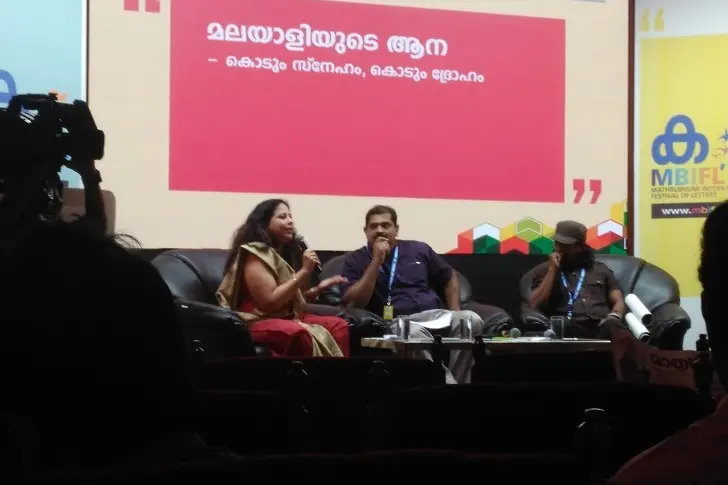
The first panel discussion at Mathrubhumi International Festival of Letters 2018 moderated by acclaimed writer Anita Nair proved to be an enlightening session as guests Dr. T.S. Rajeev, director of Centre for Elephant Studies, and N.A. Naseer, wildlife photographer, nature conservation activist and author shared their experiences with the audience.
The session, Malayaliyude Aana - kodum sneham, kodum droham, covered many aspects of the Malayalis love for the elephant that, according to the panelists, was now an obsession with little regard for the welfare of the animal. Dr. Rajeev explained the physical and behavioural peculiarities of the elephant that made the wild animal a misfit for the role imposed on it by Malayalis - that of leading processions at temple festivals. Elephants have a lower body temperature than human beings, so the animals should not be exposed to extreme hot weather, he said. But temple festivals are held in the hottest time of the year. Anita Nair recalled the pride with which temple committee members showed off the number of elephants arranged for the festival at her hometown in Kerala while no one spared a second thought about the inconvenience caused to the animals in the process. Naseer, who shot to fame 25 years ago with the disturbing photograph of an injured elephant being used in a temple procession, said he was at the event hoping to bring awareness to the issue. He has since made it his cause to portray the inhumane conditions in which elephants are used for processions.
Topics discussed included questioning the need for inclusion of elephants at temple festivals and processions, the gap between implementation of rules that had been set by legal bodies to protect elephants, the many superstitions and supernatural capabilities humans associate with the animals, and the like. Malayalis believe that tying a strand of hair from an elephants tail wards off fear. The truth is that these animals, for their enormous size, take off in fright when they sense a threat to their lives. How can they remove fear he asked. He also said that there was a tendency to compare actors to tuskers to increase the sense of awe that they are seen with by the public. "I have seen hoardings in towns erected by the fan club associations of actors, juxtaposing their photographs with that of elephants. It is in contrast to the nature of elephants," Naseer said.
He also warned against false information circulated about elephants. "There are people who propogate the existence of something known as Gaja Muthu, obtained from the brains of elephants, that is highly valued as a precious stone. I have conducted numerous postmortems but am yet to come across such a stone. They are, in reality, calcium deposits that form in the brain of a carcass over time," Dr. Rajeev said.
Elephants cannot be held captive, they can only be tamed, Dr. Rajeev noted. Naseer said if people insisted that elephants could be domesticated, then they also be let free like other animals usually seen around peoples homes. They are quite capable of fending for themselves in the forests, where they belong. It is we who make them helpless by forcing them to adapt to our environment. This affects them on many levels.
Anita Nair's new book Kaakae, Kaakae koodu evide was also launched at the event.
Published: 03 Feb 2018, 03:14 pm IST
Related Topics
Disclaimer: Kindly avoid objectionable, derogatory, unlawful and lewd comments, while responding to reports. Such comments are punishable under cyber laws. Please keep away from personal attacks. The opinions expressed here are the personal opinions of readers and not that of Mathrubhumi.
