
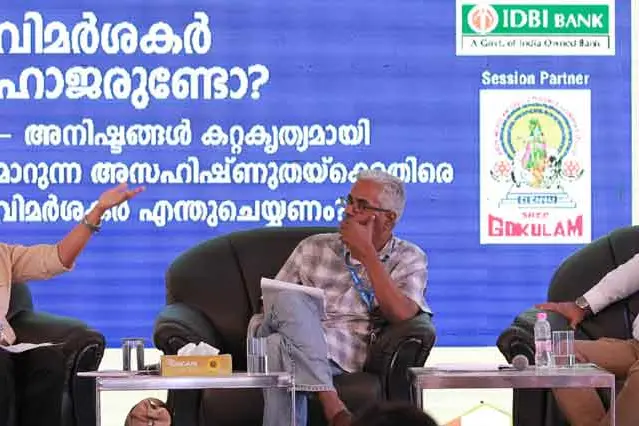
Yet another relevant topic, on the intolerant attitude towards criticism voiced by free thinkers,Vimarshakar hajar undo, was debated before an enthusiastic audience at the Mathrubhumi Festival of Letters on the second day. Moderated by social critic Deepak Sankaranarayanan, the guests film critic C.S. Venkiteswaran and poet Veerankutty spoke about the many challenges faced by critics.
Leftist thinker Sankaranarayanan said that critics have always enjoyed a certain social immunity which should ideally act as a buffer for them. However, this environment had changed in recent times. He observed the right of the public to correct critics when they made mistakes but in the current scenario, political parties were discouraging this much-needed act. The many pillars, be they social, cultural, economic or political, that usually protected a critic, were now becoming undone. People only want ideas now, something that was once made possible only through criticism. Healthy criticism in any organisation, he felt, would give rise to any latent internal friction which in turn would create more ideas while protecting it from external agencies of destruction. He said authority was a prerequisite of every social order while a sense of justice was an aspect that was imposed. No justice would be forthcoming without healthy criticism, he warned. The political scenario in India, he said, is one where everything is being labelled sacred and thereby, unquestionable.
Mr. Venkiteswaran, who is also a documentary film maker and professor at the University of Calicut, said the age of new media was a time of democratic excess.
Those sections of society that were previously unseen now had a public forum to raise their views. We are in the midst of change. The language of criticism is being affected as new challenges crop up, he said. Veerankutty, an academician as well with several collections of poetry to his credit, recited a poem before sharing his views. He said that critics exist as a tool that aided in development but was always looked at with doubt by authorities. He said that books, even if destroyed, would ensure that the public remembered the views expressed through them, be they on government, politics or government.
Published: 03 Feb 2018, 06:57 pm IST
Related Topics
Disclaimer: Kindly avoid objectionable, derogatory, unlawful and lewd comments, while responding to reports. Such comments are punishable under cyber laws. Please keep away from personal attacks. The opinions expressed here are the personal opinions of readers and not that of Mathrubhumi.
