
In a forest township where you navigate by water towers and banyan trees, every building is an experiment and nobody has agreed on the ending.
Nobody gives you directions in Auroville. They give you landmarks.
Turn left at the banyan. Keep going till you see the big water tower. Ask someone after that.
This is a township with hardly any streets and almost no addresses, scattered through a forest over red earth paths. You navigate by water towers, old banyan trees and whoever you happen to meet along the way. There is a cinema here called Cinema Paradiso, and the name suits the place, it runs on stories more than maps. You are not lost, exactly. You are somewhere the usual rules stopped applying in 1968.
That was the year Mirra Alfassa, known as the Mother, founded it, carrying forward the vision of Sri Aurobindo, the philosopher and freedom fighter who dreamed of a new way of individual and collective life.
French architect Roger Anger drew the plan, a vast spiral, four zones spreading outwards, and the Matrimandir at its heart. Then the forest, planted largely by residents, grew into something no drawing predicted.
The footprint is small, but the density of ideas is enormous. Earth construction, water recycling, bamboo structures and passive cooling have all been tested here, often at full scale and for years. Some became useful technologies. Others stayed experiments. Auroville has always allowed both.
Around 3,500 people live here at most, in Villupuram district, straddling Tamil Nadu and Puducherry.
Begin with the golden sphere
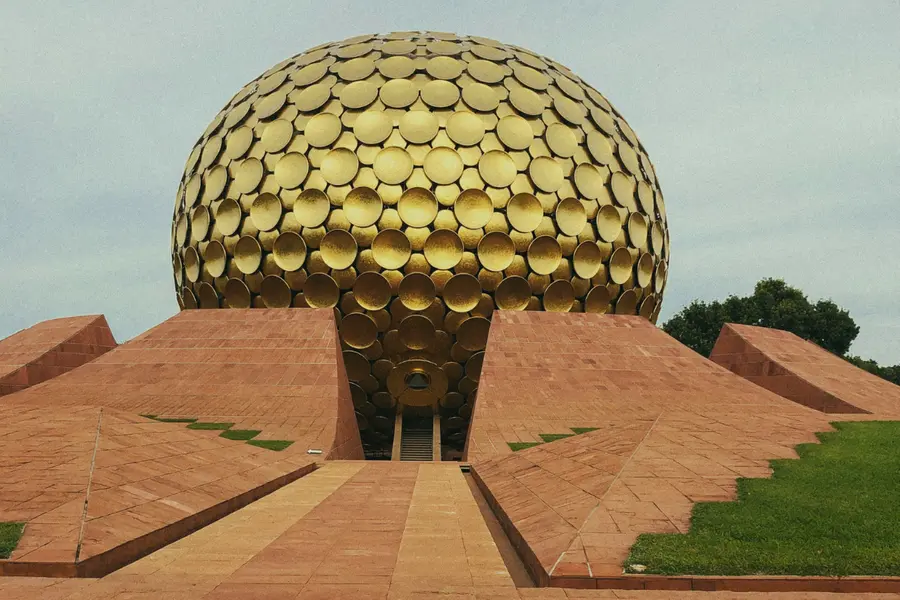
The Matrimandir rises above the trees, ringed by 12 red sandstone petals. From far away it looks almost unreal. Up close, you see the individual discs of gold leaf, and the sandstone holding the whole thing to the ground.
Inside, it goes hushed, white marble, white carpet, four columns, a crystal globe, one shaft of sunlight. No priests, no images, no ritual. Construction began in 1971 and finished in 2008, the year Anger died.
Arrive like everyone else
Also Read: Vijay's ‘Leo’ cafe is real! This Kashmir cafe has become a tourist hotspot for Thalapathy fans
The Visitors' Centre, built in 1998 and designed by Suhasini Ayer, is where most travellers begin, information desk, exhibitions, a video hall, café, bookshop, handicraft shops and an open-air theatre.
It was also a testing ground for Compressed Stabilised Earth Blocks, natural light and cross-ventilation. It gets busy, and that is the charm. Thousands of people pass through daily, so the experiment has to work as a real public building.
Eat with a thousand people
The Solar Kitchen, finished in 1997, serves around a thousand meals a day. Its roof holds the showstopper, a 15m spherical solar concentrator made of ferrocement segments and roughly 11,000 hand-cut mirror facets, focusing sunlight into steam for the kitchen below.
A diesel boiler handles early mornings, then the sun takes over. A grand idea, doing a very ordinary job.
Find your compass
The water tower between Prayatna and Vikas, built in 1996, rises 26m in stabilised earth block, holding 130,000 litres in its ferrocement tank and another 200,000 underground. In a place without conventional addresses, it is civic architecture and a navigation aid in one. People quite literally find their way home by it.
Watch the town decide
The Town Hall, completed in 2003, gathers administration into compact spaces linked by ramps, bridges and cantilevers. Concrete, brick and ferrocement give it a practical, slightly unfinished look, and the weathering is allowed to show. It sits within sight of the Matrimandir on purpose, Anger wanted those making decisions to keep the centre in view.
Slow down at Savitri Bhavan. This is a centre for studying Sri Aurobindo's epic poem ‘Savitri’, set on an artificial plateau where a pond gathers rainwater from the roofs.
Inside, a gallery holds around 600 paintings made by Huta under the Mother's guidance. Outside, a rammed-earth wall was built from 96 soil samples from 27 countries for Auroville's 50th anniversary in 2018.
Also Read: India has a surf scene now & here's where to find it
Sit at the Peace Table
Next door, in the Unity Pavilion, two slabs of black walnut from a 300-year-old tree, shaped by George Nakashima, wait in near-silence. The timber does most of the talking.
The Tibetan Pavilion follows the Kalachakra mandala, its foundation stone laid by the Dalai Lama in 1993.
At the Vérité Meditation Hall, a single opening in the dome drops a sharp beam of light onto a red oxide floor, with no air conditioning and very little fuss.
Dustudio's courtyard steps down like a stepwell, its red rammed-earth walls carrying Devanagari calligraphy.
At the Bamboo Centre, bamboo is grown, cured, split, steamed and bent by apprentices from nearby Tamil villages, working beside architecture students and visiting designers.
Meet the houses that were baked
Ray Meeker built mud-brick houses, packed them with pottery, then fired the whole structure like a kiln. Around 20 were made. It stopped because the energy it demanded made it hard to call sustainable.
Also Read: The new Chennai table, design-led dining across the city to bookmark
Auroville keeps its failures on display, too.
Don't skip the trash
EcoService in Kottakarai is the least photogenic stop and the most honest. Bags marked plastic turn out to hold metal, cloth and food.
Shredded thermocol is pressed into partition blocks for buildings elsewhere in town. It is decades of unglamorous work by people who simply keep going.
The Crown, the ring road from Anger's master plan, has finally taken shape, and mature trees were cleared along parts of it. For the Auroville Foundation, it is the plan coming true. For many residents, houses were demolished and trees felled without the consent of the Residents' Assembly. Both sides have argued it in court. The road, meanwhile, got built.
End at Centerfield, where there is nothing to do at night but look at the stars. After a day of buildings, infrastructure and arguments about the future, the forest takes over.
Auroville is not a finished idea you tour. It is one still being planted, poured, questioned and sometimes abandoned. For some, the utopia is already lost. For others, it is yet to begin.
Somewhere between the two, you'll find your way back by the water tower.
(All photos in this article are sourced from Nipun Prabhakar.)
Published: 30 Sept 2026, 10:48 am IST
ABOUT THE AUTHOR

Related Topics
Disclaimer: Kindly avoid objectionable, derogatory, unlawful and lewd comments, while responding to reports. Such comments are punishable under cyber laws. Please keep away from personal attacks. The opinions expressed here are the personal opinions of readers and not that of Mathrubhumi.