
From extra legroom to wider seats, discover how Indian airlines are changing the domestic flying experience.
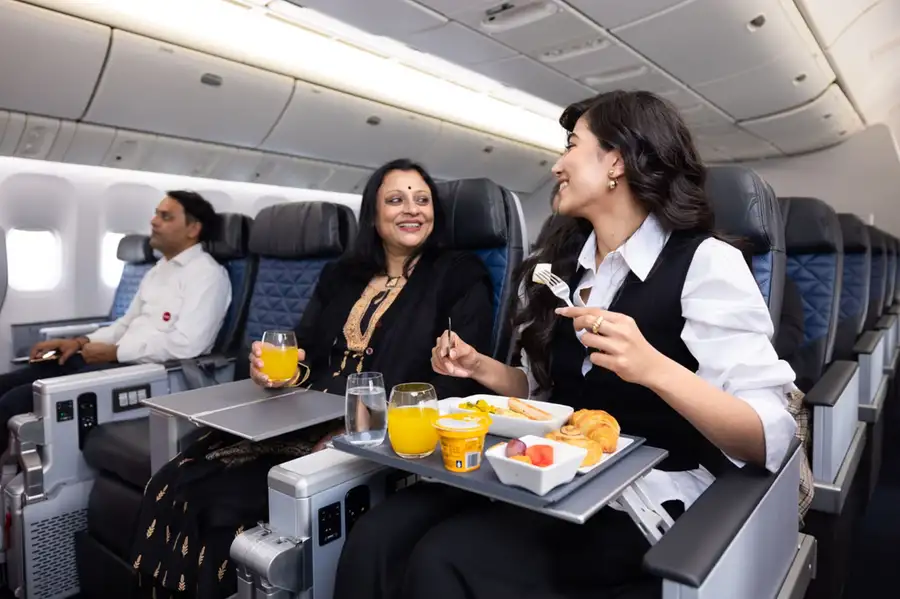
For years, premium air travel was largely associated with long international journeys. Business class and first class offered lie-flat beds, elaborate dining, spacious seating and personalised services, while economy passengers had to make do with standard seating and limited legroom. Premium economy emerged as a middle ground, offering additional comfort without the high price of business class.
That distinction is now becoming less pronounced. Airlines across the world are increasingly extending premium cabin experiences to shorter routes, recognising that passengers are willing to pay for greater comfort and convenience even when they are flying for just three to five hours. The focus is no longer exclusively on luxury travel but also on making shorter journeys more comfortable, particularly for business travellers and passengers who value personal space.
The trend is also changing the way airlines look at cabin configuration and revenue generation. Instead of treating premium seating as a product exclusively for long-haul flights, carriers are finding ways to offer different levels of comfort across their regional networks.
Long-haul comfort finds a place on shorter routes
Several international airlines are already deploying aircraft with dedicated premium economy cabins on relatively short regional sectors. Cathay Pacific, for instance, operates its Airbus A350 aircraft on selected routes between Hong Kong and Singapore, a journey of approximately four hours. The aircraft offers a dedicated premium economy cabin with wider seats, around 40 inches of seat pitch and enhanced onboard services.
Similarly, Singapore Airlines deploys long-haul configured A350 and Boeing 777 aircraft on selected regional routes, including the Singapore-Hong Kong sector. Its premium economy product offers additional legroom, wider seating and amenities such as calf rests and upgraded inflight entertainment. During peak periods, the airline has also deployed its Airbus A380 on this route, giving passengers access to a premium cabin experience usually associated with much longer international journeys.
Air New Zealand has adopted a similar approach on its trans-Tasman services connecting Auckland with Australian cities such as Sydney and Melbourne. These flights typically take between three and four hours, but passengers travelling in premium economy on selected Boeing 787-9 services get access to seats with approximately 41 inches of pitch, additional recline and improved dining.
The appeal is straightforward. On a relatively short flight, passengers may not necessarily need an expensive lie-flat business class seat. However, they may appreciate more legroom, a better recline, additional personal space and a more comfortable dining experience. Premium economy offers a middle ground between the restricted space of standard economy and the considerably higher cost of business class.
Premium seating is not just about international travel
The trend is also gaining momentum in North America, where airlines are extending premium cabin products to domestic transcontinental routes. Delta Air Lines offers its Premium Select product on selected services connecting New York with Los Angeles and San Francisco. These flights can last between five and six hours, depending on the direction of travel and operating conditions.
United Airlines has similarly introduced its Premium Plus cabin on selected domestic transcontinental services. Passengers benefit from wider seats, additional legroom, footrests, improved dining and enhanced inflight entertainment. American Airlines is also moving towards dedicated premium seating on its Airbus A321XLR aircraft, with a separate premium economy cabin planned as part of its multi-class configuration.
An important aspect of this strategy is aircraft utilisation. Airlines frequently operate long-haul configured widebody aircraft on busy regional routes or domestic sectors between major cities. This allows them to offer premium products on shorter journeys without necessarily designing an entirely separate aircraft configuration for every route.
However, the availability of these cabins depends on the aircraft assigned to a particular flight. Even on the same route, passengers may find different seating configurations depending on the aircraft type and operating schedule. This makes aircraft deployment an important part of the premium travel proposition.
Also read | Chennai airport retains India's punctuality crown, ranks sixth globally
India's premiumisation story is already taking shape
While much of the international attention is focused on airlines such as Cathay Pacific, Singapore Airlines, Air New Zealand and Delta, India is not entirely new to the premium cabin concept. In fact, the country's domestic aviation market has already begun moving towards a more differentiated passenger experience.
Air India has expanded its premium economy offering across its domestic network, providing passengers with an intermediate option between economy and business class. The airline announced in March 2025 that its premium economy product was available on 39 domestic routes, with more than 50,000 seats offered weekly at the time. The offering includes a dedicated cabin, additional legroom, priority check-in and boarding, complimentary hot meals served on premium chinaware and a more spacious seating environment.
The airline's domestic premium economy product offers a seat pitch of approximately 32 inches, compared with standard economy seating, along with improved upholstery and additional recline. Air India also announced plans to increase its weekly premium economy seat deployment by 30 per cent following the retrofit of its legacy narrowbody aircraft. Its premium economy fares were also promoted through limited-period offers starting at just Rs 599 above standard economy fares, although actual prices vary according to the route and demand.
The airline has been concentrating on major business corridors such as Delhi-Mumbai, Delhi-Bengaluru, Delhi-Hyderabad, Mumbai-Bengaluru and Mumbai-Hyderabad, where there is demand for different levels of travel comfort.
IndiGo, traditionally associated with the low-cost, single-class business model, has also entered the premium travel segment with its IndiGoStretch product. Introduced in November 2024, the product offers a business-class experience on selected domestic routes. Its seats feature a two-abreast configuration, 38 inches of pitch and 21.3 inches of width, along with adjustable headrests, additional recline and power outlets.
Passengers also receive complimentary meals, priority check-in and boarding, additional baggage allowance and other benefits. The product has been progressively introduced across busy domestic routes, including Delhi-Mumbai, Bengaluru-Mumbai and Delhi-Chennai, among others.
These developments indicate that Indian airlines are increasingly looking beyond the traditional economy-class model. However, there is an important distinction: while Air India's premium economy offers an intermediate seating category, IndiGoStretch is a business-class product. Neither should be confused with the more elaborate premium economy cabins found on some international widebody aircraft.
Nevertheless, both developments demonstrate that Indian passengers are being offered more choices in how much comfort and convenience they wish to purchase.
Also read | Why does this Airbus A320 passenger aircraft have the nose of a fighter jet?
Will Indian passengers pay more for a better flying experience?
This is perhaps the most interesting question for the Indian domestic aviation market. India remains a highly price-conscious aviation market, where ticket prices often influence travel decisions more than the onboard experience. For a large section of passengers, getting from one city to another at an affordable fare remains the primary consideration.
However, the market is also changing. Business travel, higher disposable incomes, growing aspirations and an expanding middle class are creating demand for differentiated travel experiences. Passengers are increasingly looking at factors beyond the basic ticket price, including seating comfort, baggage allowance, priority services, convenience and the overall quality of the journey.
A KPMG India Customer Experience Report 2025 offers an interesting insight into this shift. According to the report, 30 per cent of surveyed customers, primarily leisure travellers, said they would be willing to pay more for better airline service, while 29 per cent indicated a willingness to pay more for better aircraft and modern amenities that improve cabin comfort. These findings suggest that a section of Indian passengers is prepared to spend extra when the additional value is clearly visible.
However, willingness to pay more does not necessarily mean that passengers will automatically choose premium economy. The additional fare will have to be justified by a tangible improvement in the journey.
For instance, a passenger travelling from Mumbai to Delhi may be willing to pay an additional amount for a wider seat, extra legroom, priority boarding and a complimentary meal, particularly if the journey is connected to an important business meeting. Similarly, an elderly passenger, a family travelling with children or someone who values additional personal space may consider the upgrade worthwhile.
On the other hand, a student, a budget-conscious family or someone taking a short flight for personal reasons may prefer to save the additional money. If the difference between an economy and premium economy ticket becomes too large, the passenger may simply choose the cheaper option.
The challenge for airlines, therefore, will be to identify the right price point. Premium seating cannot become attractive merely because it carries a premium label. Passengers must be able to see and experience the difference they are paying for.
The economics behind a more premium cabin
For airlines, premium seating offers an opportunity to generate additional revenue from passengers who are willing to pay more without necessarily increasing the number of flights operated. A dedicated premium section can also help carriers attract corporate customers, frequent flyers and travellers who value convenience.
However, introducing a separate premium cabin on short-haul aircraft comes with operational and commercial considerations. Airlines have to balance the number of premium seats against the much larger economy market. Every additional premium seat also takes up cabin space that could otherwise accommodate multiple economy passengers.
The economics become particularly important on domestic routes where flight durations are relatively short. A passenger may be willing to pay extra for a more spacious seat on a four-hour flight, but may not see the same value on a journey lasting just 60 to 90 minutes.
This is where airlines could consider a more flexible approach. Instead of introducing elaborate premium cabins across their entire networks, they could deploy upgraded seating on selected high-demand routes connecting major business centres and metropolitan cities. They could also offer different levels of comfort through seat upgrades, additional legroom, priority services and bundled benefits.
The pricing strategy would be equally important. An affordable upgrade over the standard economy fare could attract a wider section of passengers than a premium product priced close to business class.
Recent domestic airfare trends also underline the importance of pricing. A Business Standard analysis of Cirium data found that economy fares increased year-on-year on 18 of India's 20 busiest domestic routes in June 2026, while business-class fares declined on 16 of those routes. The findings suggest that premium cabin demand and pricing are influenced by competition, available capacity and the willingness of different passenger segments to pay.
What will Indian flyers choose between comfort and cost?
The future of premium seating in India may not necessarily be about offering the most luxurious cabin. It could instead be about providing passengers with the option to make their journeys more comfortable without having to pay business-class prices.
A passenger may not need a lie-flat bed or an elaborate multi-course meal on a two-hour domestic flight. But an extra few inches of legroom, a comfortable seat, a decent meal, priority boarding and the assurance of a less crowded cabin could make a noticeable difference.
For airlines, the opportunity lies in understanding that not every passenger has the same expectations or willingness to spend. While some will continue to choose the lowest available fare, others may be willing to pay a little more for a better experience.
As Indian carriers expand their premium offerings and compete for a larger share of the country's growing aviation market, the next phase of cabin evolution could well be about bringing affordable luxury to shorter domestic journeys.
But will an average Indian economy-class passenger be willing to spend an additional Rs 1,000, Rs 2,000 or even more for a wider seat, extra legroom and a premium onboard experience on a two- or three-hour flight? Or will price continue to remain the deciding factor when choosing an airline?
Would Indian passengers embrace a more premium short-haul flying experience, or is economy-class affordability still the bigger priority? The answer could shape how the country's airlines design their cabins in the years ahead.
Published: 09 Nov 2026, 03:34 pm IST


ABOUT THE AUTHOR

Disclaimer: Kindly avoid objectionable, derogatory, unlawful and lewd comments, while responding to reports. Such comments are punishable under cyber laws. Please keep away from personal attacks. The opinions expressed here are the personal opinions of readers and not that of Mathrubhumi.