
One unhurried day in Amsterdam, from the Night Watch restoration to warm stroopwafels, bitterballen and canals lit up at night.
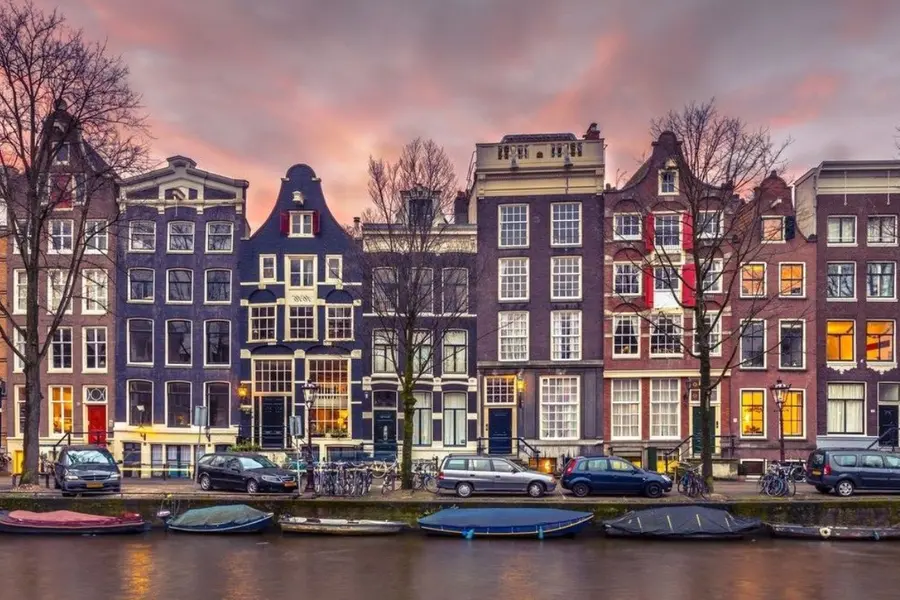
The first thing you notice in Amsterdam is the sound, or rather the lack of it. No honking, no engines roaring. Just the soft whir of bicycle wheels, a bell ringing somewhere behind you, and water lapping gently against old stone. Early in the morning, a thin mist lies on the canals and the gabled houses lean over it like tall, tired friends. The city doesn’t hurry you. It seems to say, there is no rush, everything is within reach.
So I stopped rushing. I had a list, of course, but I let the canals decide.
Morning: Getting lost on purpose
The old centre is best explored on foot, with no plan at all. I followed the Amstel for a while, crossed one arching bridge, then another, and slipped into an alley I couldn’t have found again if I tried. Then, suddenly, a little white bridge, the Staalmeestersbrug, and beyond it the tower of the Zuiderkerk rising above the water. I stood there longer than I meant to.
Claude Monet painted this same view in 1874, and a hundred and fifty years later it still stops people mid-step. A cyclist swerved around me, unbothered. I was clearly not the first person to freeze here.
Late morning: The Night Watch, behind glass
At the Rijksmuseum, the biggest surprise was not a painting but a wall of glass.
Rembrandt’s The Night Watch is in the middle of a long restoration, and instead of hiding it, the museum lets you watch the work happen.
I stood among strangers, all of us quiet, all leaning slightly forward, watching conservators tend to a masterpiece in real time. It felt less like looking at art and more like standing inside its care.
Afterwards I wandered through the Gallery of Honor, past the Dutch masters, and then out into the free garden, where the noise of the museum faded behind me.
Afternoon: Sweetness and silence
Lunch was a stroopwafel, still warm, bought at Rudi’s stand in the Albert Cuyp market. Two thin waffles with caramel melting between them, the syrup sticky on my fingers.
Around me, stalls selling flowers, clothes and fried snacks hummed with noise, and three generations of one family worked side by side behind the counter. It was the kind of food that doesn’t need a TikTok line to be good.
Later, the mood changed completely.
Also Read: The mystery behind the giant stones: My visit to Stonehenge
At the Anne Frank House on the Prinsengracht, nobody spoke above a whisper. You climb the steep stairs, pass through the hinged bookcase, and enter the cramped annex where eight people hid for years.
I saw her original diary and the photos still pinned to her bedroom wall. There was no grand display, only small rooms and the heavy weight of what happened inside them. (Book ahead. Tickets are sold only on the official website and sell out fast.)
I needed somewhere gentle afterwards. The Begijnhof was exactly that: a walled courtyard of brown brick houses, tucked into one of the busiest parts of the city, yet completely still.
Women lived here for more than six hundred years, caring for the sick and teaching, and today only single women still call these houses home.
Hidden inside is a secret Catholic church from the 17th century, from the days when public churches had to be Protestant.
Also Read: I travelled to Jane Austen’s home and found the tiny table where she wrote
The city, I realised, is full of rooms like this, quiet spaces folded inside loud ones.
Evening: Borrelen
By five o’clock, I had learned the local custom. You go borrelen: a drink, a snack, and nowhere to be. At Café Luxembourg I ordered a glass of wine and a plate of bitterballen, crisp on the outside and soft, savoury ragout within. The table was small, the conversation around me was in a language I didn’t understand, and I have rarely felt more at ease.
Night: The canals light up
As dusk settled, the bridges began to glow, each one drawing a perfect arch of light on the black water. The canals that had looked soft and misty in the morning now shimmered.
A cyclist rolled across a bridge, his bike light flickering in the reflection. Nearby, a repair shop owner named Frans van der Meer was closing up his shop, which has stood for 102 years. Inside hangs a wheel from World War I, built from wood, cork and metal springs because rubber was scarce. History here isn’t kept behind ropes. Sometimes it hangs from the ceiling of a bike shop.
I walked home along the water, past houseboats and tall windows glowing yellow, and thought about how the city had changed shape as the day went on. The same canal was a misty watercolour in the morning, a busy road at noon, and a mirror of lights at night. The same bridge could be a photo stop, a shortcut, or a quiet place to simply stand.
Also Read: No street names, no addresses, a day lost (and found) in Auroville
Amsterdam is small, and everything is within reach. But what I took with me wasn’t the list of places I saw. It was the slowing down. In this city, the light, the hour and the way you arrive change what you see. You don’t tick it off. You let it unfold.
(Disclaimer: Image credits do not belong to Mathrubhumi. All images are the property of the respective artists and have been sourced via Pinterest.)
Published: 17 Oct 2026, 02:34 pm IST
ABOUT THE AUTHOR

Related Topics
Disclaimer: Kindly avoid objectionable, derogatory, unlawful and lewd comments, while responding to reports. Such comments are punishable under cyber laws. Please keep away from personal attacks. The opinions expressed here are the personal opinions of readers and not that of Mathrubhumi.