
Perseid meteor shower, six planets and a total solar eclipse mark August 12, 2026. Here's what skywatchers in India can see.
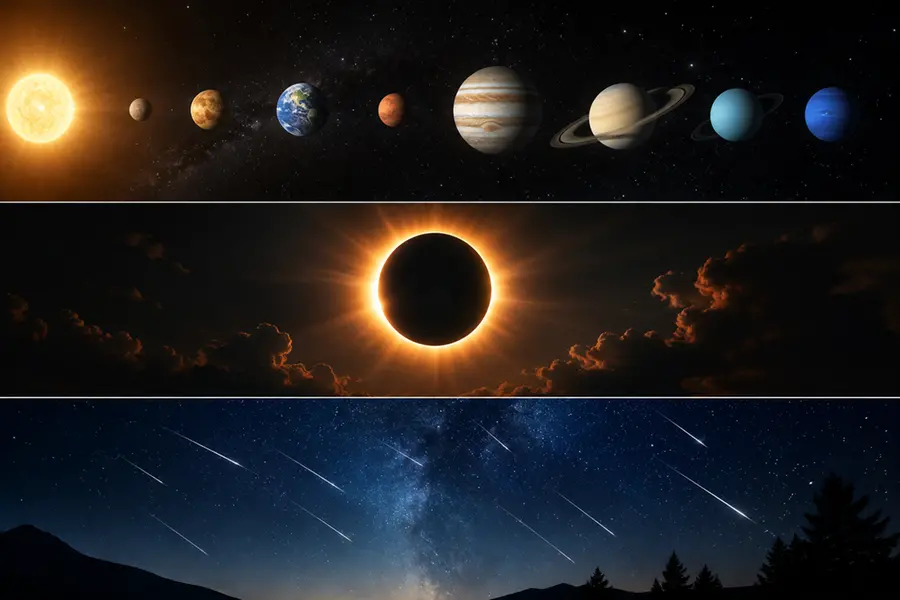
August 12, 2026, is shaping up to be an unusually busy day in the astronomical calendar. A total solar eclipse will sweep across parts of the Northern Hemisphere, six planets will appear across the pre-dawn sky and the annual Perseid meteor shower will reach its peak overnight.
For skywatchers in India, however, the celestial spectacle comes with an important distinction: not everything happening in the sky will be visible from the country. While the solar eclipse will remain out of India's view, the planetary alignment and Perseid meteor shower could offer plenty to watch, provided the skies are clear.
The Perseids are particularly promising this year because their peak coincides with a New Moon, leaving the night sky largely free from bright moonlight. Under dark-sky conditions, observers could potentially see dozens of meteors each hour.
Total solar eclipse: Can India see it?
The headline event on August 12 will be a total solar eclipse, but Indian skywatchers will have to sit this one out.
According to NASA, the Moon's shadow will travel across parts of northern Russia, Greenland, Iceland and Spain, with a small portion of Portugal also falling within the path of totality. Several other regions across the Northern Hemisphere will witness a partial eclipse.
India is outside the eclipse's visibility zone. That means the Sun will not appear partially or completely covered from Indian locations during this event.
For those watching from a location where the eclipse is visible, eye safety is essential. NASA recommends certified eclipse glasses or an appropriate solar viewer whenever any part of the Sun can be seen. Ordinary sunglasses are not safe for viewing a solar eclipse.
Also Read: What did astronomers see during India’s 1868 solar eclipse? The Helium mystery explained
Six planets to appear before sunrise
Indian observers do have another celestial event to look forward to on the same date.
Mercury, Jupiter, Mars, Saturn, Uranus and Neptune will be positioned along the morning sky, creating what is commonly described as a planetary parade.
The planets will not actually form a perfectly straight line in space. Their apparent alignment is largely a perspective effect, as seen from Earth, with the planets appearing close to the ecliptic, the apparent path followed by the Sun across the sky.
Not all six will be equally easy to spot from India. Mars and Saturn should be among the more accessible naked-eye planets, while Uranus and Neptune are much fainter and are better viewed with optical equipment. Mercury and Jupiter may also be difficult targets because of their low position near the horizon and the brightening twilight.
The best chance of seeing the planetary display will come before sunrise, assuming a clear horizon and favourable weather.
New Moon creates darker skies
The timing of the New Moon is one of the biggest advantages for anyone hoping to observe the night sky on August 12.
During a New Moon, the illuminated side of the Moon faces away from Earth, leaving little or no visible lunar light to brighten the sky. For astronomers and casual stargazers alike, that means darker conditions and a better chance of spotting faint celestial objects.
That is especially useful this year because the New Moon arrives alongside the peak of the Perseid meteor shower.
Perseid meteor shower reaches its peak
The Perseids are among the most popular annual meteor showers and are produced when Earth moves through debris left behind by Comet 109P/Swift-Tuttle.
As tiny pieces of this cometary material enter Earth's atmosphere at high speeds, they heat up and glow, producing the bright streaks commonly known as shooting stars.
The shower is active for several weeks each year, but its strongest activity comes around the August peak. In 2026, the peak falls during the night of August 12 and into the early hours of August 13. Under ideal dark-sky conditions, observers can potentially see around 50 to 100 meteors per hour, although actual numbers vary depending on location, weather, light pollution and the observer's view of the sky.
What time can Indians watch the Perseids?
For observers in India, the best opportunity comes after midnight and towards dawn, when the Perseid radiant has risen higher in the sky.
A practical viewing window is between about 2 am and 4.30 am IST on August 13, although meteors may be visible earlier in the night as well.
The meteors can streak across different parts of the sky, so there is no need to stare at one particular point. The constellation Perseus is the apparent radiant of the shower, but the meteors themselves can appear far away from it.
The biggest challenge for Indian observers could be the weather. August falls within the monsoon season in much of the country, and clouds or rain could obscure the view even when astronomical conditions are favourable.
How to watch the Perseid meteor shower from India
No telescope is necessary to enjoy the Perseids. In fact, watching with the naked eye gives observers a wider field of view.
For the best experience:
- Move as far as possible from city lights and other sources of artificial illumination.
- Choose a location with an unobstructed view of the sky.
- Give your eyes around 20 to 30 minutes to adjust to the darkness.
- Avoid repeatedly checking your phone, as bright screens can interfere with night vision.
- Lie back or use a reclining chair so you can comfortably watch a large section of the sky.
- Check the weather forecast before heading out, particularly in regions affected by monsoon clouds.
- Be patient, as meteors do not appear at a perfectly constant rate.
Astronomy guides also recommend avoiding telescopes and binoculars for meteor-shower viewing because their narrow fields of view can make it easier to miss meteors appearing elsewhere in the sky.
Where in India could the Perseids be easier to see?
Dark locations away from major cities will generally offer better conditions than urban areas. Places with relatively low light pollution and wide horizons can improve the chances of spotting fainter meteors.
Popular stargazing destinations in India have included Ladakh, Spiti Valley, Jaisalmer, Coorg and the Andaman and Nicobar Islands. However, the ideal location on August 12-13 will ultimately depend on local cloud cover, rainfall, visibility and accessibility.
For anyone travelling specifically to watch the shower, a remote location is not automatically better if clouds cover the sky. Checking local weather conditions shortly before the observation is therefore just as important as escaping light pollution.
So, while Indian skywatchers will miss the dramatic daytime darkness of the August 12 eclipse, they should not write off the date. Once night arrives, the sky could offer its own spectacular show.
Published: 12 Aug 2026, 09:09 am IST
ABOUT THE AUTHOR

Disclaimer: Kindly avoid objectionable, derogatory, unlawful and lewd comments, while responding to reports. Such comments are punishable under cyber laws. Please keep away from personal attacks. The opinions expressed here are the personal opinions of readers and not that of Mathrubhumi.