
The digital boom is hookin’ kids. As platforms profit, a global fight for age limits intensifies.
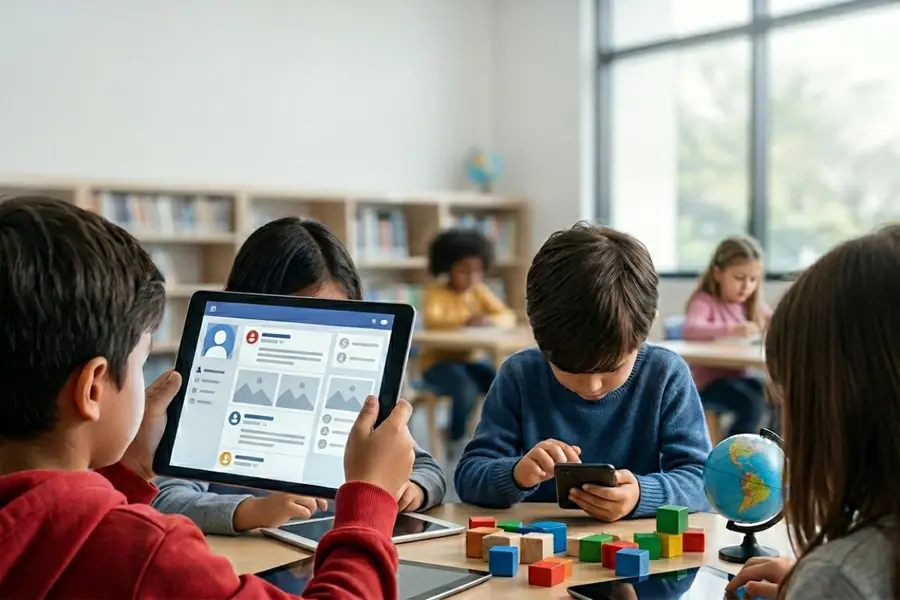
There have been a number of studies conducted in recent years that have flagged off concerns around the use of social media among children between the ages of 12 and 15. In the United States, a study observed that children between the ages of 12 and 15 spent around three hours a day on social media.
Another study conducted in 2026 involving 12,000 adolescents in Bradford, United Kingdom found that using social media more than three times a day was associated with poorer mental health and wellbeing among teenagers.
Social media usage has surged, with several companies benefiting from the content users generate. While adults form a significant portion of their audience, a huge number of children are also influenced by and addicted to these platforms.
Concerns over children's exposure to harmful content have prompted several countries to impose age-based restrictions on social media. The aftermath of cases such as the death of 12-year-old Rossella Ugues in Italy, the Blackout Challenge incidents involving minors in the United States, and the cyberbullying-related death of Canadian teenager Amanda Todd have forced several countries to introduce new age-related regulations aimed at protecting innocent lives.
Denmark
Denmark was, perhaps, among the first few countries to ban social media platforms for children under the age of 15. In November 2025, the Danish government announced that it had secured support from three governing coalition parties and two opposition parties in parliament regarding the ban on social media.
According to Danish authorities, excessive social media use contributes to cyberbullying, exposure to harmful content, declining mental health and increased screen dependency among young users.
There have also been concerns that social media is affecting children's social development and reducing opportunities for real-world interactions, prompting urgent measures to safeguard children from the harms associated with these platforms.
Australia
Australia imposed age-related restrictions under which children under the age of 16 are banned from using social media. The new regulation came into effect in December 2025, preventing children from using Facebook, Instagram, Snapchat, Threads, TikTok, X, YouTube, Reddit, Twitch and Kick.
Sites such as WhatsApp and YouTube Kids do not fall under these regulations, offering some relief for children.
The Australian government has warned social media companies to keep children away from their services, and companies that fail to comply with the rules may face penalties of up to AUD 49.5 million.
The move was implemented following a government report that found 37% of minors had been exposed to harmful content.
The Australian government explained that the social media ban is needed to protect the mental health and wellbeing of Australian children and teenagers. Activities such as cyberbullying, exposure to harmful content and online predation outweigh the positive influences of social media.
A research report published as part of eSafety's "Keeping Kids Safe Online" survey sought to present a clearer picture of the use of online platforms and experiences of harm among children aged 10 to 15 in Australia.
Canada
Following Australia's footsteps, the Canadian government introduced a digital safety bill that could lead to a social media ban for children under 16.
According to the new legislation, social media companies can sidestep the ban if they have policies that protect young users. However, officials have stated that the bill may take almost a year to pass.
The new Bill C-34 proposed by the Canadian government cites growing concerns that need to be addressed. These include harmful content that sexually victimizes a child, intimate content shared without consent, self-harm content, cyberbullying, hate speech, incitement to violence, and the promotion of terrorism or violent extremism.
All these measures are intended to protect Canadian children from violence, self-harm and other online risks.
France
France is another country where lawmakers passed a bill in late January that would impose a permanent ban on social media for children under 15. In order to protect children from excessive screen time, President Emmanuel Macron has supported the measure.
The bill still needs to pass through the country's Senate before a final vote in the lower house. The French government has stated that cyberbullying, harmful and inappropriate content, online harassment, addictive algorithms and excessive screen time have taken a toll on young children's mental health, creating an urgent need for age-based restrictions on social media.
United Kingdom
Another country considering a social media ban is the United Kingdom, where now-resigned Prime Minister Keir Starmer announced on June 15 that social media restrictions would be considered for children under the age of 16. The ban would apply to a range of social media platforms, including Snapchat, TikTok, YouTube, Instagram, Facebook and X.
Messaging apps such as WhatsApp and Signal will not be included in the ban, and there are also going to be limitations on AI tools, as artificial intelligence chatbots will have to ensure that they are used only by people over the age of 18.
Starmer stated that the ban could be in place by spring 2027. The risks include cyberbullying, exposure to harmful and age-inappropriate content, online harassment, self-harm material, and the addictive nature of social media algorithms.
Children's mental health has also been taken into consideration, with the government aiming to create a safer online environment for children and reduce the risk of harmful influences on young users.
Also read: No TikTok, Instagram or YouTube for under-16 under UK's new plan
Spain
Spain is another country where Prime Minister Pedro Sanchez announced in early February that the country is working towards banning social media for children under the age of 16. The ban still requires parliamentary approval.
The government is also attempting to introduce a new law that would make social media executives personally responsible for hate speech on their platforms.
The government has highlighted risks such as cyberbullying, exposure to harmful content, addictive online behaviour and the effects of excessive screen time on young people's mental health and development.
There are similar efforts underway in other countries as well.
Germany
German Chancellor Friedrich Merz's Conservatives discussed a proposal to bar children under the age of 16 from using social media platforms. Despite attempts to introduce new measures, centre-left coalition partners were hesitant to support an outright ban.
Indonesia
The Indonesian government stated early March that it is planning to ban children under the age of 16 from using social media and other popular online platforms.
The country plans to begin with platforms such as YouTube, TikTok, Facebook, Instagram, Threads, X, Bigo Live and Roblox.
The country's government has cited risks such as cyberbullying, exposure to harmful and age-inappropriate content, online exploitation and the negative effects of excessive social media use on children's mental health and development.
Greece
Greek Prime Minister Kyriakos Mitsotakis announced in April that the country is attempting to ban social media access for children under the age of 15 beginning in January 2027.
Mitsotakis stated that the move is aimed at tackling rising anxiety, sleep problems and the addictive use of social media among children.
As social media becomes an inseparable part of childhood, governments are facing a difficult question on how much freedom should children have online, and at what cost?
Whether these measures prove effective or not, the debate over children's space in the online world is only just beginning.
Published: 22 Jun 2026, 07:18 pm IST
Disclaimer: Kindly avoid objectionable, derogatory, unlawful and lewd comments, while responding to reports. Such comments are punishable under cyber laws. Please keep away from personal attacks. The opinions expressed here are the personal opinions of readers and not that of Mathrubhumi.
