
Fendi's viral $10K mirror-work bag looks like appropriation until you clock the 30-year Mumbai collaboration behind it.
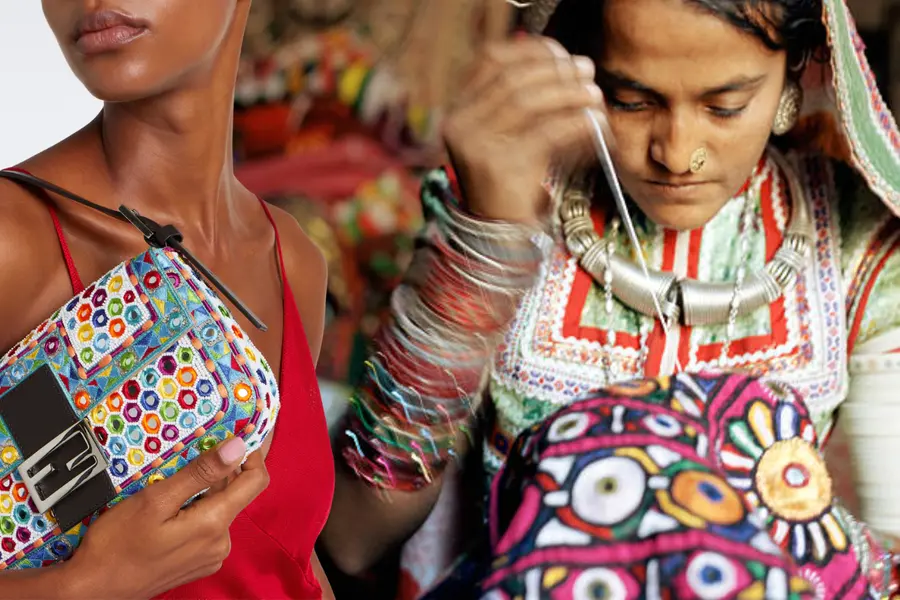
Some people are going to say, "It's Gujarati embroidery. Fendi stole it and didn't even say thank you." Others are going to say, "It's just a bag." Both are lazy, and both miss the actual question, which is, what does it mean for a craft to travel, and who gets to decide when the travelling stops counting as theft?
That was the first thought when the internet discovered Fendi's mirror-work Baguette and immediately reached for the appropriation button, as if thirty years of documented collaboration between an Italian design house and a Mumbai embroidery atelier could be flattened into one Instagram carousel.
The Bag, for those just tuning in
Fendi's Fall/Winter 2026–27 Baguette is covered in 39,500 beads and 475 mirrors, stitched by hand over more than 138 hours, and priced at $10,000, which, per bead, is either an outrage or a bargain, depending on how much you enjoy doing that math.
The house frames it as a re-edition, tracing lineage back to a late-'90s Baguette now sitting in the permanent collection at the Palais Galliera in Paris. What it does not do, anywhere on its own product page, is say the word ‘India.’ No Gujarat, no Navratri, no Chanakya. For a bag almost entirely out of a technique with a name, abhla, or shisha work, practiced for generations by artisan communities across Gujarat and Rajasthan, that's a strange silence to sit with.
So is this appropriation, actually?
Here's where it gets inconvenient for the people who wanted a clean villain. The embroidery wasn't outsourced to some faceless factory chasing a trend, it was made by Chanakya International, the Mumbai-based embroidery and textile house founded in 1986, run by Karishma Swali. And Swali hasn't just worked with Fendi's creative director Maria Grazia Chiuri recently, she's worked with her since the early 1990s, back when Chiuri was running accessories at Fendi, long before ‘cultural appropriation’ was a phrase anyone used at brunch.
Also Read: Jacob & Co.'s new devout flex is called the Mahadev edition, and no, it's not subtle
Swali herself has pointed to an earlier Fendi Baguette, embroidered in mirrorwork some three decades ago, as one of the pieces from their partnership that means the most to her. Which is to say, this isn't Fendi discovering Indian craft in 2026. It's Fendi returning to a relationship it's had since before most of the people criticising it were born.
Collaboration and appropriation can look identical from the outside
This is the part everyone skips because it's less satisfying than outrage, a finished object can't tell you how it was made. A mirror-work bag produced by underpaid ghost labour and a mirror-work bag produced through a decades-long paid partnership with a craft institution can look exactly the same in a product photo. The difference lives entirely in the parts you can't see, who was commissioned, who was credited, who got paid what. And on that count, Chanakya isn't some anonymous workshop. It's an institution that has the Chanakya School of Craft, founded in 2016, which has trained more than 1,400 women in craft-based education.
Also Read: Namaste Milano! Dhruv Kapoor brings RCB, beadwork and all to fashion week
Somewhere between ‘it's just a bag’ and ‘they stole our culture’ is the actual answer, which is boring compared to both, it's a genuine, decades-old collaboration that a one-line credit could have defused entirely. The craft isn't the problem. The caption is.
Published: 25 Sept 2026, 12:07 pm IST
ABOUT THE AUTHOR

Related Topics
Disclaimer: Kindly avoid objectionable, derogatory, unlawful and lewd comments, while responding to reports. Such comments are punishable under cyber laws. Please keep away from personal attacks. The opinions expressed here are the personal opinions of readers and not that of Mathrubhumi.