
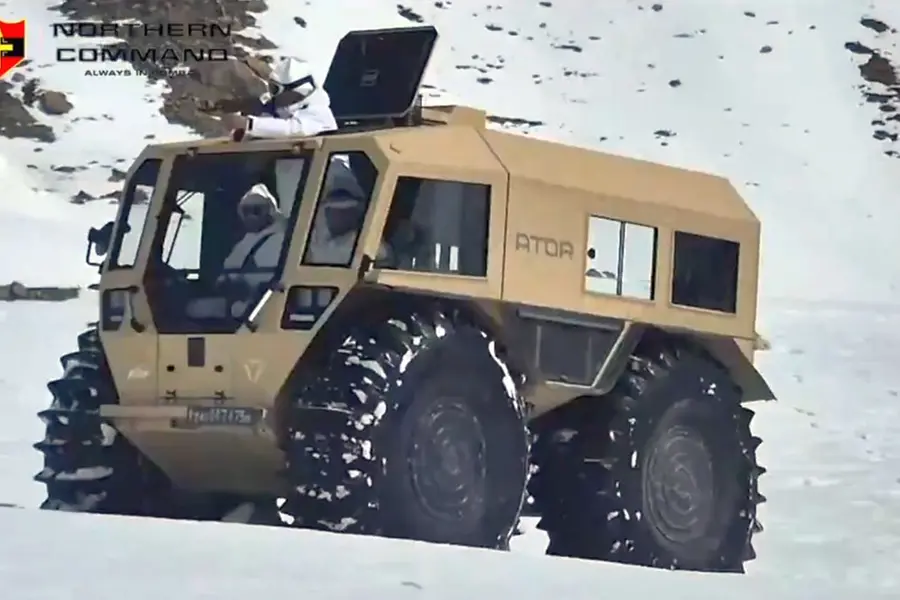
High up in the Karakoram mountains, more than 16,000 feet above sea level, lies the Siachen Glacier -- one of the harshest and coldest battle zones in the world. Temperatures here drop below minus 40°C, and soldiers brave avalanches, icy winds, and steep snow-covered paths. Since 1984's Operation Meghdoot, Indian troops have stood strong in this difficult region. Now, a new specialist mobility vehicle called Kapidhwaja -- likely the ATOR N1200 -- is giving our soldiers a much-needed boost. It's not just a machine; it is a symbol of India's strength and self-reliance.
Made by JSW Defence and Copato Ltd, Kapidhwaja is built for extremes. It is around 4 meters long, 2.6 meters wide, and nearly 3 meters high—most of its height coming from its massive 1.8-meter tyres. These tyres have special treads that grip snow, slush, and soft ground, and they even help the vehicle move across water like a small boat.
Also Read

Weighing 2,400 kg, it can carry 1,200 kg of goods such as food, fuel, medicines, and bullets—and still tow another 2,350 kg. It can also transport eight soldiers and a driver—keeping whole teams together and ready.
The real backbone of Kapidhwaja is its strong steel frame made from Docol high-strength steel, which can take up to 1,000 MPa of pressure. That means it bends instead of breaking—perfect for the glacier’s rocky and frozen paths. Its flat base lets it glide over bumps, and a special zinc coating keeps the metal from rusting, promising long service life in tough conditions.
It is powered by a 1.5-litre, 3-cylinder engine that gives 55 horsepower and 190 Nm torque -- just enough strength to keep going between minus 40°C and 40°C. It runs on a 6-speed manual gearbox, goes up to 40 km/h on land, and floats at 6 km/h in water.
Fuel is key in such remote places, and Kapidhwaja is built to last. It has a 95-litre main fuel tank and four extra 58-litre cans -- holding 232 litres in total. This gives it the stamina to travel long distances without needing to refuel often. With 600 mm of ground clearance, it can pass over rocks and snow easily. It even floats if it hits deep water. Unlike regular steering wheels, it uses two levers -- like in bulldozers -- for better control over snow and slippery paths.
In Siachen, even simple jobs like delivering food or medicines become life-threatening tasks. Helicopters can’t always fly due to weather, and that's where Kapidhwaja plays a key role. It moves through snow where other vehicles fail and could help carry injured soldiers when air evacuation is not possible. While such rescue stories aren’t always shared, its design makes it a reliable option for saving lives.
But what makes Kapidhwaja truly special is its Indian identity. It is built in Chandigarh under a ₹250 crore contract for 96 units as part of the Make in India drive. Earlier, we had to depend on foreign vehicles for such extreme conditions, but not anymore. Kapidhwaja shows that India can design and build machines that match global standards, reducing import dependence and boosting national pride.
Siachen is more than just a battlefield -- it is a symbol of India's determination. Secured in 1984, it remains key to our defence. Kapidhwaja does not just move men and material -- it could also help build communication infrastructure. As Reliance Jio and the Army push for 4G and 5G networks in Siachen, vehicles like Kapidhwaja might help carry equipment through the snow.
Of course, using this vehicle isn't without its problems. The extreme cold and moving ice can affect its performance. Soldiers need training to use the unique lever steering, and the Army will need more vehicles over time. But India has overcome such challenges before -- and with more units expected, the Army is serious about making Kapidhwaja a long-term part of operations.
Compared to other utility vehicles like the Polaris Ranger, Kapidhwaja clearly stands out. It can float, carry heavier loads, and handle snow better -- making it the perfect partner for Siachen's tough missions. As we mark over 40 years of our soldiers holding this icy ground, Kapidhwaja stands as a new symbol of that sacrifice. It's not just a vehicle -- it's India's resolve in motion, ensuring our heroes are never alone, even in the harshest corners of the world.
The author is a defence, aerospace & political analyst based in Bengaluru.
Published: 16 Apr 2025, 10:05 am IST
Related Topics
Disclaimer: Kindly avoid objectionable, derogatory, unlawful and lewd comments, while responding to reports. Such comments are punishable under cyber laws. Please keep away from personal attacks. The opinions expressed here are the personal opinions of readers and not that of Mathrubhumi.