
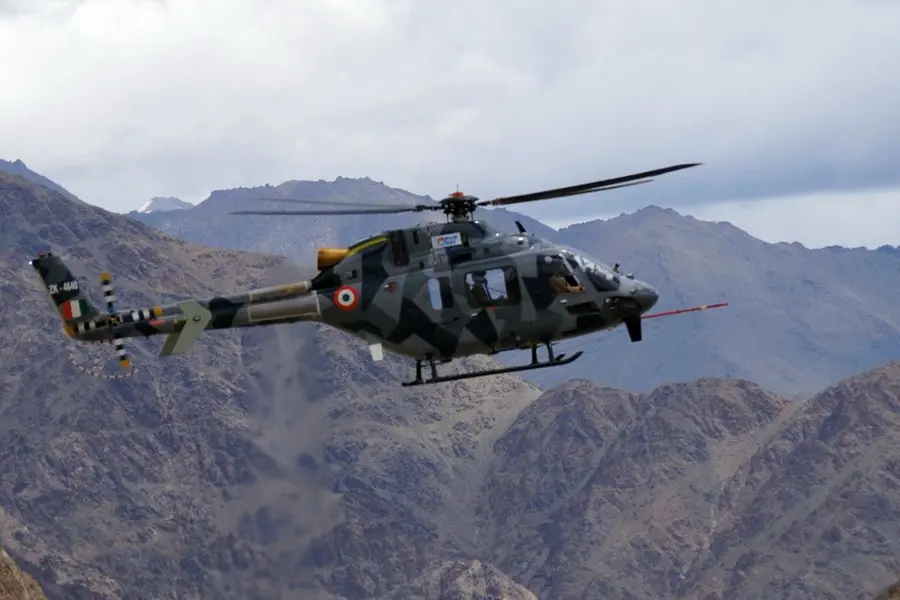
The Aero India 2025 show at Yelahanka provided a unique opportunity to experience the Light Utility Helicopter (LUH) firsthand. On February 11th, I had the privilege of flying the LUH LSP 003 with Wing Commander Anil Bhambhani, the project pilot, an experience that offered valuable insights into this promising helicopter.
The afternoon flight, scheduled for 1500 hours, took place under a scorching 32-degree Celsius temperature, resulting in a density altitude of 5500 ft. After a concise pre-flight briefing, Anil and I walked to the parked LUH. He conducted the external checks with practiced ease, explaining their simplicity. Once strapped into the cockpit, Anil provided a comprehensive overview of the controls and switches, familiarizing me with the glass cockpit display during both startup and flight. The display was intuitively arranged, ensuring easy access to crucial flight information. This particular helicopter was a basic version, yet to be fitted with AFCS, however it did have a cyclic trim facility and a spring-loaded switch for the collective. For ease of flying the cyclic trim had been bypassed. Later versions, I learned, have an autopilot system incorporated.
The startup procedure was straightforward. With clearance from the control tower, Anil smoothly lifted the helicopter into a hover taxi, heading towards the runway. The initial lift off was remarkably smooth, and the hover taxi proved comfortable, with only a slight twitch in yaw. At the runway, Anil handed over the controls to me for takeoff. The initial hover was easily maintained, and the take-off itself was uneventful. Out of habit from flying the Dhruv, I instinctively reached for the cyclic trim switch. Anil gently reminded me that this helicopter lacked that feature, advising me to rely on normal pressure to operate the cyclic. This adjustment made handling the helicopter significantly easier.
After establishing a climb, we levelled off at 800 ft AGL and headed towards Bangalore airfield. Maintaining a level flight at 110 knots required approximately 60% torque. The high atmospheric temperature and the numerous high-rise buildings along our flight path created significant turbulence. The rotors responded to the turbulent air with noticeable twitching.
At HAL Bangalore airfield, we performed several hover exercises, including spot turns, sideward flights, and a few circuits and landings. Initially, my spot turns were cautious, but Anil demonstrated quick turns to both the left and right, showcasing the helicopter's agility. The left sideward flight into the wind was particularly impressive. I was able to achieve speeds of 20-25 knots with 8-10 knots of crosswind, with ample right rudder authority remaining. Following another takeoff, we climbed back to 800 ft AGL and executed a few steep turns, reaching a 60-degree bank angle and approximately 2+ G. The rotor response was crisp, and the bank angle was easily controlled, indicating good rotor power. While the response was crisper than the Cheetah/Chetak, it wasn't quite as pronounced as in the Dhruv. The future addition of autopilot and auto-trim capabilities will undoubtedly ease out the pilot's workload. In this aircraft, however, considerable rudder work was required, particularly in level flight. The increased rudder activity is primarily due to continuous offloading of the tail rotor by the vertical fin.
We then joined the circuit at Yelahanka and landed back on the runway. Anil then performed a hover taxi back to the dispersal area.
Overall, it was a thoroughly enjoyable and informative flight. The LUH demonstrated its potential, offering a glimpse into the future of light utility helicopters. The flight highlighted the aircraft's agility and responsiveness, while also revealing areas for improvement, such as the integration of a full authority autopilot system. The experience left me with a strong appreciation for the LUH program and its contribution to the Indian aviation landscape.
A Veteran's Verdict: Flying the LUH
Aero India 2025 wasn't just about fighter jets and missiles. For me, the highlight was getting my hands on the Light Utility Helicopter (LUH) LSP 003 . It had been 16 years since I last piloted a helicopter. But thanks to the incredible team at HAL and the skill of Wg Cdr Anil Bhambhani, the LUH project pilot, I was back in the cockpit, experiencing the thrill of flight once more.
This wasn't just a joyride for an old-timer. The LUH is a game-changer, and here's why it matters to both civilians and the defense sector:
What makes the LUH special?
Imagine a helicopter that's nimble enough to navigate tight spaces, powerful enough to carry a decent load, and versatile enough for a range of tasks. That's the LUH in a nutshell. During my flight, I experienced firsthand its impressive manoeuvrability. We performed steep turns, sideward flights, and even quick spot turns – manoeuvres that would be challenging in older helicopters like the Cheetah/Chetak. The LUH's crisp rotor response and ample power make it a joy to fly.
Why civilians should care?
Think beyond the military applications. The LUH has immense potential for civilian roles:
* Disaster relief: Reaching remote areas during floods or earthquakes, delivering supplies, and evacuating casualties.
* Medical emergencies: Rapid air ambulance services, especially in congested urban environments.
* Law enforcement: Aerial surveillance, search and rescue operations, and quick response to incidents.
* Tourism: Scenic flights and access to remote tourist destinations.
* Aerial photography and surveying: Capturing high-quality images and data for various purposes.

Why the defense sector should be excited
The LUH is a force multiplier for the Indian military:
* Logistics support: Supplying troops in challenging terrains like the Himalayas.
* Casualty evacuation: Rapidly evacuating injured soldiers from the battlefield.
* Reconnaissance and surveillance: Gathering intelligence and monitoring borders.
* Counter-insurgency operations: Providing air support in challenging environments.
* Training: A modern platform for training future helicopter pilots.
LUH vs. H125: A quick comparison
The LUH (Light Utility Helicopter) and the Airbus H125 (formerly known as the AS350 Écureuil) are both light utility helicopters, but they have some key differences that make them suitable for different roles. Here's a comparison:
LUH
* Developed by: Hindustan Aeronautics Limited (HAL), India
* Engine: ARDIDEN 1U turboshaft engine
* Max Takeoff Weight: 3,150 kg
* Max Speed: 250 kmph
* Range: 550 km
* Payload: Higher than H125
* Cost: Likely lower than H125
* Strengths:
~ Higher payload capacity, allowing it to carry more cargo or passengers.
~ Designed for hot and high conditions, making it suitable for operations in challenging environments like the Himalayas.
~ Likely to be more affordable to acquire and operate.
~ Glass cockpit and modern avionics.
* Weaknesses:
~ Shorter range compared to the H125.
~ Lower top speed.
~ Relatively new design, so long-term operational data is still being gathered.
H125 (AS350 Écureuil)
* Developed by: Airbus Helicopters, France
* Engine: Safran Arriel 2D turboshaft engine
* Max Takeoff Weight: 2,250 kg (standard)
* Max Speed: 287 kmph
* Range: 630 km
* Payload: Lower than LUH
* Cost: Higher than LUH
* Strengths:
~ Longer range, making it suitable for missions that require covering larger distances.
~ Higher top speed.
~ Proven design with decades of operational experience.
~ Wide global support network.
* Weaknesses:
~ Lower payload capacity compared to the LUH.
~ Higher acquisition and operating costs.
The LUH often draws comparisons with the Airbus H125, a popular light utility helicopter.3 Here's a quick rundown:The LUH boasts a higher payload capacity and is likely to be more affordable. The H125 has a longer range and higher top speed. The best choice depends on the specific mission requirements.
I can't thank CTP (RW) Gp.Capt. Anand, Wg Cdr Bhambhani and the HAL team enough for this incredible opportunity. Their professionalism and dedication to the LUH program are truly commendable. To any pilot, young or old, I highly recommend experiencing the LUH. It's a testament to Indian aerospace engineering and a glimpse into the future of rotary-wing flight.
The author was former Chief Test Pilot (Executive Director) of Research and Development (RW) at Hindustan Aeronautics Limited (HAL). A Vir Chakra awardee, he has flown over 33 different types of aircraft and helicopters, and has over 9000 hours of accident free, operational, prototype testing and instructional flying experience.
Published: 07 Mar 2025, 03:39 pm IST
Related Topics
Disclaimer: Kindly avoid objectionable, derogatory, unlawful and lewd comments, while responding to reports. Such comments are punishable under cyber laws. Please keep away from personal attacks. The opinions expressed here are the personal opinions of readers and not that of Mathrubhumi.