
India and Pakistan are once again at the centre of military tensions after Operation Sindoor. This time, drones are playing a key role in attacks and counter-attacks. As per Indian military officials, Pakistan launched drone and missile attacks on 36 Indian military sites across Jammu, Punjab, Rajasthan, and Gujarat during the night of May 7–8, 2025.
India used its powerful air defence systems like the S-400 to stop these attacks. But there’s a buzz that Pakistan may have used Songar drones, made in Turkiye. Though it's unclear if these drones were used in all 36 attacks, they are being closely examined.
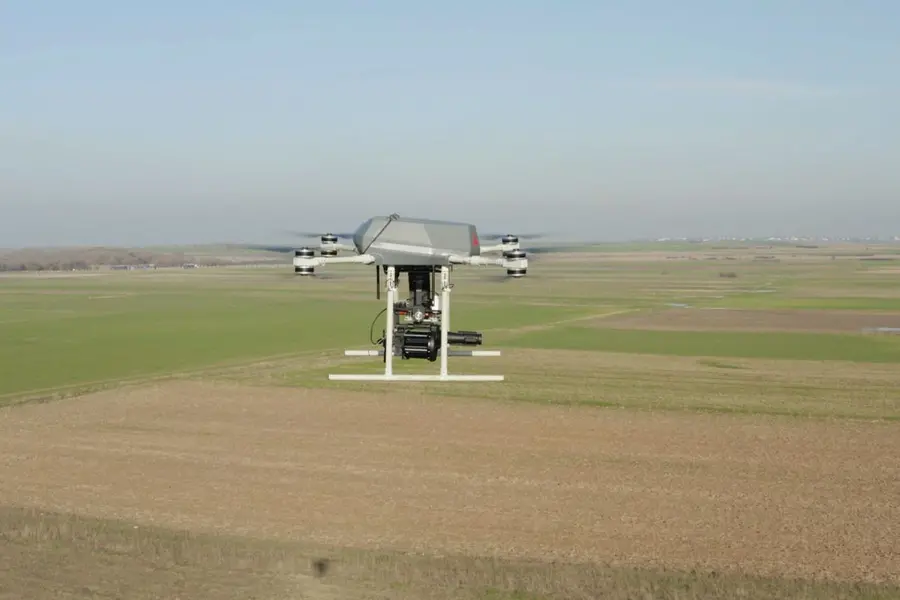
The Songar drone, made by Turkiye’s company Asisguard, is a lightweight but deadly machine. It has eight rotors and weighs about 25 kg. It is small (145 cm wide, 70 cm tall), so soldiers can easily carry or transport it. It can also be fitted onto 4x4 military vehicles, making it ideal for quick battlefield movement.
One of the biggest strengths of the Songar drone is its weapons. It comes with a 5.56x45 mm NATO-standard machine gun that holds 200 bullets. It can fire one bullet at a time or shoot in bursts of 15 bullets. The drone also has a special stabilisation system called OASIS and robotic arms, which help it shoot accurately. The makers say it can hit a small target just 15 cm wide from 200 metres away.
The Songar can also carry different kinds of weapons. These include:
* A 40 mm grenade launcher
* A Togan 81 mm mortar, which explodes with a blast radius of 35 metres
* A laser-guided mini-missile that can reach up to 2 km away
In 2024, a six-barrel 40 mm rotary grenade launcher was also added to the drone. This gave it much more firepower, making it even more dangerous in combat.
Pakistan may have picked the 36 Indian targets carefully -- airbases and control centres like Awantipura, Srinagar, Pathankot, Amritsar, Ludhiana, Bhuj, Jaisalmer -- spread across 1,800 km. These locations were probably selected to damage India's military command after India struck nine terror camps in Pakistan-occupied Kashmir earlier that same day.
Could Songar drones have been used in all 36 attacks?
Technically, it is tough. Each Songar drone can fly only about 10 km from its base and can stay in the air for only 30 minutes. This makes it good for border areas, but not great for wide coverage without many launch points. If Pakistan used these at all 36 sites, it would have needed a big setup of multiple control stations or mobile units.
The MEA confirmed that more than 50 drones were shot down. But they didn't say if all were Songars. Some could have been Chinese or Pakistani-made drones. Even though Songar is great for desert areas like Rajasthan or rugged regions like Jammu, it alone couldn't cover such a wide attack area.
How much does one Songar cost?
While there’s no official price, reports on social media suggest 400 drones cost about ₹80 crore, which is about $24,000 per unit. That’s cheap and powerful -- which makes it tempting for Pakistan to use in bulk.
India's air defence responded swiftly. From L-70 guns to Schilka systems (ZSU-23-4 "Shilka", a self-propelled anti-aircraft weapon system), they knocked down the drone swarm. Indian systems even jammed their GPS signals, which Songars rely on. India also reportedly used Harop drones to destroy Pakistan’s air defence near Lahore.
Pakistan's close ties with Turkiye make it likely they had access to Songar drones. But using only Songars across all 36 attacks is unlikely. Their limited range and flight time would have required a very complex plan.
The MEA didn't confirm what exact drones were used, but focused more on Pakistan’s aggression. That itself sends a message—India sees the threat of drone warfare rising and is preparing for it.
Using armed drones like Songar raises ethical concerns too. Countries like the US, UN, and even Turkiye’s own President Erdoğan have asked both nations to de-escalate. India, for its part, avoided hitting back at Pakistani military bases, showing restraint.
To sum up, the Songar drone, with its 10 km range, 30-minute flight time, and Rs 20 lakh price tag, could have been used by Pakistan -- but probably not at all 36 sites. India’s defence forces managed to stop the attacks, proving that technology and smart strategy can win over surprise drone strikes.
The drone war between India and Pakistan is only heating up.
Published: 09 May 2025, 08:17 pm IST
Related Topics
Disclaimer: Kindly avoid objectionable, derogatory, unlawful and lewd comments, while responding to reports. Such comments are punishable under cyber laws. Please keep away from personal attacks. The opinions expressed here are the personal opinions of readers and not that of Mathrubhumi.
