
Donald Trump’s recent claim that Pakistan, Russia, and China have secretly conducted nuclear tests has stirred global controversy.
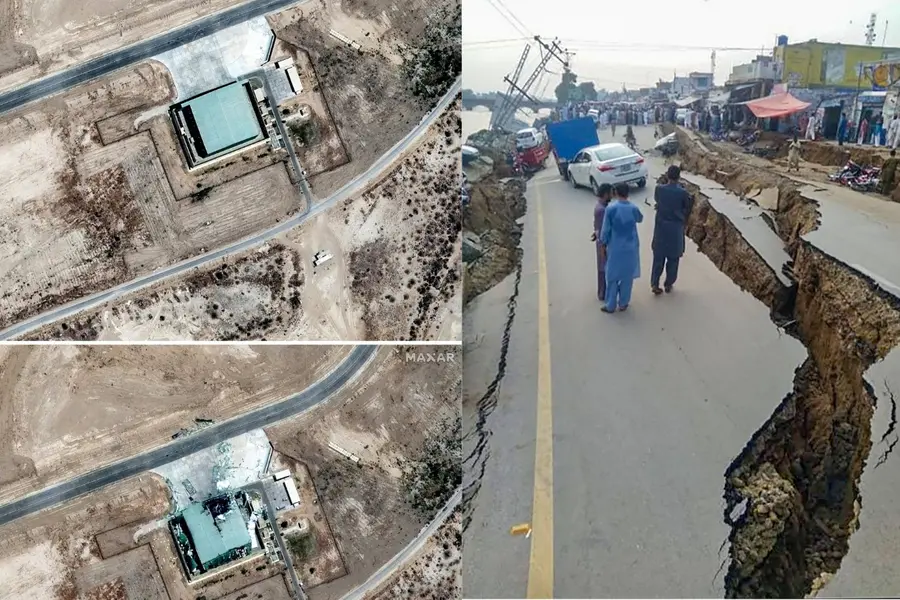
Donald Trump made a shocking statement on November 2 that has raised many eyebrows around the world. Speaking to CBS' 60 Minutes, the former US President claimed that Russia, China and Pakistan are secretly testing nuclear weapons.
He said this is the main reason why America is now planning to restart its own nuclear weapon tests after many years. Scott Bessent, who is Trump's White House Economic Adviser, was sitting next to him during this interview and he supported what Trump was saying. This claim has created a lot of noise in international circles, and many people are now asking — is this true, or is Trump making things up?
Trump's statement has brought back an old rumour that many people in India had heard earlier this year. Between April and May 2025, when tensions between India and Pakistan were running very high, there were whispers that Pakistan had secretly conducted nuclear weapon tests. The timing was suspicious because India and Pakistan had just gone through a serious military clash, and emotions on both sides were extremely heated. During that tense period, the Afghanistan-Pakistan region experienced four separate earthquakes between April 30 and May 12. These earthquakes measured between 4.0 and 4.7 on the Richter scale. What made people suspicious was that these readings were very similar to the seismic readings that were recorded during Pakistan's official nuclear tests back in 1998.
For those who don't remember, Pakistan openly became a nuclear weapons power in May 1998 when it conducted two rounds of nuclear tests called Chagai-1 and Chagai-2 on May 28 and May 30. Those tests were done at the Ras Koh hills in Baluchistan, and the world could see the seismic signatures clearly. The strength of those explosions registered on earthquake monitoring systems around the globe. So when similar seismic readings appeared in the same general region in 2025, some people naturally started wondering if Pakistan was testing nuclear weapons again, but this time secretly.
To understand why people get confused between earthquakes and nuclear tests, you need to know a little bit about how nuclear explosions work. When a nuclear bomb explodes, it releases an enormous amount of energy in a very short time. A 20-kiloton nuclear explosion, which is considered a medium-sized bomb, is equal to the explosive force of 20,000 tonnes of TNT. This massive release of energy creates powerful shock waves that travel through the ground. These shock waves are very similar to the seismic waves created by earthquakes. Both can be detected by earthquake sensors placed around the world. This is exactly why nuclear tests often look like earthquakes on monitoring equipment.
History has shown us that nuclear tests can easily be mistaken for natural earthquakes if a country does not announce what it has done. On October 9, 2006, North Korea conducted its first nuclear test. Initially, earthquake monitoring stations around the world detected seismic activity with a magnitude above 4 and thought it was just a regular earthquake. Only after North Korea announced several hours later that it had tested a nuclear weapon did the world realise that the hermit kingdom had become the ninth country to possess nuclear weapons. This incident proved that without proper verification and announcement, it is very difficult to tell the difference between an earthquake and an underground nuclear test just by looking at seismic data alone.
So what really happened in the Afghanistan-Pakistan region in 2025? India's National Centre for Seismology carefully studied all the data from those April-May tremors. After detailed analysis, they confirmed that these were normal tectonic earthquakes and not nuclear tests. This assessment was backed up by the United Nations' Comprehensive Nuclear Test Ban Treaty Organisation, which is usually called CTBTO. This organisation operates more than 300 monitoring stations spread across the entire globe. Their job is to detect any nuclear explosion anywhere on earth. After checking all their data from those days, the CTBTO found absolutely no signs of any nuclear test happening anywhere in the world during that period.
There was another important piece of evidence that proved these were not nuclear tests. Most of these earthquakes happened hundreds of kilometres away from Pakistan's only known nuclear test site at Ras Koh hills in Baluchistan. If Pakistan was really conducting nuclear tests, it would most likely use the same location where it had tested before, because that site is already prepared and monitored by Pakistan's own military. Testing at a completely different location would not make practical sense.
The Afghanistan-Pakistan region is politically very sensitive because India, Afghanistan and Pakistan have seen many border clashes and tensions in recent years. But this region is also geologically very sensitive. The reason is simple geography. This is the exact area where two massive tectonic plates meet each other. The Indian Plate, which carries India and Sri Lanka, is slowly pushing into the Eurasian Plate, which includes Russia, China and most of Europe. When these giant plates collide and grind against each other, they create enormous pressure. This pressure gets released from time to time in the form of earthquakes. This is why the Afghanistan-Pakistan region experiences frequent earthquakes throughout the year.
Just to show how active this region is, a 6.3 magnitude earthquake hit Mazar-i-Sharif in Afghanistan on November 3, killing seven people. Earlier on August 31, an even stronger 6.0 magnitude earthquake had killed more than 2,200 people in the same general area. These were devastating natural disasters that had nothing to do with nuclear weapons. They were caused purely by the movement of tectonic plates deep underground.
Now let's talk about Pakistan's nuclear weapons policy. Since 1998, when both India and Pakistan became open nuclear powers, Pakistan has used its nuclear arsenal as a protective shield. This shield allows Pakistan to continue using terrorism as part of its state strategy without fear of serious punishment from India. Whenever tensions rise and India threatens strong military action, Pakistan waves its nuclear weapons and warns the world that any conflict could go nuclear. This nuclear blackmail has worked for Pakistan for many years. But in May 2025, during the height of the India-Pakistan crisis, India made it very clear that it would not bow down to Pakistan's nuclear threats anymore. This was a major shift in India's policy and it openly challenged Pakistan's entire strategy of nuclear blackmail.
Pakistan's military leadership is definitely under heavy pressure from hardliners to conduct a nuclear test and show strength. But the reality is that Pakistan's economy is in terrible shape. The country desperately needs loans from the World Bank and the International Monetary Fund just to keep running. Pakistan also depends heavily on support from the United States and other Western countries. If Pakistan conducts a nuclear test without international permission, it will immediately face severe economic sanctions. These sanctions could completely destroy what is left of Pakistan's economy. This is why Pakistan's military leaders, despite all the pressure, are very unlikely to actually conduct a nuclear test right now.
However, the situation could change if things become truly desperate for Pakistan's military establishment. If they feel cornered or humiliated, they might take extreme steps without thinking about the economic consequences. Until that happens, every time an earthquake hits the Afghanistan-Pakistan region, rumours about secret nuclear tests will keep coming back. And every time, seismologists and international monitoring agencies will have to step in and prove that these rumours are false. This cycle will probably continue for years to come, because trust between India and Pakistan remains at rock bottom, and Trump's recent comments have only added fuel to the fire of suspicion.
Published: 05 Nov 2025, 02:55 pm IST
Disclaimer: Kindly avoid objectionable, derogatory, unlawful and lewd comments, while responding to reports. Such comments are punishable under cyber laws. Please keep away from personal attacks. The opinions expressed here are the personal opinions of readers and not that of Mathrubhumi.
