
The RVV-BD isn't just another missile purchase -- it's India's answer to a changing security environment, delivered at hypersonic speed.
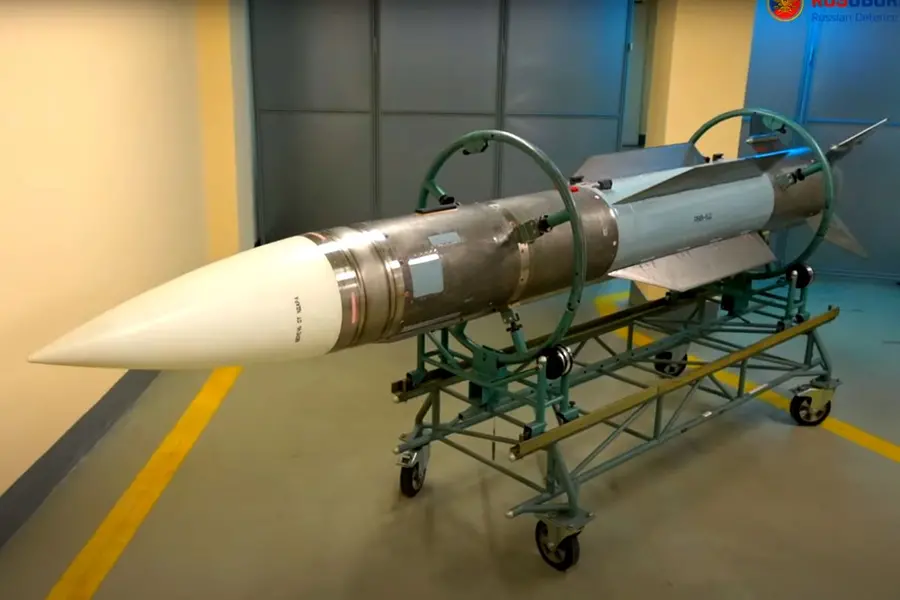
India is about to add a serious weapon to its air defense arsenal -- one that will make any enemy pilot think twice before entering Indian airspace. The RVV-BD missile, called 'AA-13 Axehead' by NATO, is a monster of a weapon that can reach targets up to 200 kilometres away, and even more when conditions are perfect.
This missile can hunt down not just fighter jets, but also big, valuable aircraft like Airborne Warning and Control Systems (AWACS) and refuelling tankers that usually stay far behind the battle lines.
According to reports by idrw.org, India is nearly ready to sign a landmark deal with Russia to buy the RVV-BD -- the export version of Russia's deadly R-37M air-to-air missile. This comes at a crucial time, with tensions along our borders showing no signs of cooling down.
What does RVV-BD actually mean?
RVV-BD stands for "Raketa Vozdukh-Vozdukh Bolyshoy Dalnosti," which in Russian means "air-to-air missile of very long range." And it lives up to that name completely.
Why India needs this right now
This missile is being designed specifically for the Indian Air Force's Su-30MKI fleet—our workhorse fighter jets that form the backbone of our air power. With this weapon, India will gain a massive advantage in beyond-visual-range (BVR) air combat where pilots fire missiles at enemies they can't even see yet. This will fill a critical gap in our capabilities until our own indigenous Astra Mk-II missile is fully ready for action.
The urgency became crystal clear after the May 2025 Operation Sindoor dogfights, which exposed a chink in India's armour vis-a-vis long-range air combat. Pakistan deployed China's PL-15 missiles, and our forces found themselves at a disadvantage in BVR combat. The RVV-BD will level that playing field and then some.
A Speed Demon That Doesn't Miss
This missile is frighteningly fast -- it flies faster than Mach 6, which means it's zooming through the sky at roughly 7,409 kilometres per hour. To put that in perspective, that's about six times the speed of sound. It races toward its target powered by a dual-thrust solid rocket motor, which means it uses two stages of thrust -- one massive burst to launch it off the rail, and another to keep it speeding toward the target without losing momentum.
What makes it truly dangerous is its active radar seeker -- essentially, it has its own radar system built in. Once fired, the missile thinks for itself. It can find and lock onto the target on its own, even if the enemy tries to jam its signals or confuse it with electronic warfare tricks.
Built to Kill
Weighing around 510 kilograms and stretching over 4 metres long, this missile is no lightweight, but it fits perfectly under the Su-30MKI fighter jet without slowing it down or making it less agile. Think of it like a shark with a massive set of teeth—it doesn't slow down just because it's carrying serious firepower.
The warhead carries 60 kilograms of high-explosive fragmentation material. When it explodes, it doesn't just blow up—it scatters thousands of razor-sharp metal fragments in all directions, shredding anything nearby. Wings, engines, fuel tanks -- nothing survives the blast.
Here's where it gets even more interesting: it uses a radioactive proximity fuse. Don't worry -- it's a tiny, safely sealed radioactive sensor that detects when the missile is extremely close to a target and automatically triggers the explosion. This dramatically increases the chances of a successful kill.
The combination of speed, smart guidance, and devastating warhead creates what experts call a "kill radius" -- the area where the explosion and flying metal fragments spread wide enough to damage or destroy an aircraft. Even if the missile doesn't score a direct hit, it can still cripple or bring down the target.
This gives the RVV-BD a success rate of 60 to 80 percent -- meaning 6 to 8 out of every 10 shots will destroy or disable an enemy fighter jet. In military terms, this has earned it the nickname "one-shot, one-kill" in air battles.
What This Means for India's Sukhois
The Indian Air Force operates 260 Su-30MKI jets, and equipping them with the RVV-BD will fundamentally change the air combat equation in South Asia. Pakistan's Air Force uses the Chinese PL-15E missile, and China's own forces deploy the PL-15. After Operation Sindoor exposed our BVR gap, getting this missile isn't just an upgrade -- it's a necessity.
Negotiations kicked off at Aero India 2025 and quickly moved through high-level diplomatic meetings. The deal isn't just about buying missiles off the shelf -- it includes technology transfer and local production under India's 'Make in India' initiative. The production will likely happen at Bharat Dynamics Limited (BDL), one of India's premier defense manufacturing companies.
While the government is keeping exact numbers confidential for strategic reasons, sources suggest the first batch could include 200 to 300 missiles. The estimated cost is approximately $1.5 billion, which translates to roughly ₹13,200 crore in Indian currency. Deliveries are expected to begin arriving by 2027, giving our Air Force a serious capability boost in just about two years.
Why Russia Remains India's Partner
This deal reinforces the strong defense relationship between India and Russia, which has remained steady despite Western sanctions over the Ukraine war. Russia continues to be one of India's most reliable defense partners, willing to share advanced technology and support local manufacturing -- something not every country offers.
The agreement also aligns perfectly with the Indian Air Force's ambitious target of acquiring more than 1,000 long-range BVR missiles by the end of this decade. That's a massive arsenal, and the RVV-BD will form a crucial part of it.
The Super Sukhoi Connection
India is already upgrading its Su-30MKI fleet into what's being called the "Super Sukhoi" -- a massively enhanced version with cutting-edge AESA radars that can track multiple targets simultaneously, and integration with weapons like the BrahMos supersonic cruise missile. Adding the RVV-BD to this upgraded platform will create a formidable fighting machine.
With the Super Sukhoi's advanced radar able to spot targets hundreds of kilometres away, and the RVV-BD able to strike at those distances, the combination will give India a long-range strike capability that will make any adversary think very carefully before crossing the Radcliffe Line (India-Pakistan border) or the LAC (Line of Actual Control with China).
New Era in South Asian Air Power
In the high-stakes aerial chess game playing out over South Asia, where every capability matters and where air superiority can decide the outcome of conflicts, this missile deal represents a major move. It's not just about having a longer-reaching weapon -- it's about sending a clear message to potential adversaries that India's Air Force can strike first, strike far, and strike with devastating accuracy.
For the common citizen, this means our Air Force will have the tools it needs to protect our skies and deter aggression. For military strategists, it means India is serious about maintaining air superiority in a region where tensions remain high. And for anyone watching from across the border, it means the cost of miscalculation just went up dramatically.
The RVV-BD isn't just another missile purchase -- it's India's answer to a changing security environment, delivered at hypersonic speed.
The author is a defence, aerospace & geopolitical analyst.
Published: 09 Oct 2025, 10:25 am IST
Related Topics
Disclaimer: Kindly avoid objectionable, derogatory, unlawful and lewd comments, while responding to reports. Such comments are punishable under cyber laws. Please keep away from personal attacks. The opinions expressed here are the personal opinions of readers and not that of Mathrubhumi.
