
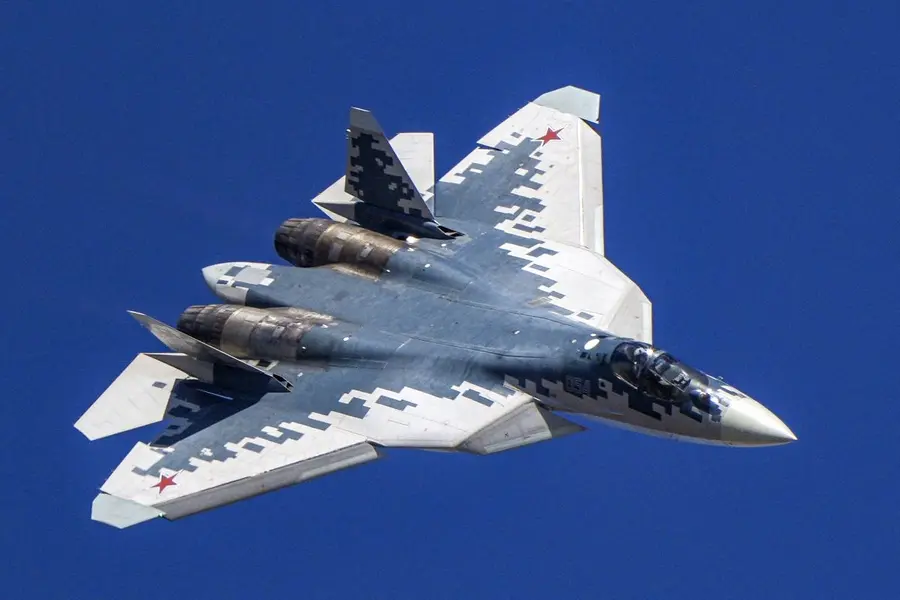
In a major move in the global race for advanced fighter jets, Russia has made a bold offer to India: the export of its Su-57E stealth fighter, along with complete access to its source code.
This offer, considered a game-changer by many experts, would allow India to fully customize the aircraft -- adding its own weapons and systems. Such deep access is rarely given and goes far beyond what countries like the US or France typically allow when they sell their own fighter jets.
Russia's proposal comes just as the United States is reportedly getting ready to offer India its own fifth-generation jet, the F-35A. The US hopes this deal will help India strengthen its air force and respond to China’s increasing use of stealth fighters in the region.
If accepted, Russia's offer could shift the balance of military power in Asia and give India a major edge in future air combat.
Indian defence sources say that the Su-57E fighter jet being offered to India will come with advanced technologies that match the upgrades planned for India's Su-30MKI jets under the Super-30 programme.
This includes a powerful radar using Gallium Nitride (GaN), which improves detection and tracking of enemy targets, and an advanced mission computer developed by Indian defence electronics companies. These upgrades aim to boost the jet's performance and make it easier to work with India's existing systems.
The Super-30 programme is a joint effort between Hindustan Aeronautics Limited (HAL) and Russia's United Aircraft Corporation (UAC). Its goal is to upgrade around 150 to 200 Su-30MKI fighter jets, turning them into highly advanced '4.5++ generation' aircraft.
These upgraded jets will get better electronic systems, improved radar, and stronger electronic warfare features, making them more powerful and capable in modern combat.
Combining the Super-30 systems with the Su-57E fighter jet marks an important change in India's defence strategy. It means India could smoothly use its own weapons -- like the Astra beyond-visual-range (BVR) missile and home-grown precision-guided munitions (PGMs) -- on one of Russia's most advanced fighter jets. This gives India more control and flexibility by allowing its own technology to work directly with top-level Russian aircraft.
This strategy supports India’s 'Atmanirbhar Bharat' (self-reliant India) mission by helping the country depend less on foreign weapon suppliers. At the same time, it allows India to stay ahead in military technology by using more of its own advanced systems and equipment.
The Su-57E fighter jet is expected to work with several Indian-made weapons. These include the Astra Mk1 and Mk2 missiles, which can hit enemy aircraft from far away, and the Rudram series of anti-radiation missiles, which are specially designed to locate and destroy enemy radar and communication systems. The jet will also be able to carry advanced air-to-ground precision strike weapons developed by DRDO for accurate targeting during combat.
Russia's offer to give India access to the Su-57E's software system directly responds to a major concern India had during the Rafale fighter jet deal with France. Despite India's repeated efforts through diplomatic channels, France refused to share the Rafale's source code.
In contrast, Russia's openness with the Su-57E is seen as a big step forward, giving India more control over how it uses and upgrades the aircraft.
A senior defence official said that France's refusal to share important software source codes is still a major concern for Indian defence planners. This is especially frustrating as India is trying to make its own weapons systems work smoothly on different fighter jets and platforms.
Dassault Aviation, the company that makes the Rafale fighter jet, has continued its policy of not sharing the main software code for important systems. These include the Thales RBE2 AESA radar and the Modular Mission Computer (MMC). The company says this is because of intellectual property rights and international rules on technology exports.
* AESA Radar (Active Electronically Scanned Array) is a modern radar system that can quickly track multiple targets and guide missiles with great accuracy. It works faster and is harder to jam than older radar types.
* Modular Mission Computer (MMC) is the brain of the fighter jet. It controls and manages many functions during a mission, such as navigation, radar data, and weapons systems. Without access to its core code, it's difficult for India to fully integrate its own weapons and systems into the Rafale.
This refusal to share the core software has made it very difficult for India to fully customise the Rafale jets according to its changing defence needs. It has also created problems when trying to fit Indian-made weapons -- like the Astra missile and the Smart Anti-Airfield Weapon (SAAW) -- onto the Rafale, even though India and France are working together in other areas.
India's Smart Anti-Airfield Weapon
Smart Anti-Airfield Weapon (SAAW) is an Indian-made precision-guided bomb developed by the Defence Research and Development Organisation (DRDO). It is designed to target and destroy enemy airfield assets -- like runways, aircraft shelters, fuel tanks, and radar stations -- from a safe distance.
Here is how it works
Range and Weight: It can strike targets from over 100 km away, meaning the aircraft launching it doesn't have to fly close to enemy territory. Its a 125Kg Class weapon
Accuracy: It uses advanced guidance systems like GPS and INS (Inertial Navigation System) to hit targets with high precision.
Purpose: The main aim is to disable enemy airbases without the need for direct bombing by manned aircraft, reducing the risk to pilots.
In short, SAAW allows India to neutralize enemy airfields from a distance with great accuracy -- making it a powerful and safe weapon for modern warfare.
A chance for India
India signed a deal in 2016 to buy 36 Rafale fighter jets from France for €7.8 billion (about Rs 70,000 crore). All the jets were delivered by December 2022. These aircraft have been deployed at Ambala Airbase to guard against threats from Pakistan, and at Hasimara Airbase to strengthen defences against China.
To strengthen its naval air power, India signed another agreement with France in April 2025 to buy 26 special Rafale fighter jets designed to operate from aircraft carriers. These jets are expected to be delivered between 2028 and 2030, and will help improve India’s defence at sea.
India's lack of access to the Rafale fighter jet's core software has once again raised concerns about the country’s strategic independence and control over its defence systems. This is especially important as India plans to add more homegrown technologies to foreign-made fighter jets in the future.
That's why Russia's offer of the Su-57E is being seen in New Delhi as more than just the sale of a fighter jet. It is viewed as a chance for India to gain greater technological control and freedom in defence decisions, especially in today’s world, where global powers are increasingly divided into two major blocks.
Su-57E, Russia's best stealth fighter jet
The Su-57E, which was first shown to the world at Aero India 2025, is the export version of Russia’s most advanced stealth fighter jet. It is a multirole aircraft, meaning it can perform different tasks like air-to-air combat and ground attacks.
The jet is designed to be hard to detect by radar (stealthy), highly agile in the air, and equipped for next-generation warfare, where it can easily share information and work closely with other aircraft and systems in a networked battlefield.
The Su-57E was developed by the Sukhoi Design Bureau under Russia’s United Aircraft Corporation (UAC). It is powered by two AL-41F1 jet engines that come with a special feature called 3D thrust vectoring.
3D thrust vectoring means the jet can change the direction of its engine thrust in multiple directions – not just up and down, but also side to side. This gives the pilot greater control, especially during sharp turns or sudden movements. It allows the jet to perform extreme flying maneuvers, even after it has stalled (lost lift), which is very useful during close-range air battles (dogfights) or when trying to dodge incoming missiles.
The Su-57E has several stealth features designed to make it harder to detect by enemy radar and heat sensors. These include:
* Radar-absorbing materials that reduce how much radar signal bounces off the jet
* Internal weapons bays that hide missiles and bombs inside the aircraft instead of carrying them outside
* A slanted (canted) shape of the aircraft that helps deflect radar waves
* Curved (serpentine) air intakes that block direct view of the engine fan blades, which are normally easy to detect by radar.
All these features work together to lower the jet's radar cross-section (how big it looks to radar) and its infrared signature (the heat it gives off), making it more difficult for enemies to spot or track it.
The Su-57E is equipped with the N036 Byelka AESA radar system, which has antennas facing forward and to the sides. This setup gives the fighter 360-degree situational awareness, meaning it can detect threats from all around the aircraft.
The system also has high-bandwidth data fusion, which means it can quickly gather and combine information from different sensors to give the pilot a clear and complete picture of the battlefield.
In addition, it includes strong ECCM (Electronic Counter-Countermeasures) features. This helps the radar continue working effectively even when the enemy tries to jam or interfere with it using electronic warfare.
The Su-57E can carry a wide range of powerful weapons. These include:
* R-77M and R-74M² air-to-air missiles: These are used to shoot down enemy aircraft. The R-77M is a long-range missile that can hit targets from far away, even beyond visual range. The R-74M² is a short-range missile designed for close combat, especially useful in dogfights.
* Kh-38 and Kh-59MK2 precision air-to-ground weapons: These are used to strike ground targets with high accuracy. The Kh-38 is a guided missile that can be used against tanks, bunkers, or other ground threats. The Kh-59MK2 is a stealthy cruise missile designed to hit targets from a long distance while flying low to avoid radar detection.
* Kh-47M² Kinzhal missile: This is a hypersonic missile, meaning it travels at more than five times the speed of sound. It's mainly used for strategic deep-strike missions, meaning it can hit important enemy targets located very far away. The Kinzhal is very hard to detect or stop due to its high speed and ability to change direction mid-flight.
In short, the Su-57E is built to carry a variety of modern missiles for both air and ground attacks, giving it a strong edge in different types of missions. The Su-57E comes with advanced electronic systems (called avionics) to help the pilot during missions. These include:
* A high-quality IRST (Infrared Search and Track) system, which can detect enemy aircraft by their heat signature without using radar, making it harder for enemies to know they’re being tracked.
* A full glass cockpit, meaning the control panels use modern digital screens instead of older analog dials. These wide displays give the pilot more information in a clear and easy-to-use format.
* An integrated electronic warfare (EW) system, which helps protect the jet by jamming enemy radars, detecting incoming threats, and working smoothly in modern, high-tech battlefields where air, land, sea, and cyber systems are all connected (called multi-domain, network-centric warfare).
Russia has offered the Su-57E to a few countries that have close military and strategic relations with it, such as Algeria, Vietnam, and Myanmar. However, no official export deals have been signed so far.
There is ongoing talk that both China and India are showing interest in some of the technologies used in the Su-57. However, experts believe India is more likely to become the first country to buy it. This is because India urgently needs a fifth-generation fighter jet to match China's increasing use of advanced jets like the J-20 and J-35.
The Super Sukhoi upgrade plan
India's current fleet of over 270 Su-30MKI jets forms the main strength of its Air Force. These aircraft are powerful multirole fighters that can carry a wide variety of weapons and fly long distances. They play a key role in defending India on both the western front (against Pakistan) and the eastern front (against China).
The Su-30MKI, built in partnership between HAL (India) and Sukhoi (Russia), is one of India’s most important fighter jets. It runs on AL-31FP engines that have thrust vectoring, allowing the jet to move quickly and turn sharply in the air, which helps in dogfights.
Right now, it uses a PESA radar (a type of radar that scans electronically), but this will soon be upgraded to a more modern AESA radar, which is faster and more accurate.
The jet also includes Israeli electronic warfare (EW) systems that protect it by detecting and blocking enemy radar and missile threats. It can carry and use a wide variety of weapons, both Indian-made and Russian, giving it great flexibility for different combat missions.
The Super Sukhoi upgrade plan aims to make the Su-30MKI even more advanced. Some of the major improvements include:
* A digital cockpit, which replaces older instruments with modern touch-screen displays, making it easier for pilots to get and use information.
* Faster and smarter data processing, so the jet can react quickly during combat by handling more information at once.
* The ability to use standoff weapons, like the BrahMos-A -- a supersonic cruise missile that can hit targets from far away without the jet getting too close to danger.
* It will also be able to carry powerful long-range air-to-air missiles, such as the R-77-1 and Astra Mk2, which are designed to destroy enemy aircraft from a great distance.
Girish Linganna is a defence, aerospace & geopolitical analyst.
Published: 04 Jun 2025, 02:33 pm IST
Related Topics
Disclaimer: Kindly avoid objectionable, derogatory, unlawful and lewd comments, while responding to reports. Such comments are punishable under cyber laws. Please keep away from personal attacks. The opinions expressed here are the personal opinions of readers and not that of Mathrubhumi.
