
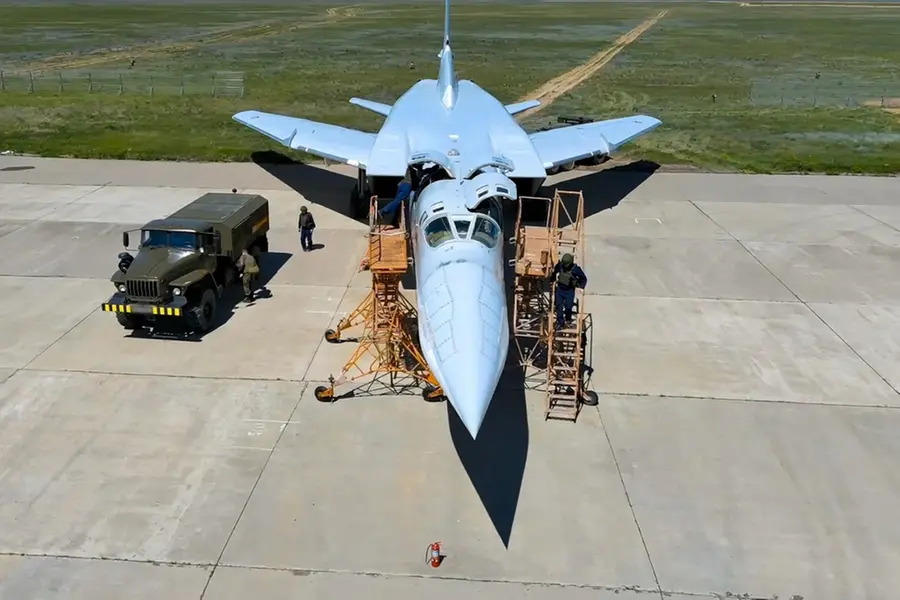
Russia's Federal Security Service (FSB) has announced that it stopped an effort by Ukrainian intelligence to persuade a Russian pilot to steal a Tu-22M3 supersonic bomber jet. Multiple media reports claimed citing the FSB on Monday (July 8) that Ukrainian special services had offered Italian citizenship and money to a Russian pilot if he would 'fly and land a missile carrier in Ukraine'. The FSB also accused NATO of being involved in the plan.
Russia’s Tu-22M3 jet, known as ‘Backfire-C’ by NATO, is a long-range supersonic bomber designed by Tupolev. It can use aerial bombs and guided missiles to target both sea and ground locations.
Also Read

Kyiv’s forces have reported that Russian troops often use the bomber jet to attack Ukraine during the ongoing war. This jet can carry Kh-22 cruise missiles, which are capable of carrying nuclear warheads.
The FSB also mentioned that, during the operation, it had got information which enabled Russia’s military to pick out and strike Ukraine’s northwestern Ozerne airfield. Newsweek stated that it could not verify the FSB’s claims and had contacted the Ukrainian authorities and NATO through e-mail for comment.
The Ploy to Steal a Bomber
The FSB released a video which apparently showed the Russian pilot with his face is hidden by a helmet. He said Ukrainian intelligence contacted him on the Telegram messaging app in an attempt to recruit him.
He added that someone he did not know had written on Telegram and started threatening his family, demanding that he set the aircraft on fire.
The pilot reported everything to his superiors. The person who contacted him did not mind disclosing that he was from the Ukrainian intelligence.
Introducing himself as Pavlo, the man offered the pilot money to fly to Ukraine a long-range bomber, which was no ordinary plane, but a bomber capable of carrying nuclear weapons.
Ukraine has often used drones to target Russian military bases, stating that these were legitimate military objectives in the war.
Last August, Russia had accused Ukraine of launching a drone attack on a military airfield in the Novgorod region, where Tu-22M3 bombers were reportedly stationed. A fire started in the aircraft parking area, but was quickly extinguished. One of the planes got damaged, but no one was hurt, according to the Russian Defence Ministry. Later, several pictures came up online showing that at least one Russian Tu-22M3 supersonic bomber had caught fire.
Tu-22M3 strategic bomber: Russia's pride
The Tu-22M3 is an upgraded version of the original Tu-22M series, created by the Tupolev Design Bureau. In terms of size, the Tu-22M3 is about 42.46 metres (139 feet) long, has a wingspan of 34.28 metres (112 feet) when the wings are fully extended and stands around 11.05 metres (36 feet) tall. Its wings can change shape, which helps it perform better at different speeds and heights.
The plane is powered by two NK-25 afterburning turbofan engines, each generating up to 55,115 pounds (25,000 kilograms) of thrust. This powerful engine setup allows the Tu-22M3 to reach speeds of up to Mach 1.88 (2,000 km/h or 1,243 mph) and gives it a combat range of about 7,000 kilometres (4,350 miles) without needing to refuel.
The Tu-22M3 comes with advanced technology for flying and navigation. It can carry a crew of four people -- a pilot, co-pilot, navigator and weapons systems officer. The plane can take off with a maximum weight of around 126,400 kilograms (278,900 pounds).
It is fitted with a radar that helps it fly close to the ground, electronic countermeasures (ECM) to protect against threats and a high-tech targeting system.
The Tu-22M3 is equipped with a range of weapons, making it suitable for various missions. Its arsenal includes Kh-22 (AS-4 ‘Kitchen’) and Kh-32 long-range anti-ship missiles, Kh-15 (AS-16 ‘Kickback’) short-range nuclear missiles and conventional bombs.
The bomber can carry up to 24,000 kilograms (52,910 pounds) of weapons in its internal bomb bay and on external hard points.
The Tu-22M3 has a wide range of operational capabilities, enabling it to carry out strategic bombing, maritime strikes and reconnaissance missions. It can operate in any weather day or night, and can penetrate heavily defended airspace. Its long range and high speed make it a powerful tool for projecting power and acting as a deterrent.
The author of this article is a Defence, Aerospace & Political Analyst based in Bengaluru.
Published: 09 Jul 2024, 11:48 am IST
Related Topics
Disclaimer: Kindly avoid objectionable, derogatory, unlawful and lewd comments, while responding to reports. Such comments are punishable under cyber laws. Please keep away from personal attacks. The opinions expressed here are the personal opinions of readers and not that of Mathrubhumi.