
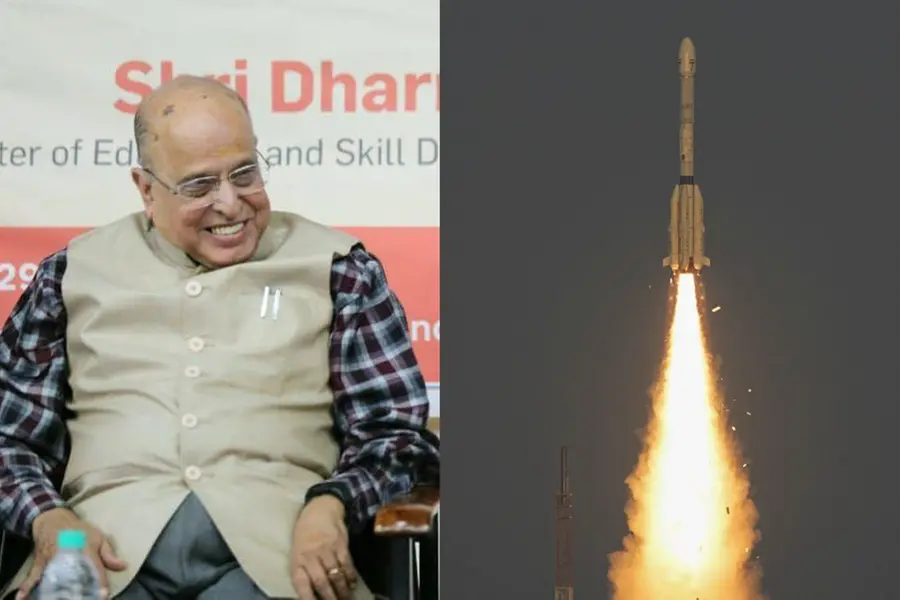
Today, India mourns the loss of Dr Krishnaswamy Kasturirangan -- a giant in the world of space science -- who passed away at the age of 84 in Bengaluru, Karnataka. For many, his name is synonymous with India's rise as a space power. From humble beginnings in Kerala to steering the Indian Space Research Organisation (ISRO) to global heights, his life is a story of grit, vision, and unparalleled contributions to our nation's dreams.
As we bid farewell to this Padma Vibhushan awardee, let’s reflect on his remarkable journey and the legacy he leaves behind.
Also Read

A boy from Ernakulam with big dreams
Dr Kasturirangan was born on October 24, 1940, in Ernakulam, in what was then the Kingdom of Cochin. Life was not easy for young Krishnaswamy. His mother, Visalakshi, passed away when he was a child, leaving him and his brother Ravi in the care of their maternal grandparents. His father, CM Krishnaswamy Iyer, a chemistry graduate, worked hard at Tata Airlines, later retiring as a senior officer at Indian Airlines. Education was a priority in the family, thanks to his grandfather, Chalakudy Manikam Iyer, who ensured his sons were well-educated.
At the age of 10, after his grandfather's sudden death, Kasturirangan moved to Bombay (now Mumbai) to live with his father. He studied at Sree Rama Varma High School in Ernakulam and later at South Indian Education Society High School in Matunga. His love for science bloomed early. He pursued a BSc (Honours) in Physics and an MSc in Physics from Bombay University, topping it off with a PhD in Experimental High Energy Astronomy from the Physical Research Laboratory in Ahmedabad in 1971, under the guidance of none other than Dr Vikram Sarabhai, the father of India's space program. This was the spark that set his path ablaze.
A stellar career at ISRO
Dr Kasturirangan joined the ISRO in 1971, at a time when India's space program was still in its infancy. Over the next three decades, he became the architect of some of ISRO's biggest triumphs. He served as ISRO's Chairman from 1994 to 2003, a golden era that saw India leap into the elite club of space-faring nations.
His contributions were game-changers. As director of the ISRO Satellite Centre, he oversaw the development of cutting-edge spacecraft like the Indian National Satellite (INSAT-2) and the Indian Remote Sensing Satellites (IRS-1A and 1B). These satellites weren't just machines; they were lifelines -- enabling communication, weather forecasting, and resource mapping for a developing nation.
He was also the Project Director for Bhaskara-I and II, India's first experimental earth observation satellites, laying the groundwork for future missions.
Under his leadership as ISRO chairman, India achieved milestones that made the world take notice. The Polar Satellite Launch Vehicle (PSLV) and the Geosynchronous Satellite Launch Vehicle (GSLV) became the backbone of India's space launches, proving we could send satellites into orbit with precision. He spearheaded the launch of advanced remote-sensing satellites like IRS-1C and 1D, which were among the best in the world for civilian use, and ocean observation satellites like IRS-P3 and P4, helping India monitor its vast coastline and resources.
Perhaps his most visionary contribution was setting the stage for India's planetary exploration. Dr Kasturirangan led the studies that defined Chandrayaan-1, India's first moon mission, launched in 2008. This mission put India on the global map, proving we could dream big and deliver. His foresight ensured India joined the handful of nations -- only six at the time -- with major space programs.
As an astrophysicist, he also championed research in high-energy X-ray and gamma-ray astronomy, contributing to studies of cosmic rays and their effects on Earth's atmosphere.
Beyond ISRO: A life of service
Dr Kasturirangan's impact was not limited to space. After ISRO, he served as a Rajya Sabha member (2003–2009), director of the National Institute of Advanced Studies, and chancellor of institutions like Jawaharlal Nehru University and the Central University of Rajasthan.
He chaired the committee that drafted the National Education Policy 2020, a transformative roadmap for India’s future. His work earned him the Padma Shri, Padma Bhushan, and Padma Vibhushan, alongside international honours like the Brock Medal and the Allan D Emil Memorial Award.
A personal touch
Despite his towering achievements, Dr Kasturirangan remained grounded. He married Lakshmi in 1969, and they had two sons, Rajesh and Sanjay. Tragically, Lakshmi passed away in 1991, a personal loss he bore with quiet strength. His life was a balance of scientific rigor and deep humanity, inspiring countless young Indians to reach for the stars.
Dr Kasturirangan's passing leaves a void, but his legacy is etched in the skies. Every satellite India launches, every mission to the moon or Mars, carries his vision. He showed us that a boy from Ernakulam could help India touch the stars. His work reminds us that isn't just about machines -- it's about uplifting a nation, connecting its people, and dreaming beyond the horizon.
Let's honour Dr Kasturirangan by nurturing the spirit of curiosity and innovation he embodied. India's space journey is far from over, and his contributions will guide us, like a constellation, for generations to come.
The author is a science writer based in Bengaluru.
Published: 25 Apr 2025, 03:37 pm IST
Related Topics
Disclaimer: Kindly avoid objectionable, derogatory, unlawful and lewd comments, while responding to reports. Such comments are punishable under cyber laws. Please keep away from personal attacks. The opinions expressed here are the personal opinions of readers and not that of Mathrubhumi.