

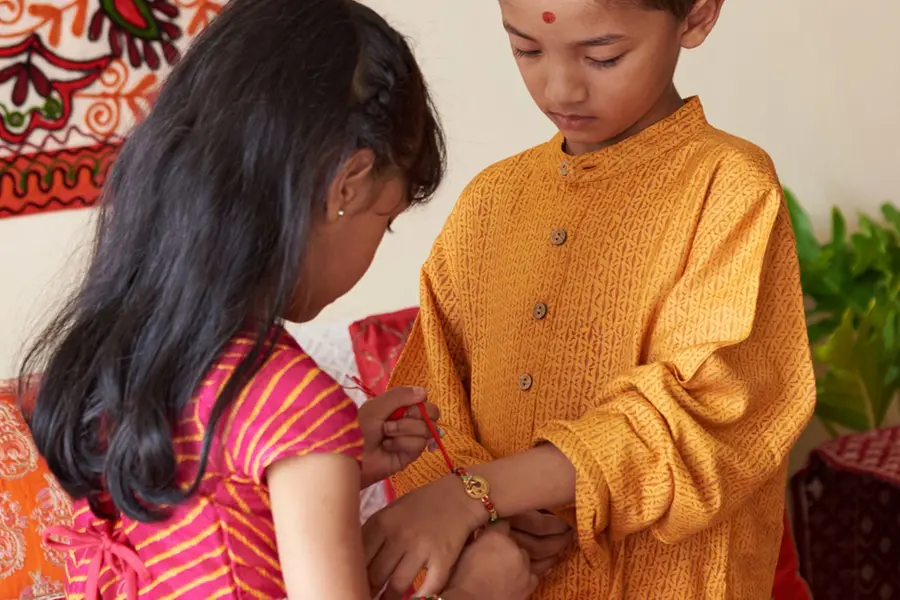
From childhood days when school kids would shy away from tying rakhi to their crushes, to now fully grasping the deep meaning behind Raksha Bandhan, this festival has evolved immensely. Originally celebrated with simple rituals, the festival's essence has expanded over time, becoming a symbol of not just sibling affection but a broader sense of safety and unity. However, there are still many who have no knowledge about the deep-rooted ancient Hindu mythology behind this festival.
Among the most renowned stories is the tale from the Mahabharata involving Lord Krishna and Draupadi. According to the tale, when Krishna injured his finger, Draupadi tore a piece of her saree to bandage his wound. In gratitude, Krishna vowed to protect her, a promise he upheld during the Vastraharan or disrobing incident, where he miraculously extended the saree in return for the cloth she tied to his wound. The saree shielded her from humiliation. This act of divine protection and promise is believed to be the core theme of the festival.
Another significant mythology is that of King Bali and Goddess Lakshmi. King Bali, a devoted follower of Lord Vishnu and asked him to stay with the latter to save his kingdom but Vishnu god's wife Lakshmi was upset by it as she missed her husband and wanted him to come back to Vaikuntha. Goddess Lakshmi in disguise went to King Bali's kingdom and requested to stay there, on Shravan Purnima she tied a rakhi on Bali's wrist, revealing her true identity and requesting him to release Vishnu. This gesture of trust and respect established the tradition of Raksha Bandhan as a symbol of goodwill and protection.
There are many more mythological stories surrounding this festival.
In the early 20th century, the much celebrated poet Rabindranath Tagore redefined Raksha Bandhan as a festival of unity among all communities in India. He pictured Raksha Bandhan not just as a bond between siblings but as a symbol of protection and solidarity across different backgrounds.
Today, Raksha Bandhan has adapted to modern lifestyles, reflecting changes in how people celebrate this festival.
Prashant Kumar Singh, a model and dancer, noted that, "the festival's essence remains, but our celebrations have shifted. Many of us now live far from home, so the festival has become more virtual, focusing on gifts rather than the personal touch we once cherished."
Similarly, MBA student Shalvi Kumari recalls, "I miss the joy of celebrating Raksha Bandhan with my brothers in person. With more online interactions now, the festival feels different, but it still holds a special place in our hearts."
Reflecting on societal concerns, Nishant Singh, an IT professional from Kolkata, expresses his mixed feelings: "Raksha Bandhan used to be a joyful occasion, but it now carries some worry. With my sisters living in different cities, I'm concerned about their safety. Despite the festival's focus on protection, societal issues like violence against women can overshadow the celebrations. If we just look into the case of the female doctor here in Kolkata, it was such a horrifying case. For me, my sister's safety matters, and them being in different states makes me concerned about their safety. Not just my sisters it's about sisters of the nation. The situation is very scary"
Despite these changes, Raksha Bandhan continues to be a significant day for strengthening bonds and celebrating relationships. It is not only observed between biological siblings but has expanded to include cousins, friends, and anyone who shares a deep sense of brotherhood, surpassing cultural and religious boundaries. The festival remains a powerful symbol of unity and care.
As Raksha Bandhan 2024 approaches, with the Purnima Tithi falling on August 19, starting at 3:04 am and ending at 11:55 pm, families across India will gather to celebrate the festival with traditional rituals.
Sisters will prepare thalis with rice, kumkum, sweets, and diya, and the exchange of rakhi will serve as a reminder of their mutual care and protection.
Published: 19 Aug 2024, 07:20 am IST
ABOUT THE AUTHOR
Related Topics
Disclaimer: Kindly avoid objectionable, derogatory, unlawful and lewd comments, while responding to reports. Such comments are punishable under cyber laws. Please keep away from personal attacks. The opinions expressed here are the personal opinions of readers and not that of Mathrubhumi.