

When Kerala elected its first Communist government in 1957, the historic victory attracted attention far beyond India. A declassified CIA briefing reveals how American intelligence assessed EMS Namboodiripad's narrow majority, his government's economic challenges and the possibility that successful Communist governance in Kerala could strengthen the Left across India
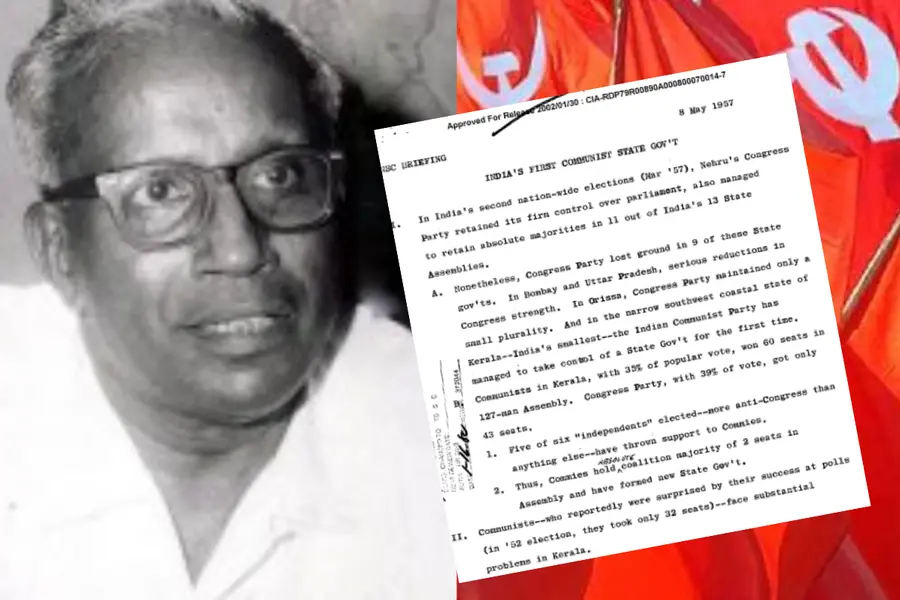
A declassified CIA briefing from May 1957 reveals how Washington viewed Kerala's first Communist government, its narrow majority, economic challenges and the possibility that its success could strengthen Communist movements across India.
Thiruvananthapuram: As Kerala prepares to celebrate its 70th formation day on November 1, a declassified Central Intelligence Agency (CIA) briefing offers a fascinating glimpse into how the United States viewed one of the state's earliest political milestones: the election of India's first Communist-led government in 1957.
Formed on November 1, 1956, following the reorganisation of Indian states along linguistic lines, Kerala went to the polls just months later. The election brought the Communist Party of India (CPI), led by E M S Namboodiripad, to power, marking a historic moment in India's parliamentary democracy and attracting the attention of American intelligence agencies during the Cold War.
A CIA briefing titled India's First Communist State Gov't, prepared in May 1957, examined the election results, the Communists' narrow legislative majority and the potential consequences of their administration's success.
A victory that surprised even the Communists
The CIA document noted that although Jawaharlal Nehru's Congress retained its dominance nationally in the 1957 general elections, Kerala emerged as a major exception.
The Communist Party secured 60 seats in the 126-member Kerala Assembly, while the Congress won 43 despite receiving a larger share of the popular vote.
The briefing recorded that the Communists received 35 per cent of the vote against the Congress's 39 per cent. Five of the six elected independents subsequently supported the Communist Party, allowing it to form a government backed by 65 legislators.
The document described this as a "coalition majority of 2 seats" and noted that the Communists "reportedly were surprised by their success at polls".
The narrow majority was particularly significant because the government depended on the continued support of independents.
On April 5, 1957, E M S Namboodiripad assumed office as Kerala's first Chief Minister, heading a Communist-led ministry that would become a subject of international political scrutiny.
Why Kerala's Communist government worried Washington
The CIA's assessment went beyond the immediate election results. Its central concern was whether the Communist government could demonstrate that a party advocating Communist ideology was capable of delivering effective administration through India's democratic system.
The briefing suggested that economic improvements in Kerala could have consequences across the country.
"Any local economic gains will have nation-wide appeal," the document observed.
It also warned that a moderate approach to governance could make the Communist Party more acceptable to voters elsewhere in India.
According to the assessment, such an approach could help present the party as a domestic political organisation pursuing a national programme rather than one closely associated with Moscow or Beijing, then commonly referred to as Peking.
The CIA identified Orissa, now Odisha, as another state where Communist influence could become politically significant.
It noted that the Communists held the balance of power between the Congress, with 56 seats, and the right-wing opposition, with 51 seats, in the 140-member Assembly.
Bombay State was also identified as an area where Communist influence could potentially expand. The concern was that success in Kerala could provide a political model capable of strengthening the Communist movement nationally.
Poverty, unemployment and an opportunity for the Left
The intelligence assessment also examined Kerala's economic and social conditions.
It described Kerala as one of India's poorest states, with a population of approximately 14 million, limited industrial development and an economy heavily dependent on agriculture and plantations.
Food shortages, unemployment and the lack of natural resources were among the challenges identified.
However, the document also highlighted the state's relatively high literacy rate.
According to the briefing, Kerala had a literacy rate of approximately 45 per cent, compared with the national average of 28 per cent. It estimated that educational institutions produced around 23,000 high-school graduates and 10,000 college graduates annually.
These figures reflected the CIA's contemporary assessment and the statistical information available at the time.
The agency believed the Communist government faced considerable difficulties but also had opportunities to build public support by addressing long-standing economic grievances.
'Moderation' as a political strategy
One of the most striking observations in the declassified document concerned the new government's approach to administration. The CIA noted that the Communists appeared determined to avoid confrontation and operate within India's constitutional framework.
"Moderation" was described as the government's announced watchword.
The briefing listed several early measures taken by the administration, including reductions in ministerial salaries. The document also referred to the government's initial interest in nationalising foreign-owned plantations.
The CIA interpreted these developments as evidence that the government was attempting to balance its ideological objectives with political and constitutional realities.
At the same time, it identified land reform as a significant long-term objective of the Communist administration.
Could the Congress government remove the Communists?
The briefing also examined how the Congress-led Central government might respond to the Communist victory. It anticipated that New Delhi would strongly oppose the Communists politically while avoiding overt harassment.
The document suggested that the Centre could exploit any failure by the Kerala government to improve economic conditions. However, it also acknowledged constitutional limits on the Central government's ability to remove an elected state administration.
The CIA assessment stated that the Central government could not force the Communists out of office unless a breakdown of "law and order" occurred. It also considered the possibility of opposition parties joining forces to defeat the ministry through a no-confidence motion.
However, the agency regarded such an outcome as unlikely in the immediate future because the opposition parties were divided. The briefing consequently assessed that the Communists were likely to remain in office for at least a year.
The government's actual tenure extended beyond that prediction. The EMS ministry remained in office until July 31, 1959, when it was dismissed, and President's Rule was imposed amid the political agitation known as the Vimochana Samaram, or Liberation Struggle.
Published: 01 Nov 2026, 07:00 am IST


ABOUT THE AUTHOR
Related Topics
Disclaimer: Kindly avoid objectionable, derogatory, unlawful and lewd comments, while responding to reports. Such comments are punishable under cyber laws. Please keep away from personal attacks. The opinions expressed here are the personal opinions of readers and not that of Mathrubhumi.