
America dominates Iran's skies but at a cost: over 1,000 JASSM-ER stealth missiles fired in four weeks, leaving just 425 usable from a 2,300 stockpile. As premium weapons dwindle, B-52s switch to basic JDAMs -- exposing vulnerabilities in a war draining arsenals meant for China.
The United States is fighting a war against Iran, and on the surface it claims to be winning. Powerful bombers fly over Iranian skies. Missiles rain down on targets. US President Donald Trump speaks with great confidence. But behind this show of strength, something alarming is happening quietly -- America is running dangerously low on its most powerful missiles. And this secret is now out.
Let us understand this step by step, like a story.
The JASSM-ER missile saga
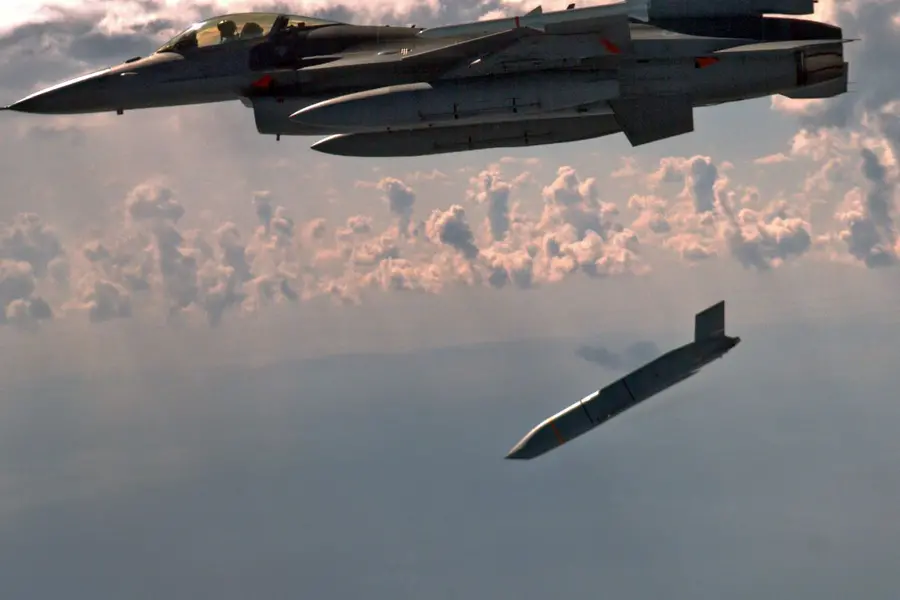
Think of the JASSM-ER as America's most trusted long-distance arrow. Its full name is the Joint Air-to-Surface Standoff Missile -- Extended Range. Developed by Lockheed Martin, one of America's biggest weapons companies, this missile can fly over 965 kilometres -- roughly the distance from Mumbai to Hyderabad and back -- without the aircraft carrying it going anywhere near danger.
It is stealthy, meaning enemy radars find it very hard to detect. It carries a massive 450-kilogram warhead that can punch through heavily protected targets and blow them up. It costs around $1.5 million per missile -- that is roughly Rs 12 crore for a single missile.
America started this war on February 28 with about 2,300 of these missiles in stock. In just the first four weeks of fighting, America used more than 1,000 JASSM-ER missiles. Read that again. One thousand missiles. In four weeks.
Also Read | Middle East War: When brinkmanship becomes policy
After all the firing, and after shifting remaining missiles from Pacific stockpiles and other locations, America will be left with only around 425 usable JASSM-ER missiles. Out of 2,300. That is barely enough to arm 17 large B-1B bombers for a single mission. On top of that, 75 more missiles are damaged or have technical faults and simply cannot be used.
A person directly familiar with the matter -- who did not reveal their name because this information is highly sensitive -- confirmed this to media persons. And the picture does not stop there. When you add the shorter-range JASSM missiles, which fly about 400 kilometres, America has already used nearly two-thirds of its total missile stockpile in this one war alone.
Two-thirds. Gone. In weeks.
Why is this a problem beyond Iran?
Here is where it gets truly serious. These missiles were not just meant for Iran. They were sitting in stockpiles originally designed for a possible conflict with China -- particularly over Taiwan.
By pulling missiles from the Pacific region and sending them to the Middle East, America is quietly weakening its position in Asia. Military experts are asking a very uncomfortable question -- if China makes a move on Taiwan now, does America have enough firepower left to respond?
Replacing these missiles is not quick. At current production speed, Lockheed Martin plans to make only 396 JASSM missiles in 2026. Even if the factory runs at full capacity, it can produce about 860 per year. That same production line also makes another important missile called the LRASM -- Long Range Anti-Ship Missile. Restoring what has already been spent could take many, many years.
War is getting costlier... in every way
Meanwhile, the war itself is becoming more dangerous and expensive. On April 3 -- a Friday -- a US F-15E fighter jet, one of America's finest warplanes, was shot down over Iran. Shortly after, an A-10 attack aircraft was also downed. Two rescue helicopters were hit by Iranian fire. The US and Israel had claimed they had destroyed most of Iran's air defence systems. But clearly, Iran still has teeth.
Iran has also destroyed more than 12 MQ-9 strike drones -- unmanned aircraft that America uses for precision strikes -- during this war. And Iran is fighting back hard with its own weapons.
According to Gulf countries, Iran has launched more than 1,600 ballistic missiles across the region, plus around 4,000 basic Shahed-type cruise missiles. To defend against those ballistic missiles alone, at least 3,200 interceptor missiles would be needed.
America's Patriot PAC-3 interceptor missiles -- the missiles used to shoot down incoming threats -- are also being consumed rapidly. Lockheed Martin currently makes about 650 of those per year. They have signed a deal to increase production to 2,000 per year by 2030. But that is years away. Right now, the shelves are getting thinner.
Switching to cheaper bombs
Here is a telling moment. US Joint Chiefs Chairman General Dan Caine announced on March 31 that America has started flying its older B-52 bombers directly over Iran. The B-52 is a massive, slow aircraft. You would only fly it over enemy territory if you were fairly confident the skies are safe. Flying B-52s allows America to drop cheaper, widely available JDAM precision bombs instead of expensive JASSM-ER missiles.
JDAM stands for Joint Direct Attack Munition. In simple words, it is a kit that turns a regular, old-fashioned bomb into a smart, GPS-guided weapon. These are far cheaper and available in large quantities. So America is switching from its expensive premium arrows to more basic but reliable ones -- because the premium stock is running out.
Military analyst Kelly Grieco from the Stimson Center pointed out that the fact B-52s are only now flying over Iran raises questions about how much America is still depending on long-distance strike methods.
Trump's chilling words and what comes next
On the night of April 1, President Trump gave a speech. He said, "In the next two to three weeks, we will push them back to the stone age." Strong, dramatic words. But he did not clarify whether he meant Iran's military, its government, or its civilians. That ambiguity is deeply disturbing for the world.
There is also growing speculation that the US may try to capture Kharg Island -- Iran's main oil export hub. As US ground forces, including Marines and paratroopers move into the region, the conflict is clearly escalating beyond just airstrikes.
Also Read | The Kharg Island trap: Why Trump's plan to seize Iran's oil hub could backfire
America has also used hundreds of Tomahawk cruise missiles -- another powerful long-range weapon -- in its Iran attacks. Before the war, America had about 4,000 Tomahawks in stock. In 2025, only around 100 new ones were produced, while 240 older versions were upgraded.
What does this mean for the world -- and India?
For ordinary people, here is the simple truth. Wars burn through weapons the way fires burn through wood.
America is the world's most powerful military — but even its supplies have limits. As missile stockpiles shrink, the pressure to either escalate dramatically or find a diplomatic exit grows stronger every day.
India watches all of this very carefully. Iran is an important oil supplier. The Strait of Hormuz -- through which massive amounts of the world's oil travel -- is right in the middle of this conflict.
Every missile fired, every drone downed, every escalation brings the world's oil supply closer to serious disruption.
What happens in those desert skies does not stay there. It comes home -- in petrol prices, in inflation, in economic uncertainty.
America may own the skies over Iran today. But the missile clock is ticking.
The author is an science communicator and a defence, aerospace & geopolitical analyst.
Published: 05 Apr 2026, 12:54 pm IST
Related Topics
Disclaimer: Kindly avoid objectionable, derogatory, unlawful and lewd comments, while responding to reports. Such comments are punishable under cyber laws. Please keep away from personal attacks. The opinions expressed here are the personal opinions of readers and not that of Mathrubhumi.
