
What happens to an aircraft when its flying days are over?
Have you ever wondered what happens to an aircraft once its life in the sky comes to an end? Does it simply disappear into a scrapyard, its wings and fuselage reduced to pieces of metal? Or can an aircraft that has carried thousands of passengers across countries and continents somehow continue to live on?
For one very special Boeing 757, the answer is surprisingly beautiful.
You can now carry a little piece of it in your pocket.
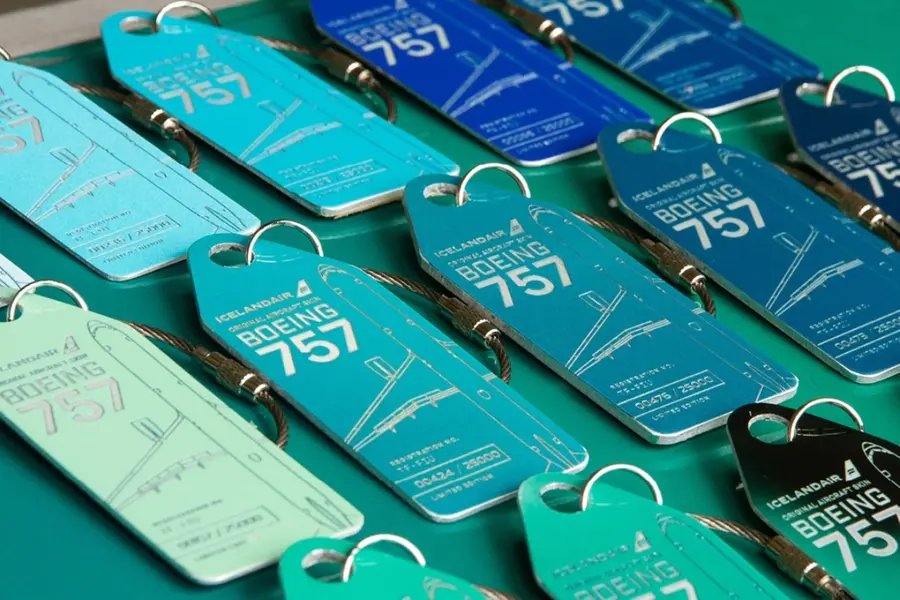
Icelandair’s TF-FIU, better known as “Hekla Aurora”, was once one of the most recognisable aircraft in the airline’s fleet. Its distinctive fuselage was painted to resemble the Northern Lights dancing above an Icelandic landscape. Now, even though the aircraft has stopped flying, pieces of that extraordinary livery are beginning a new journey as limited-edition Aviationtags.
The aircraft behind the Northern Lights
The story of Hekla Aurora began long before it became an aviation celebrity. The Boeing 757 took its first flight in April 1994. It initially flew with Iberia and later spent some time with Air Europa before joining the Icelandair Group in 2004.
But it was in 2014 that the aircraft received the transformation that would make it unforgettable.
A team of specialist artists in Norwich, England, set about recreating the magic of Iceland's Northern Lights across the aircraft's fuselage. Working from photographic references, they painstakingly airbrushed sweeping shades of green, turquoise and blue across the aircraft, with a dark Icelandic winter landscape beneath.
It was not just an aircraft wearing a special paint scheme. The idea was to bring the feeling of the aurora borealis to life. Inside the cabin, a custom LED lighting system added another touch of magic, allowing passengers to experience something of the Northern Lights even while flying thousands of feet above the ground.
The aircraft was officially introduced by Icelandair in February 2015 on a flight from London to Reykjavík. And Hekla Aurora quickly became much more than another aircraft in the fleet.
A name with a story
Even its name carried a piece of Iceland.
“Hekla” is both a traditional Icelandic girl's name and the name of one of Iceland's well-known volcanoes. “Aurora”, of course, refers to the aurora borealis, the iconic Northern Lights that have fascinated travellers and dreamers for generations. The name seemed almost made for an aircraft that was designed to carry the Icelandic landscape into the skies.
For years, Hekla Aurora flew between Europe, Iceland and North America, becoming a favourite among aviation enthusiasts and passengers alike. But an aircraft's life is measured not only in routes and flight hours. Sometimes, the memories made along the way become part of its story too.
From the Atlantic to an unexpected journey
Hekla Aurora's flying career even included a few unusual assignments. In October 2023, the Boeing 757 was called upon to bring 126 Icelandic citizens home from the Middle East via Jordan.
Only days later, the aircraft found itself flying a very different kind of route, stepping in for an unavailable regional aircraft on the short domestic journey between Reykjavík and Akureyri. For an aircraft more accustomed to crossing the Atlantic, it was certainly an unusual change of scenery.
But perhaps that is what makes the story of an aircraft so fascinating. Behind every registration number is a collection of journeys, passengers, places and moments that can never quite be repeated.
The final flight
On October 12, 2025, Hekla Aurora made its final journey. Icelandair marked the retirement of the aircraft with a scenic farewell flight over Iceland. Around 140 passengers joined the special occasion, with some travelling from abroad specifically to be part of the aircraft's final flight.
There was something fitting about the way it ended.
After spending years carrying the image of the Northern Lights across the skies, Hekla Aurora got one last chance to fly over the country whose natural beauty had inspired its identity. The Boeing 757 was subsequently transferred to Lleida, Spain. For many aircraft, that might have been the quiet end of the story. For Hekla Aurora, it wasn't.
A second life begins
In July 2026, the Aviationtag team travelled to Lleida and found the retired aircraft waiting there. In temperatures exceeding 40 degrees Celsius, the Cologne-based team carefully removed sections of the original aircraft skin, and there was something remarkable about what they found. The Northern Lights livery was still there.
The colours that had once moved across the fuselage while the aircraft crossed the skies were now preserved on pieces of its skin. Instead of allowing those fragments of the aircraft's story to disappear, Aviationtag decided to give them another life.
The recovered material was taken to the company's workshop in Cologne, Germany, where it is being handcrafted into limited-edition Aviationtags. Each piece is different.
Depending on where it came from on the fuselage, one tag might carry a flash of green, another a deep blue, while another could contain a section of the Icelandic landscape that once travelled around the world. In other words, no two pieces tell exactly the same visual story.
A little piece of the sky
There is something wonderfully poetic about the transformation. Once, the material formed part of an aircraft that carried people across the North Atlantic. Today, a small piece of that same material can sit in someone's hand, on a desk, or perhaps in a pocket.
It is no longer flying, but it is still travelling, this time through the people who choose to carry a piece of its history with them.
“An aircraft like Hekla Aurora doesn’t come along every day. Its livery, its history, and the connection people feel to it are simply extraordinary. We knew we wanted to make sure a piece of it would live on,” says Tobias Richter, Co-founder of Aviationtag, and perhaps that is the real charm of the idea.
An aircraft does not necessarily have to remain in the sky to remain part of aviation.
When retirement becomes a new beginning
The story of Hekla Aurora also offers a gentle reminder that an aircraft's life does not necessarily have a single ending. Retired aircraft can be dismantled, their components and materials recovered, recycled or repurposed. In this case, part of an aircraft's physical identity has been preserved in a completely different form.
Aviationtag began with a simple but unusual idea. Founded in 2016 by Stephan Boltz, the company developed a concept of turning original materials from retired aircraft into limited-edition collectables. Over the years, it has worked with airlines and aviation partners and recovered material from more than 150 aircraft.
Each piece carries something more valuable than its material alone: a connection to an aircraft that once flew, and Hekla Aurora may be one of the more magical examples. The Boeing 757 that once carried the Northern Lights across Europe and North America may have made its final flight. But pieces of its green and blue sky are still travelling.
Only now, you don't need a boarding pass to take the journey, as you can simply carry a piece of the aircraft with you.
Published: 17 Sept 2026, 08:14 pm IST
ABOUT THE AUTHOR

Related Topics
Disclaimer: Kindly avoid objectionable, derogatory, unlawful and lewd comments, while responding to reports. Such comments are punishable under cyber laws. Please keep away from personal attacks. The opinions expressed here are the personal opinions of readers and not that of Mathrubhumi.