
How did Serbia's students stand up to alleged electoral manipulation, media propaganda, surveillance and intimidation? In an exclusive interview, CRTA election watchdog's Raša Nedeljkov reveals how solidarity helped the student movement resist pressure, overcome political divisions and challenge an entrenched establishment.
What does it take to defeat a political establishment accused of manipulating elections, controlling much of the mainstream media and using state institutions to intimidate its critics? In Serbia, a student-led movement has offered an extraordinary answer: solidarity, persistence and a refusal to compromise on democratic principles.
The Students' Movement, which brought together people from across ideological and political divides, emerged as a formidable challenge to Serbia's ruling establishment. Its electoral success followed a prolonged struggle marked by mass demonstrations, accusations of foreign interference, alleged surveillance of activists and attempts to discredit protesters through pro-government media.
At the centre of this struggle was a generation of young Serbians who refused to abandon their demands despite intimidation and pressure. Their movement, according to election observers, demonstrated how collective action could overcome deep political divisions and challenge an entrenched system.
For India, where concerns about electoral transparency, the independence of institutions and the treatment of protesting students have become subjects of intense political debate, Serbia's experience raises important questions about the resilience of democracy.
In an exclusive interview with Mathrubhumi's Carl Lafrenais, Raša Nedeljkov, head of the Election Observation Mission at CRTA, Serbia's independent election watchdog, discusses the methods allegedly used to manipulate elections, the role of media propaganda, threats faced by public-sector employees and the extraordinary determination of Serbia's student movement.
Nedeljkov also explains how students overcame attempts to portray them as foreign agents, why solidarity became their strongest weapon and what young Indians fighting for democratic accountability can learn from Serbia.
Edited excerpts from the interview follow.
What happens when a ruling party controls much of the media, uses state institutions to its advantage and is accused of manipulating elections? In Serbia, they have just lost an election to the Students' Movement, to the Student List. How did they do it?
First of all, thank you very much for taking an interest in a small country like Serbia and in this great success of the Serbian people. I would say it was a dedicated effort by thousands of people who stood together in solidarity in the fight for core, basic values. They did not give up when things became difficult. The Students' Movement succeeded in connecting various sections of our society beyond ideological beliefs. Within the Students' Movement, there were people, and there still are people, who stand on completely opposite sides of specific issues and problems, with different opinions on how those problems should be solved. However, they found common ground on the basic issues that needed to be resolved first, before we could enter a stage where other problems could be addressed. All the differences between various groups were put aside to solve the biggest problem. And the biggest challenge in liberating our society was ousting the authoritarian regime.
India is facing similar allegations of voter manipulation. When the institutions responsible for protecting fair elections fail to act against the ruling party, what options are left for ordinary citizens? How serious was voter manipulation in Serbia? Could you give us examples of how it was happening?
There are three main areas of manipulation in Serbia. The first is the engineering of the conditions under which elections are held. For example, the timeline. Only one person, the president of Serbia at that time, influenced when we would have elections, at which level they would be held and under which rules. Would they be parliamentary elections, presidential elections or local elections? Because he had a majority in parliament, he could adopt laws that he thought would serve his advantage while refusing to adopt recommendations intended to create a level playing field. Then there is the question of who has the right to vote. In a democratic society, that should be determined by law, right? If you are an adult, if you have citizenship and if you meet the legal requirements to represent yourself, you should be included in the voter register. Well, that was not the case in Serbia. The voter register was manipulated by the ruling political party, determining who was included and who was not. The third issue concerns the diaspora. I suppose India also has a large diaspora throughout the world, right? Serbian citizens are allowed to vote from abroad, at our embassies and consular offices. Even that was manipulated. At the last moment, the Serbian government decided not to open polling stations in places where Serbian citizens were living abroad, effectively preventing them from voting. Then there is the media. You mentioned media manipulation at the very beginning. Can you imagine a country in which the president addresses the nation directly, live on television, 500 times between the beginning of the year and October? All national television stations carried these addresses, which lasted around 30 minutes on average. Some of those live addresses were broadcast simultaneously by 44 television stations. And just for comparison, we are a small country. We are a country of approximately six million citizens. So you can understand how extraordinary this media propaganda apparatus was, how concentrated it was and how people were essentially being brainwashed by propaganda ahead of the elections.
Something I heard was that around 94 per cent of mainstream media airtime was devoted to praising and defending the government or the ruling party, while about 80 per cent of the airtime given to the Student List was used to portray them negatively. Is that true?
Yes, exactly. These are the findings from our media monitoring. Even when the opposition, including the Student List, had an opportunity to appear on national television stations, they were portrayed negatively. But the biggest problem for our democracy and for free and fair elections was intimidation and threats against people, especially those working in the public sector. People employed in the public sector faced threats that they would lose their jobs unless they proved that they had voted for the incumbent government. They voted for the incumbent party out of fear because they were afraid of losing their jobs or access to healthcare and other services. There were also serious threats against vulnerable groups, particularly people living below the poverty line. They were threatened that their social welfare payments would be stopped if they did not vote for the ruling party. These were bizarre and extreme cases, showing that there was essentially no red line the ruling political party was unwilling to cross to secure votes.
In India, protesting students and government critics are often labelled anti-national. Our prime minister has even called some of them 'dimagi naxals', or thought criminals, and foreign-funded agents. Serbian students were also accused of being foreign agents and plotting what the government called a 'colour revolution'. How was that narrative used against them? Did ordinary people initially believe it, and how did it affect the protesting students?
You are now talking to one of the ringleaders of foreign mercenaries, domestic traitors and leaders of the colour revolution! All this nonsense that was being served to the public was believed only by the less educated or completely brainwashed sections of society who were already supporters of the ruling political party. But do you know what the ruling political party could not fight? They tried to turn grandchildren against their grandparents. Grandmothers and grandfathers were watching television stations telling them that their grandsons and granddaughters were actually foreign mercenaries. But they knew their grandchildren. So, in a way, it was quite ridiculous. And, of course, even now, with the regime beginning to crack, not everything is finished. It was not only the media that participated in this propaganda. Important sections of the security apparatus were also involved, including the intelligence community, which intimidated, threatened, arrested and detained students and their supporters. You also have to remember that Serbia is among the countries using some of the most intrusive software for spying through mobile phones, including Pegasus and Predator. These technologies were used against civil society, independent media and the student movement. Some of the data extracted through surveillance was used to compromise people, humiliate them or even create compromising situations that could make some of them crack under pressure and turn against the student movement. None of this worked. And the only reason none of this worked was that people stood together in solidarity. They worked together and succeeded in resisting all these threats with smiles on their faces, despite the pain and suffering. You have to understand that this struggle has lasted for two years. It was not something that happened overnight. And they kept smiles on their faces. I think that was the weapon the corrupt government simply did not have an answer to.
We spoke about the media and the propaganda machine. Now, after the election, how are these channels responding to the Student List's victory? How are the anchors who once portrayed the students as foreign agents and enemies of the state reacting? I heard that some of them are apologising. What is the situation?
Of course, there are people now trying to please the students through a swift change in their editorial policies. But it would be naive to think that this would simply be allowed. And, of course, we still have a lot of work ahead of us in terms of restoring institutions, restoring citizens' trust in those institutions and dealing with all these violations of the law. This must be done through institutions, through the courts and through fair trials. As a society, we must ensure that all due diligence is carried out to restore democracy. I think it is extremely important that the student movement is currently publicly calling on Serbian citizens to remain calm. They are asking people not to retaliate or take matters into their own hands, but to allow the institutions that will be rebuilt in the coming months to do their work.
My final question is about the millions of young Indians watching what is happening in Serbia. Some feel that institutions no longer listen to them, that large sections of the media will not tell their stories and that peaceful protests achieve very little. In fact, these protests are often met with violence. What would you say to those young people listening to you from India right now?
I think it is important for you not to give up. Serbian students organised marches covering kilometres across Serbia. They organised a marathon run from Belgrade to Brussels, thousands of kilometres away. Brussels is the capital of the European Union. They wanted to draw the attention of members of the European Union to the fact that there were people in Serbia fighting for democracy. They also rode bicycles from Belgrade to Strasbourg in France, where the European Parliament also has its seat. They creatively organised ways to speak to people face-to-face and bring hope back to society. They wanted people to understand that there were clean, honest, perhaps sometimes naive individuals who had no hidden agenda apart from liberating society. And I know that it is difficult. I know that at many protests, there will not be enough people. I know it would be much easier if you had the ability to communicate your message through national media. But I think Serbia's example can serve as an inspiration, especially when it comes to not giving up. Serbian students and the citizens who joined them, especially in small communities, created something completely new. But we also have to bring democracy within political parties. The students introduced a decision-making process that was painful, slow, sometimes inefficient and frustratingly inefficient. But it was the most democratic part of the movement because all students in all universities across Serbia had an equal voice in deciding the direction in which they would operate politically and who would be the candidates on their electoral list. This was something completely unique, to my knowledge, in the world. And I believe that the only advice, the only medicine for citizens across the globe struggling for democracy, is not to give up. Do not give up. Endure. And do not make compromises. The students did not compromise, even when their refusal to compromise harmed some of the honest fighters for democracy, such as civil society organisations and some traditional actors. It is not about you. It is not about me. It was not about any of us individually, whether as an organisation or as a citizen. It is about all of us collectively. If all of us collectively want to live in a democratic society, all of us have to be prepared to endure some suffering. And if that suffering is shared in solidarity among many people, it becomes easier for us to endure. And, of course, you know what? If there is one finger alone, it is quite easy to break. But a fist is something that is really hard to break. I think history has once again shown that if you stick together and do not make compromises, success will come sooner or later.
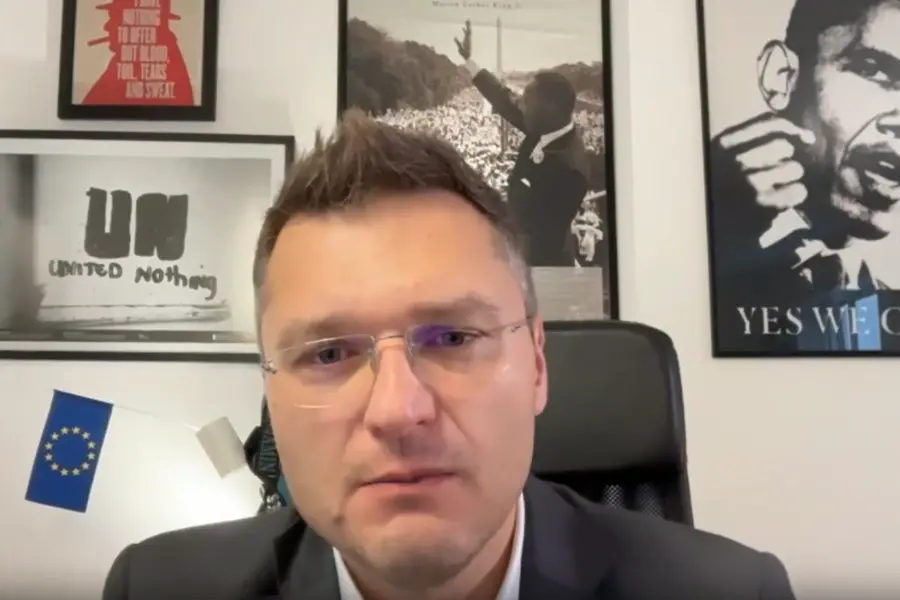
The man behind you once said, 'I have a dream' — Martin Luther King Jr. I think Serbia has achieved that dream quite spectacularly, and the waves or winds of change are being felt across borders, seas and oceans. Thank you so much for joining me, Raša Nedeljkov.
Thank you for this opportunity. And I also want to add that another man behind me once said, "Yes, we can." And yes, we have shown that we can. You can as well.
Published: 29 Oct 2026, 06:19 pm IST


Related Topics
Disclaimer: Kindly avoid objectionable, derogatory, unlawful and lewd comments, while responding to reports. Such comments are punishable under cyber laws. Please keep away from personal attacks. The opinions expressed here are the personal opinions of readers and not that of Mathrubhumi.
