
When cinema was born in India, it dealt mainly with mythological and historical genres which pulled the audience to the makeshift theatres with their makeshift projection infrastructures pulling people to a completely, almost magical form of mass entertainment
The word “Independence” has become a dicey word in present times. Though we are two years away from the 80th anniversary of Independence, what emerges within the scheme of Indian cinema is the birth of different genres within Indian cinema. When cinema was born in India, it dealt mainly with mythological and historical genres which pulled the audience to the makeshift theatres with their makeshift projection infrastructures pulling people to a completely, almost magical form of mass entertainment.
Rajah Harishchandra is the first feature film made completely in India. Its creator, Dhundiraj Govind Phalke, or, Dadasaheb Phalke, is recalled as the father of Indian cinema. A street in Dadar, where he made his first film before shifting to Nashik, is named Dadasaheb Phalke Road in tribute to his memory. The Ministry of Information and Broadcasting installed an award in his name - the Dadasaheb Phalke Award in 1969. The award is bestowed every year for a stalwart's lifetime contribution to Indian cinema.
Before Phalke, Ramchandra Gopal Torne made Pundalik (1912) with a running time of 22 minutes. He sent his film overseas for processing. Before Torne, Harishchandra Sakaharam Bhatvadekar (Save Dada) filmed a wrestling bout in 1899. Jyotish Sarkar of Kolkata filmed the Anti-Partition Day events in 1905. Phalke produced, directed, processed and distributed his film without outside help. He refused invitations by overseas financiers to make films for them.
In March 2021, the late Arun Roy made a beautiful fictionalised bio-film. It spins out the tragic story of Hiralal Sen, who would have rightly been recognized as the Father of Indian Cinema as his filmmaking precedes that of Dadasaheb Phalke. No one gives him this credit because not a single document in paper, photographs, reels of film or people remain as proof of his monumental work that comprised of 40 films including his pasteurization of a full-length play Alibaba and The Forty Thieves (1903), the picturization in moving pictures of a popular play produced by Amarendra Nath Dutta’s Classic Theatre. Dadasaheb Phalke’s first feature film Raja Harishchandra was made in 1913. All the reels of his films were completely destroyed in a fire and could not be retrieved in any form.
The late Dr.P.K.Nair, ex-curator-Director of the National Film Archive listed 25 films on the freedom struggle between 1925 and 1955 of which 11 were in Hindi. These are Azadi ke Rah Par, Andolan, Apna Ghar, Anand Math, Chandra Shekhar, Jai Bharat, Kashmir, Neecha Nagar, Swarna Bhoomi, Sikandar and Shaheed. Indians in their fifties might have heard only of Anand Math (its famous rendering of Bande Mataram in an unconventional tune), Andolan, Sikandar (Sohrab Modi and Prithviraj Kapoor) and Shaheed. Not one of the younger generations would even have heard of these films, leave alone having seen them.
But after 1947, the cinema scenario began to change slowly but steadily, moving gently away from historical fiction and mythological subjects to more socially relevant issues presented and projected through cinema. After India's independence in 1947, Indian cinema explored diverse themes, with some films consciously avoiding overt political commentary while others engaged with social and political issues. Early post-independence films often focused on social realism, particularly through the parallel cinema movement, and explored themes of urban life, social reform, and the impact of partition.
A change in this trend came about in the 1950s, particularly in Malayalam, Tamil and Bengali films. Jeevita Nouka (The Boat of life) introduced social and domestic theme, family life in Kerala with social humour. It was among the earliest Indian films to run for more than six months at a stretch. A bolder theme of socio – economic disparities and indication of prospective social revolution was expressed in Navalokam. But among the socially relevant movies of the early 1950s in Malayalam, Neelakuyil (Blue Koel) of 1954 depicted the story of powerful love breaking caste barriers but yielding finally to social pressures and the leading characters coming to grief in the face of social ostracism.
This period also saw big spectacles like Chandralekha in Tamil and the beautiful celluloid portrayal in the trilogy of Satyajit Ray starting with Pather Panchali. Parashakti, the Tamil film took Sivaji Ganesan to the heights of fame. It was a strong and defiant portrayal of the collusion between religious and economic forces in the suppression of the poor. Do Bigha Zamin questioned landlordism.
Most films were produced in Bombay and Madras studios. The largest number of films came out in Hindi, Tamil, Telugu, Malayalam, Kannada and Bengali- in that order. Among social films, Andaz and Mela stand out. The production of films in all languages dwindled in the closing years of the 20th century.
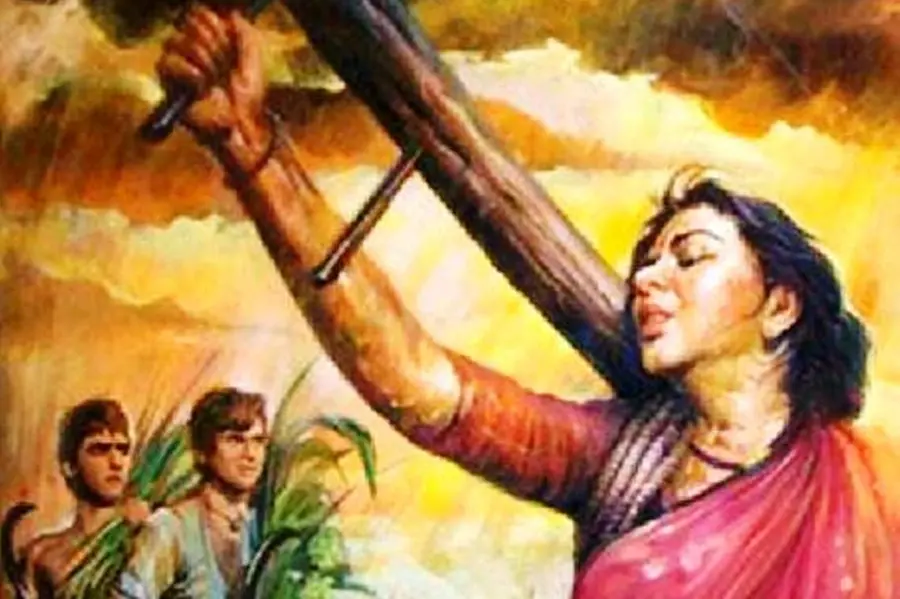
Of historical films, the first choice falls on Anarkali. Then come Mughal-e-Azam and Mother India. To the credit of Raj Kapoor and his R.K. Studios, a series of mild but poignant criticism of the oddities in social life of the 1950s and 1960s came that were also great entertainers and pieces of artistic attainments such as Awara, Shri 420, etc.
In the 1970s, Amitabh Bacchan ruled the Indian cine world portraying the defiant angry young man of the new generation. Till the late 1960s, films were directed by people who learnt the art on the job. There were no schools or training institutes for actors, directors, producers and technical experts.
The National School of Drama, New Delhi and the Film and Television Institute (FTII), Pune trained actors and directors and several other personnel connected with film. This was also the period when serious thinking was given to a cinematic style entirely different from what it was in the past. Critics have called the new trend ‘New Wave Cinema’. But what is termed the ‘New Wave’ in the history of Indian Cinema is not the ‘nouvelle vogue’ of French cinema with which Bresson, Goddard and other experimental film makers were associated in the fifties and sixties. In the Indian context, the terms are rather loosely used to describe the deliberately realist and non-commercial style of film making that sometimes experiments with form and content. Its roots are in IPTA theatre, the realist novel, and European cinema (especially Russian, French and Italian). It eschews the escapist Hollywood and the Bombay film traditions, and is concerned more with real – life issues of Indian society than with just entertainment. Other terms used to talk about this cinema are ‘alternative’, ‘parallel’, and even ‘another’ cinema.
Major Studios– The creation of major studios in Madras, Calcutta, Lahore, Bombay and Pune in the 1930s was a crucial move in the development of a proficient Indian film industry. Studio owners including Himanshu Rai and Devika Rani, V. Shantaram, V. Damle and S. Fatehlal set the tune of film production, playing an essential role in promoting national integration. People of all castes, religious, regions, sects and social classes worked together in the various studios. Film production has always prided itself in the way it has been inclusive and continues to be a shining example of communal (i.e. inter religious) harmony and tolerance. Hindus and Muslims work together and promoting National Integration and communal harmony has always been a favourite theme of the Indian film.
The studios, including Bombay Talkies, New Theatres in Calcutta, Prabhat Film Company and Gemini and Vauhini in Madras, were responsible for broadening the choice of screen subjects, with music as a primary ingredient. Like the great Holywood studios, they experimented with different stories and themes while each developing his/her own brand of film making.
Key films of this period show the origins of themes and subjects that have recurred over subsequent decades of film making. For example, New Theatres, particularly the 1935 classic Devdas by actor / director P.C.Barua, made in both Hindi and Bengali versions, gave Indian cinema its most recurrent theme: the love triangle. Devdas is an adaptation of Sarat Chandra Chatterjee’s Bengali novel of the same name. This film also gave its most enduring male character: The tragic romantic hero. Devdas is a high caste Brahmin who cannot marry the love of his life, Parvati, his neighbour’s daughter, because she is of a lower caste. He later befriends Chandramukhi, a prostitute who gives up her profession and turns to spirituality. In a downward spiral of self – destruction, the Hamlet-like Devdas becomes an alcoholic and ultimately dies at the gate of Parvati’s marital home.
Devdas touched millions of Indians in the 1930s who felt that his anguish would become their own if they dared marry against parental authority. This theme returns regularly every decade, either in a direct remake, e.g. Bimal Roy’s 1955 Devdas (director Sanjay Leela Bhansali’s new version released in 2002), or as an important theme, as in Guru Dutt’s Pyaasa (1957) or Prakash Mehra’s Muquaddar Ka Sikandar ( 1978 ).
Golden Age Of Indian Cinema – The 1950s led film historians to refer to this glorious time as the golden age of Indian Cinema. Filmmakers created individual works while sticking strictly within the set conventions of “Indian” films. The example of Mahatma Gandhi and Prime Minister Nehru’s vision of the newly independent nation was influential throughout the decade, and many excellent Urdu poets and writers worked with film makers in the hope of creating a cinema that would be socially meaningful. It is no surprise that the 1950s is regarded today as the finest period in Indian cinema, and the era has profoundly influenced generations of Indian film makers in a way that no other decade has done since.
The best directors of the time, including Mehboob Khan, Bimal Roy, Raj Kapoor and Guru Dutt, brought new depth to established themes. They drew on the wide spectrum of cinema stories, and invested them with a personal vision. The films of the late 1940s, 1950s and early 1960s were lyrical and powerful and dealt with themes including the exploitation of the poor by rich landlords, the importance of sacrifice and honour, survival in the big city, untouchability, the changing role of the woman, urban vs rural morality, nature vs nurture, materialism vs spiritualism and so on.
The average Indian film did not pretend to offer a unique storyline. A new twist to a familiar storyline helped the films to succeed. If the audience was looking for originality, they knew it was principally to be found in the musical score. Film music is of such primary importance in today’s Indian cinema that it more or less determines the box- office fate of most films. Leading choreographer Farah Khan believes ‘What is saving Indian cinema from being engulfed by Hollywood is our song and dance routines, because they just can’t imitate that’. We’ve come a long way baby, but still, miles to go before we sleep.
Published: 10 Aug 2025, 11:50 am IST
Subscribe to our Newsletter
Disclaimer: Kindly avoid objectionable, derogatory, unlawful and lewd comments, while responding to reports. Such comments are punishable under cyber laws. Please keep away from personal attacks. The opinions expressed here are the personal opinions of readers and not that of Mathrubhumi.
