
Exploring Bimal Roy`s Do Bigha Zamin (1953), a restored neo-realist masterpiece tackling social inequalities and the plight of farmers
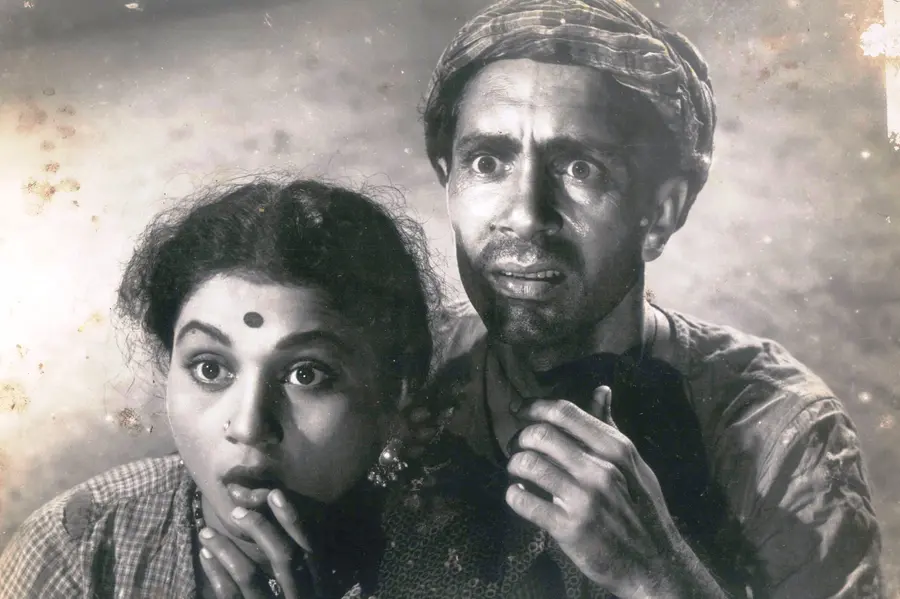
Do Bigha Zamin was one of the first mainstream Indian films to receive international acclaim; it was awarded the Prix Internationale at the 1954 Cannes Film Festival. Though it clearly was intended as a melodrama aimed at a mainstream audience, the artists involved with the production of the film were not only inspired by a common ideological belief in socialism that defied the conservatism of Indian cinema but they succeeded in demonstrating how genre could be subverted and adopted as a tool to address wider inequalities and afflictions.
Do Bigha Zamin is said to be the first ever Indian film to express the deep influence of Italian neo-realism in cinema. Neo-realism is a movement that arose in Italy after World War II, dominated the Italian cinema in the late 1940s and influenced filmmakers around the world. At a time when musicals and light comedies were allowing moviegoers to escape the grim facts of war, the neo-realists presented an authentic treatment of the wartime experience and grappled with the social problems of post-war Italy. Mainly Marxists and liberal Catholics, neo-realists advocated Leftist ideas and were strongly influenced by the Soviet cinema.
The story, by Salil Choudhury, was originally a long poem of the same name authored by the late Rabindranath Tagore. It is about Shambhu Mahato (Balraj Sahani), a poor peasant who owns a small plot of land that measures two acres for which he owes the landlord in Gopipur, a small village near Calcutta. The village does not have electricity but the zamindar lives in a spacious home lit with chandeliers. Shambhu lives in a small home with his old and asthmatic father (Nana Palsikar), wife Paro (Nirupa Roy) and growing son Kanhaiya (Ratan Kumar). The zamindar, Thakur Harnam Singh (Sapru) lands in his car with two prospectors from the city at the land where the peasants are tilling the land. He says he wants to build a factory on the huge tract of fertile land. The problem is, Shambhu’s two acres stand right in the middle of the tract ear-marked for the factory tentatively named The Great Janata Mills Ltd. When Shambu refuses to part with his land for a factory, the landlord says that he was willing to surrender the debt Shambhu owes him if Shambhu agreed to the exchange.
Zameen to kisan ke maa hoti hai huzoor, maa ko bech doon? A shocked Shambhu asks the zamindar.
Maa Baap ban jayegi says the landlord in response and when Shambhu is adamant, and asks the landlord for four days to repay the loan.
The camera cuts to Shambhu Mahato’s humble home where his father and son are planting a mango sapling that, the old man says will bear fruit after five years. This suggests hope for the future for the family which however, remains a dream as the story unfolds. With the help of his son Ratan who goes to school, he calculates the money he owes to the landlord. Ratan says it amounts to a total of Rs.65 which includes Rs.5 as interest. But the next day when he arrives with the sum after having sold household utensils, the accountant says that the sum has gone up to Rs.235.50p which he could not afford.
After about half an hour of screening time, we find Shambhu walking towards the station to catch the train to Calcutta and the soundtrack plays the famous Manna De number mausam beeta jaaye with men and women engaged in different chores in the fields as if they are bidding a fond farewell to Shambhu. The camera cuts to the train compartment filled with a debate on village versus city while a hawker hawks a mosquito killing agent suggesting the proliferation of mosquitoes in the city. Shambhu suddenly discovers his son Kanhaiya hiding in the compartment who has followed him secretly because he has never travelled in a train and wants to be with his father.
Small vignettes of the city capturing the downtrodden, the marginalised and the poor living in a slum, mostly from outside the city and the state, show the regular quarrels around the public tap. The sound track fills with screams in the night. We are told that the man has lost his leg and still has nightmares of his leg being amputated. Another group that has landed in the city in search of a livelihood sing O meri Rama Gajab teri duniya that spells out the merciless minds of city people. Yet, not everyone can be measured by the same measuring rod of ruthlessness. Shambhu begins to work as a porter carrying baggage and burdens he is too underfed to carry. Shambhu gets to drive a hand-pulled rickshaw by a twist of fate.
There are some interesting intercuts of the city and village – Kanhaiya polishing shoes, Paro engaged in some work, Shambhu pulling the rickshaw that ends in a bad accident when a man and a woman push him to race the other rickshaw, the pickpocket who sells racing tickets and also plays the harmonica, Paro at the post office asking if any letter has arrived from the city at the Chandanpur Post Office and so on. She finds she is pregnant but is almost on a forced fast since only Rs.50 is left in the family kitty. She begins to work at the construction site which pays her Rs.2/day. The badly injured Shambhu cannot shave so he grows a beard. The landlady, a sharp-tongued by generous-hearted Bengali lady gives money to Kanhaiya to get fruits for his father who needs nutrition. One day, his shoeshine box is taken away and broken. He is beaten up by his father when he brings a big sum of money.
Shambhu had gone to the city with the sole intention of coming back one day, with enough money to release the land from the grasp of the landlord. But fertile land fit for agriculture has already been turned over to industry. This spells out the beginnings of industrialisation at the cost of agricultural land not really for the benefit of the peasants but in the name of development, for cushioning the pockets whose pockets are already cushioned with money and land by ulterior means from the poor, the oppressed and the marginalised. The film defines a powerful, scathing but restrained social comment on the destiny of the forced migrant farmers and small land-owners that create capital but are deprived of their rightful share in the fruit of their contribution. The film tries to create a politically conscious milieu and an ethical awareness for social activism imperative to the proper functioning of a democratic nation. The melodrama and realism thus, accentuate the same national temperament.
The script and the humanist acting styles, including a hard but kind landlady in the Calcutta slum and the happy-go-lucky shoeshine boy (Jagdeep) who takes Kanhaiya under his wing while humming Raj Kapoor’s awara hoon number find their ancestry in Nitin Bose’s ruralist socials at New Theatres such as Desher Maati in 1938, enhanced by IPTA overtones in Salil Choudhury’s music. The film’s neo-realist reputation is almost solely based on Balraj Sahni’s extra-ordinary performance in his best-known film role. Also remarkable is Hrishikesh Mukherjee’s editing, virtually eliminating dissolves in favour of unusually hard cuts from the falling wheel of the film’s famous rickshaw race sequence to Kanhaiya coming to the bedside of his injured father.

The opening frame focusses on a close-up of a parched, cracked land because there has been no rain for two years. This crack is a metaphor both for the drought-stricken village and its people as well as a foreseeing of the ‘cracked’ future of the villagers whose land and livelihood are placed at stake by the landlord who wants to build a factory in the village. Then there is rain and this is heralded by the beautiful song hariayala saval dhol bajata aaya sung and danced in chorus reflecting the happiness they are suddenly made a part of. This is soon followed by another song, dharti kahe pukar ke with visuals showing villagers happily tilling the soil after having victimised by drought for two years. This crack also stands of the homeland that threatens the very survival of the inhabitants and owners of the land forcing some of them to migrate. This migration suggests permanent displacement for those who went away with the hope of returning home and is a form of displacement that can never be remedied.
One of the issues the film talks of in the first half of the film is the issue of property, a shadow of the Requisition and Acquisition of the Immovable Property Act, 1952.ii The parallel theme is the element of rural-urban migration when Shambhu migrates to Calcutta to earn enough money and pay back the loan to free his land and reclaim it from the landlord. We are made witness to the dehumanized face of the city within its industrial and materialistic environment where things are no better for Shambhu than they were back in his village. Perhaps, they are worse because he is a peasant and is neither a city dweller nor is he a rickshaw puller. This forced shift from his traditional occupation to a completely new and urbanized one brings along with its associated changes that in no way improve his life or his livelihood.
Do Bigha Zamin was the turning point for Bimal Roy as filmmaker par excellence. The film continues to remain the most significant film that bears the distinct stamp of the Italian neo-realism school from Bimal Roy’s films. The influence of Bimal Roy was far-reaching, both within and beyond Indian shores extending both to mainstream commercial Hindi cinema and the then-emerging parallel cinema. His Do Bigha Zamin was the first Indian film to perfect the balancing act between mainstream and off-mainstream cinema. The film’s critical success across the world paved the way for the Indian New Wave. There is an air of timelessness in the film.
Published: 03 Aug 2025, 10:50 am IST
Related Topics
Disclaimer: Kindly avoid objectionable, derogatory, unlawful and lewd comments, while responding to reports. Such comments are punishable under cyber laws. Please keep away from personal attacks. The opinions expressed here are the personal opinions of readers and not that of Mathrubhumi.