

Following the Mundathikode fireworks accident in Thrissur, a pyrotechnician points to persistent safety gaps and draws lessons from the Puttingal temple fireworks tragedy in Kerala.
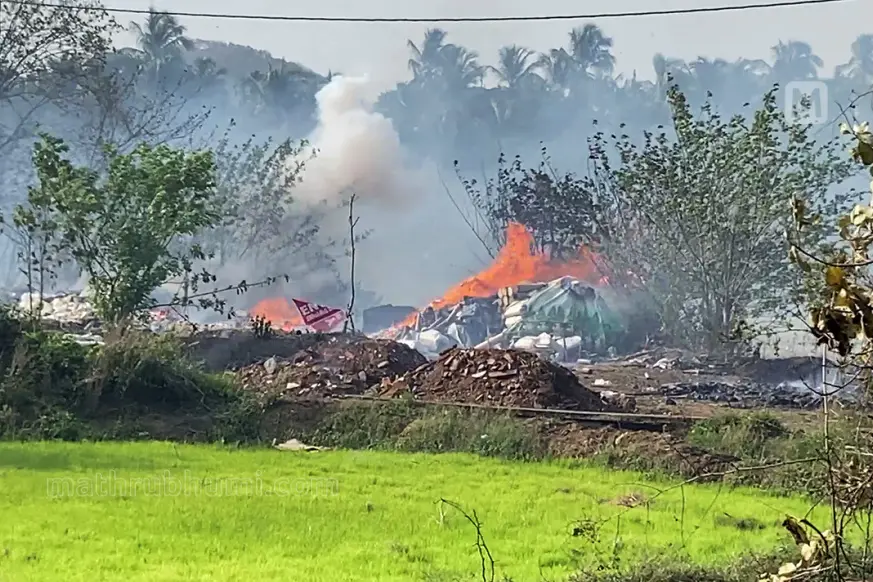
In the aftermath of the recent fireworks accident at Mundathikode in Thrissur, a conversation from just a month ago has gained unsettling relevance. When 'Mathrubhumi' interacted with veteran pyrotechnician Francis Karekkatt, the focus was on documenting Kerala’s rich fireworks tradition and the science behind it. Today, those insights read like a prescient warning.
Kerala has seen such tragedies before. The memory of the Kollam Puttingal temple fireworks tragedy still lingers as a stark reminder of what can go wrong when systems fail. In that context, Francis had, in fact, written to authorities ahead of a previous festival season, outlining key risks and suggesting corrective measures — many of which now appear strikingly relevant again.
Also Read
A pattern that repeats
Francis is unequivocal that most fireworks accidents follow a pattern. He says that while multiple agencies may be involved, “the responsibility for public safety rests with the fireworks technicians,” adding that “the police can only manage crowds — they cannot control how fireworks are handled.”
This distinction is critical. For Francis, accidents are not unpredictable events but outcomes of lapses in discipline, knowledge, and accountability.
Fireworks as a technical craft
In festivals such as Thrissur Pooram, fireworks are often perceived as a spectacle. Francis reframes this perception, pointing out that “fireworks are not just about noise — a good shell must bloom like a flower in the sky.” As he suggests, the margin for error in fireworks is extremely narrow, and even minor misjudgements can escalate into major accidents.
Where risks begin
A significant portion of risk, Francis explains, arises after the manufacturing process. “Most major accidents occur after manufacturing — when finished fireworks catch fire,” he says. The problem is compounded when safety protocols are ignored. “The law says completed fireworks must be moved to storage rooms. When this is not done, accidents become far more severe.”
He illustrates this with a stark example: “If 30,000 crackers are bundled together and one ignites, it will not sound like 30,000 bursts — it will be a single explosion like dynamite.” In enclosed spaces, he adds, the structure itself can amplify the blast, effectively acting “like the outer shell of a dynamite explosion.”
Erosion of skill and knowledge
Francis points to a gradual erosion of traditional expertise as a major concern. “Earlier workers may not have been formally educated, but they had deep practical knowledge,” he observes. “If they rubbed a chemical between their fingers, they could identify what it was.” In contrast, he says, “today’s workers depend on labels. If there is a mistake in labelling, an accident is certain.”
The challenge is compounded by the nature of the materials themselves. “Many chemicals look the same — like powdered salt,” he explains. “Two may be safe to grind or mix, but the third can be extremely dangerous. If that one is used by mistake, the result can be catastrophic.”
Handling discipline and hidden triggers
Beyond knowledge, Francis stresses the importance of strict handling discipline. “When workers move between sheds, they must clean their hands, feet, clothes — everything — very thoroughly,” he says. Without adequate facilities, however, this often does not happen. “If there is a shortage of water, they simply wipe their hands on their clothes and move on. That itself can lead to accidents.”
He also notes that accidents can spread rapidly if finished materials are not isolated. “When explosive materials catch fire, the impact can spread to nearby sheds,” he warns, making the case again for strict storage protocols.
The timer: Precision and risk
At the core of fireworks, Francis identifies one critical element: the timer. “The timer is the most vital component in fireworks,” he says, adding that traditionally, it was crafted by the most skilled technician. “If you can make a timer, you understand the entire science of fireworks.”
However, he points out a worrying shift. “Today, timers are often bought ready-made. If there is a defect — due to poor quality or other reasons — it can lead to major accidents,” he says, noting that “those who supply these components bear no responsibility.”
Fragmented responsibility
Another structural issue is the division of labour. “Earlier, fireworks were made in-house. Workers knew exactly what they were handling,” Francis explains. “Now even the ignition is sometimes outsourced.” This creates a disconnect: “Those lighting the fireworks may not have been involved in making them. They may not fully understand the risks.” Such fragmentation, he argues, weakens accountability. “When responsibility is divided among many, the chances of error increase.”
The loss of preventive practices
Francis also reflects on the disappearance of earlier safety mechanisms. “Traditionally, a sample fireworks display for Thrissur Pooram was conducted three days before the main event,” he recalls. “Its purpose was to test every item.” Adjustments would be made based on performance — strengthening or reducing intensity where necessary.
Today, that system has weakened. “Now the sample display and the main event are often handled by different people,” he says. “The original purpose of testing is lost.”
Reframing risk
In a striking comparison, Francis challenges common perceptions of danger. “Fireworks are far less dangerous than driving,” he says. “On the road, even if you are experienced, someone else’s mistake can cause an accident.” In contrast, “in fireworks, if workers are careful, a large percentage of accidents can be avoided.”
From colour to noise
Francis also laments a shift in aesthetic priorities. “Earlier, most of the budget went into colour displays,” he notes. “Today, it is mostly noise.” This, he argues, not only reduces artistic value but also increases risk.
He highlights the universality of fireworks: “To enjoy Kathakali, you need knowledge. To enjoy music, you need training. But fireworks — anyone can enjoy them.” That is precisely why, he insists, “fireworks should be a visual delight, not a painful noise experience.”
Practical measures and letter to the authorities
Many of these concerns were formally outlined in the letter Francis wrote to authorities ahead of a previous festival season. In it, he stressed practical measures that remain relevant today — from ensuring proper storage and cleanliness to reducing high-intensity explosives and avoiding reloading during live displays.
“Reloading during a display is extremely dangerous,” he reiterates. “After the show, every pit must be checked for unexploded material. If left behind, children may pick them up, leading to serious accidents.”
Licensing and accountability
Francis is also critical of the licensing framework. “Today, anyone with some interest and money can get a licence,” he says. “For such a dangerous profession, is it right to allow this so easily?” Drawing a comparison, he adds, “getting a driving licence requires multiple tests — fireworks demand even greater responsibility.”
Science, materials and unseen risks
The lack of scientific discipline is another concern. “There should be proper weighing systems and basic testing facilities,” Francis insists. “Before mixing large quantities, a small batch must be tested.”
He recalls how material quality can create hidden risks: “When industrial-grade sulphur entered the market, mixtures began heating up unexpectedly.” Such variations, he warns, can trigger accidents without warning.
The human factor
Ultimately, Francis returns to the role of human judgement. “Some operators take up multiple contracts,” he notes. “That reduces their ability to concentrate.” Fireworks, he emphasises, demand complete attention: “Without focus, accidents will happen.”
A warning that still stands
What Francis Karekkatt articulated in his recent interaction — and earlier in his letter — is not merely technical advice but a broader call for accountability. His message is simple but critical: “If license holders, workers, and organisers remain vigilant, accidents can be reduced significantly.” And, as he puts it with clarity, “fireworks do not fail on their own — people and systems fail.”
In the end, his vision remains unchanged: “Fireworks are meant to be a feast for the eyes — not a danger to life.”
Published: 23 Apr 2026, 11:04 am IST
ABOUT THE AUTHOR
Disclaimer: Kindly avoid objectionable, derogatory, unlawful and lewd comments, while responding to reports. Such comments are punishable under cyber laws. Please keep away from personal attacks. The opinions expressed here are the personal opinions of readers and not that of Mathrubhumi.