
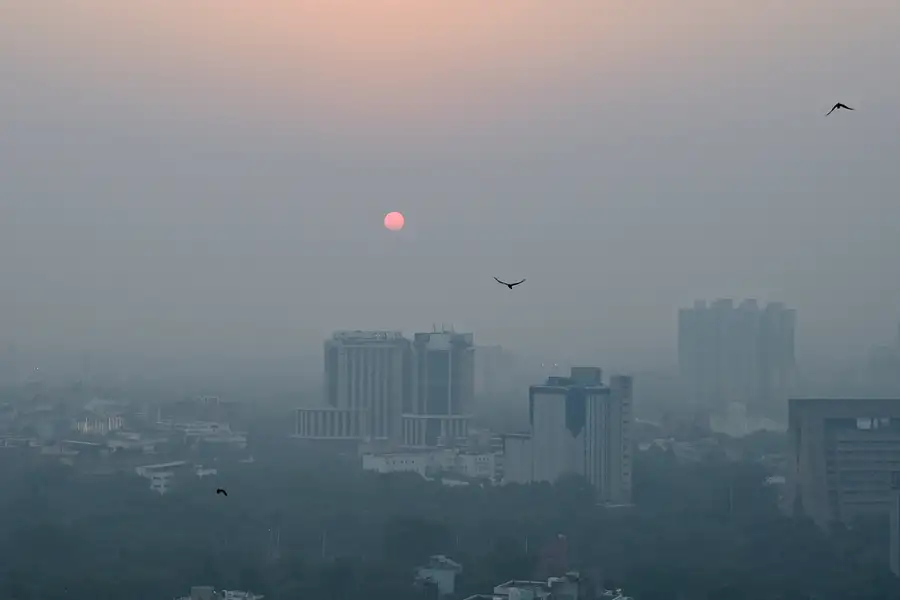
Delhi's air quality remained in the 'poor' category on Monday morning, with the overall Air Quality Index (AQI) recorded at 216 at 7.05 am, according to the Central Pollution Control Board (CPCB).
As Delhi grapples with rising air pollution, Punjab has recorded 5,972 stubble-burning incidents so far this year, taking the state close to the 6,000-mark despite efforts to prevent crop-residue fires. Firozpur tops the district-wise tally with 817 cases, followed by Tarn Taran (700) and Sangrur (689), according to official figures released as of November 15.
The figures indicate that farm fires remain a concern across the state despite a series of enforcement measures, including inspections, financial penalties and police cases against those found burning crop residue.
Of the total incidents reported, officials have inspected 5,616 fields. Stubble burning was physically confirmed at 2,478 locations. Environmental Compensation (EC) has been levied in 2,219 cases, with the cumulative penalty amount reaching Rs 1.11 crore.
However, the amount collected so far stands at Rs 40.55 lakh, leaving a significant portion of the imposed compensation yet to be recovered.
Warning and show-cause notices have been issued to 1,607 nodal and supervisory officers. Prosecution under Section 14 of the Commission for Air Quality Management (CAQM) Act has also been initiated against 35 supervisory officers.
Delhi's air quality remains 'poor', AQI at 216
Meanwhile, Delhi's air quality remained in the 'poor' category on Monday morning, with the overall Air Quality Index (AQI) recorded at 216 at 7.05 am, according to the Central Pollution Control Board (CPCB).
A thick layer of smog continued to cover several parts of the national capital, with some monitoring stations reporting 'very poor' air quality.
Sirifort recorded the highest AQI among the listed stations at 346, followed by NSIT Dwarka at 330. Both readings fell in the 'very poor' category.
Punjabi Bagh recorded an AQI of 276, followed by Chandni Chowk at 271 and ITO at 267. North Campus of Delhi University registered 259, while IIT Delhi recorded 258. These stations remained in the 'poor' category.
The AQI at Jawaharlal Nehru University (JNU) stood at 240, while Burari recorded 221 and Anand Vihar 205.
In contrast, Okhla Phase-2 recorded an AQI of 191 and IMD Lodhi Road registered 149, placing both locations in the 'moderate' category.
PM2.5 and PM10 were the prominent pollutants recorded in the national capital.
According to CPCB classification, an AQI between 0 and 50 is considered 'good', 51-100 'satisfactory', 101-200 'moderate', 201-300 'poor', 301-400 'very poor' and 401-500 'severe'.
Published: 16 Nov 2026, 09:34 am IST


ABOUT THE AUTHOR

Related Topics
Disclaimer: Kindly avoid objectionable, derogatory, unlawful and lewd comments, while responding to reports. Such comments are punishable under cyber laws. Please keep away from personal attacks. The opinions expressed here are the personal opinions of readers and not that of Mathrubhumi.