
From the Emergency and the 1984 anti-Sikh riots to her decision to decline the Prime Minister's post in 2004, Sonia Gandhi's autobiography revisits six decades of Indian political history
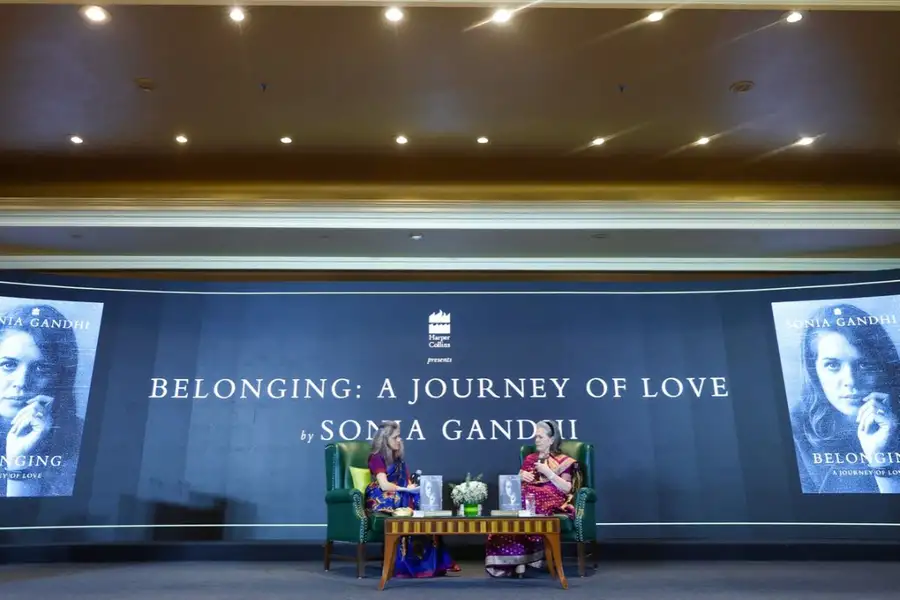
Despite enduring relentless humiliation, Sonia Gandhi does not disrespect a single opponent in her autobiography. At its core, this is a book of love and romance, serving as the testimony of a woman who witnessed Indian politics being shaped from close quarters over six decades. Walking the fine line between candor and silence, the memoir leaves the reader not with bitterness, but with a profound appreciation for Indian democracy.
The Zeal for Truth
Mark Twain famously observed that a true autobiography consists of the inner thoughts and feelings that never quite make it to the page, leaving most people with two distinct personalities: one internal and one external. In a 1996 interview, I asked the renowned journalist C. P. Ramachandran why he had never written his memoirs. He replied that he insisted on absolute truth, and writing the whole truth would hurt too many people.
In India, the only autobiography that burns like the sun with uncompromising truth is Mahatma Gandhi’s The Story of My Experiments with Truth. Reading Sonia Gandhi’s memoir brought Gandhiji, Ramachandran, and Twain to mind. While Sonia does not reveal every secret, the defining quality of her book is honesty. Its warmth stems from a genuine fervor for openness.
Arundhati Roy and Zara Chowdhary
Among the autobiographies I have read recently, three by women have moved me deeply. Alongside Sonia’s book are Arundhati Roy’s Mother Mary Comes to Me and Zara Chowdhary’s The Lucky Ones. Roy’s memoir is more than the story of a mother; it is a rich tapestry of a daughter, her brother Christopher, her uncle Isaac, her father, and her friend Pradip Krishen. Written in breathtaking prose, it reveals how Arundhati became Arundhati. Chowdhary’s book, by contrast, is a direct testimony of surviving the 2002 Gujarat riots. While Roy writes from the brink of life and Chowdhary from the brink of death, Sonia writes from the borderland between the two. Her memoir portrays a woman devastated by the untimely deaths of a mother-in-law she loved like a mother, and a husband she loved as her own soul. Language truly comes alive when tempered by the embers of lived experience.
Fearlessness
Fearlessness is the beating heart of Sonia’s autobiography, titled Belonging: A Journey of Love. Leo Tolstoy once remarked that if the Bible were reduced to a single word, it would be love. The front and back cover photographs of Sonia’s book mirror this theme. The front cover shows a 20-year-old Sonia, photographed by Rajiv Gandhi in Turin, Italy, in 1966. The final page features an 80-year-old Sonia, captured by her grandson Raihan Vadra and his partner, Aviva Baig. Rajiv’s lens captures a current of affection; Raihan and Aviva’s lens captures a radiance of fearlessness. In 2026, Sonia appears as fearlessness incarnate—proof that people become most fearless at the peak of love.
Since arriving in India as Rajiv’s bride in 1968, Sonia has faced relentless ridicule over her foreign birth. Her opponents even twisted her first meeting with Rajiv at a London coffee bar into a malicious fabrication that she was a 'bar dancer.' This memoir is her dignified answer to decades of insults. She proudly owns her Italian roots while declaring unequivocally that India is her only homeland, blunting the attacks leveled against her by critics ranging from Sharad Pawar to Sushma Swaraj.
Sonia recounts her helplessness in 1999 when Pawar and his allies challenged her origins at a Congress Working Committee (CWC) meeting:
'When I read the letter written by Sharad Pawar and his friends at the CWC meeting, my eyes filled with tears. I walked out. They were the very people who had persuaded me to enter politics, and now they had turned against me. I submitted my resignation, writing that although I was born abroad, I had chosen India as my country and would remain an Indian until my death.'
She weaves Italian words effortlessly into her narrative as she writes openly about her childhood, relatives, and friends. Embracing her Italian heritage without hesitation is the clearest proof of her conviction that she has become wholly Indian.
Strategic Silences
The sharpest observation about the book comes from her son, Rahul Gandhi. During a recorded conversation with Sonia and his sister Priyanka, Rahul remarks, 'Ma remembers what is needed, and forgets what is not.' Knowingly or not, he points directly to the politics of memory.
Some omissions are born of trauma. Rahul notes that Sonia’s memories of May 21, 1991—the day Rajiv was assassinated—are largely blank. Overwhelmed by grief that felt like the erasure of her own existence, Sonia relied on Rahul and Priyanka to help reconstruct the events of that day for the book.
Other omissions, however, are deliberate. The most glaring silence surrounds the Congress party's failure to prevent the demolition of the Babri Masjid on December 6, 1992. While Sonia had largely withdrawn from public life at the time, she details L. K. Advani’s Ram Janmabhoomi Yatra and the rise of the Hindutva movement, yet avoids examining the controversial role of then-Prime Minister P. V. Narasimha Rao. She likely holds back to avoid reopening political wounds that alienated India's Muslim community from the Congress.
It is well known that loyalty to the Nehru-Gandhi family secured Rao the premiership. As K. Natwar Singh has revealed, when the Congress emerged as the largest party in 1991 with 244 seats, Sonia consulted Indira Gandhi’s trusted advisor, P. N. Haksar. Haksar first suggested Vice President Shankar Dayal Sharma, who declined, leading Haksar to recommend Rao.
Though initially close to Sonia, Rao gradually stopped visiting 10 Janpath and attempted to steer the party away from the Nehru-Gandhi family while serving as both Prime Minister and Congress President. That ambition collapsed alongside the Babri Masjid. By the time Sonia took the helm of the party, Rao had fallen out of favor—culminating in the controversial decision not to allow his body to lie in state at the Congress headquarters after his death. None of this appears in the book. Only Sonia can clarify what truly happened, yet she remains silent, maybe unwilling to hand ammunition to opponents while Congress fights an existential battle against the Modi government and the Sangh Parivar.
Equally notable are her silences on the 2014 bifurcation of Andhra Pradesh and her rift with Y. S. Jagan Mohan Reddy—a crisis that wiped out the Congress in the state. She also skips over the exits of Amarinder Singh and Jyotiraditya Scindia, Rajiv Gandhi’s public dismissal of Foreign Secretary A. P. Venkateswaran at a press conference, and Rahul Gandhi’s public opposition to the Manmohan Singh government's ordinance years later.
Candid Disclosures: The Emergency and 1984
Where Sonia chooses to speak, her candor is striking. She offers a deeply introspective look at the 1975 Emergency and the 1984 anti-Sikh riots. While arguing that Jayaprakash Narayan’s movement had fallen under the grip of the RSS, she admits without hesitation that the Emergency was a grave mistake and that Indira Gandhi’s government lost its way.
Following the Allahabad High Court verdict, Rajiv urged his mother to resign and call fresh elections. Sanjay Gandhi fiercely opposed this, warning Indira that her enemies were out to destroy her and that lifting the Emergency would be political suicide. Sonia identifies Sanjay’s rise as an extra-constitutional authority as the root cause of the Emergency's excesses. She recalls Rajiv looking at Sanjay’s face and saying it was Sanjay who destroyed Indira. She also quotes Indira’s own helplessness: 'Sanjay does not listen to me. What can I do? He issues orders without even informing me.'
On the 1984 anti-Sikh riots, Sonia writes that the violence was a severe blow to India’s conscience, acknowledging that the Congress government looked the other way as mobs ran rampant. Though she does not directly address Rajiv’s infamous remark about the earth shaking when a big tree falls, she admits that governance had collapsed: 'While Rajiv's heart held no bigotry or rancor, there is no denying that he was thrust into a moment when effective governance had foundered and barbaric acts followed. The system had undergone a cataclysmic upheaval in which the structure of government came under severe strain—perhaps even broke down.'
She confesses that she only grasped the true horror of mob lynchings when she visited riot-torn Bhagalpur with Rajiv in 1989, asking herself: 'Had my own grief and trauma in 1984 overshadowed my mind when these very same brutalities were visited upon Sikhs in Delhi?'
What Really Happened in 2004
Sonia sets the record straight on her decision to decline the Prime Minister’s post in 2004. She dismisses the rumor that then-President A. P. J. Abdul Kalam blocked her appointment over her foreign origin, noting that Kalam himself confirmed in his own memoirs that he was ready to invite her to form the government as the leader of the single largest party.
Having initially opposed Rajiv’s entry into politics, Sonia eventually entered the fray out of duty, believing it was the only way to counter the Sangh Parivar’s divisive agenda. Though she had promised her children she would never become Prime Minister, she briefly relented under intense pressure from party leaders and workers. Priyanka, watching from outside the hall, rushed home to alert Rahul. When Sonia arrived, she was met by a furious son terrified of losing his mother the same way he had lost his father: 'You said yes?' Rahul thundered.
'They wouldn't listen to me,' I replied. 'I don't want to do it—you know I don't. I was being pressurized.'
'Pressurized? You are being pressurized?' he demanded. 'What about us?' He stormed off, his face clouded with anger.
It was Rahul’s anguish—echoed by Priyanka and close family friends Suman and Manjulika Dubey—that sealed her decision. Her subsequent refusal stunned the BJP and RSS, stripping them of their most potent political weapon. Her address to the Congress Parliamentary Party remains historic: 'I was always certain that if ever I found myself in this position, I would follow my own inner voice. Today, that voice tells me I must humbly decline this post.'
Allies and Rivals
Sonia writes warmly about her most trusted Congress colleagues, placing Arjun Singh at the top of the list alongside Priya Ranjan Dasmunsi, A. K. Antony, Ahmed Patel, Madhavrao Scindia, Sheila Dikshit, and Ambika Soni. However, she reserves her deepest admiration for P. N. Haksar, praising his intellect and ideological clarity as irreplaceable, and noting that no other Indian Prime Minister has ever had a mentor of his caliber.
Among her political rivals, she discusses only Narendra Modi in detail, observing that they rarely communicate and that he avoids making eye contact when they meet. Meanwhile, Subramanian Swamy—perhaps her most relentless critic—is omitted entirely, a telling measure of her indifference toward him.
Loneliness of Power
Tracing her journey from a small Italian village to becoming the most powerful woman in India, Sonia offers a sobering meditation on authority. She notes that outsiders rarely see the profound loneliness of power, or how easily leaders become blinded by sycophancy. She cites a letter from Rajiv to Rahul warning that few people around them are genuine, and that he would be lucky to find one or two true friends in life.
She illustrates this with a poignant memory from 1977, just after Indira Gandhi lost power. For Rahul’s birthday party, Sonia invited his classmates, but only one boy showed up; the rest stayed away on their parents' orders due to the shifting political winds. Rahul still reminds his mother that the boy who came that day remains his friend to this day.
V. P. Singh and Giani Zail Singh
Sonia writes with deep sorrow about the V. P. Singh government’s decision to withdraw Rajiv’s Special Protection Group (SPG) security in 1990. She reveals that the Indian Peace Keeping Force (IPKF) had intercepted an LTTE radio transmission plotting Rajiv’s assassination. Despite passing this intelligence to the central government, no action was taken—a revelation that underpins Rahul Gandhi’s allegation that the withdrawal of his father's security was deliberate, not accidental.
She also levels a serious charge against former President Giani Zail Singh, alleging that he attempted to topple Rajiv’s government in 1987 after Rajiv refused to back him for a second presidential term. According to Sonia, Zail Singh conspired with a media mogul, a Mumbai industrialist, and opposition leaders to unseat Rajiv, though the plot failed and R. Venkataraman was elected President.
Pluralism and the Idea of India
As the BJP prepares to seek a fourth consecutive term under Narendra Modi, Sonia turns to history for perspective. A century ago, she notes, few could have imagined that the mighty British Empire would crumble before a frail old man clad in a simple dhoti who united millions of Indians. She expresses unwavering faith that the Sangh Parivar’s ideology of hatred will meet a similar fate. Declaring that there can be no compromise with Hindutva, she vows never to retreat from the fight for the secular India championed by Gandhi, Nehru, Indira, and Rajiv. She closes the book by affirming that the love of the Indian people gave her the strength to survive every crisis.
Like the memoirs of Arundhati Roy and Zara Chowdhary, Sonia Gandhi’s autobiography demands to be read in a single sitting. Its prose is simple, luminous, and devoid of malice. Burned by the heat and sting of lived history, this tender narrative balances the sweet with the bitter. Sonia writes that she strove for complete honesty, taking full responsibility for any unintended errors. When you turn the final page, what lingers is not resentment, but the enduring promise of Indian democracy.
Published: 28 Nov 2026, 12:18 pm IST


ABOUT THE AUTHOR

Related Topics
Disclaimer: Kindly avoid objectionable, derogatory, unlawful and lewd comments, while responding to reports. Such comments are punishable under cyber laws. Please keep away from personal attacks. The opinions expressed here are the personal opinions of readers and not that of Mathrubhumi.