
Chitralekha got off to an impressive start when the then Governor Bhagawan Sahay inaugurated the Film Society on July 5, 1965
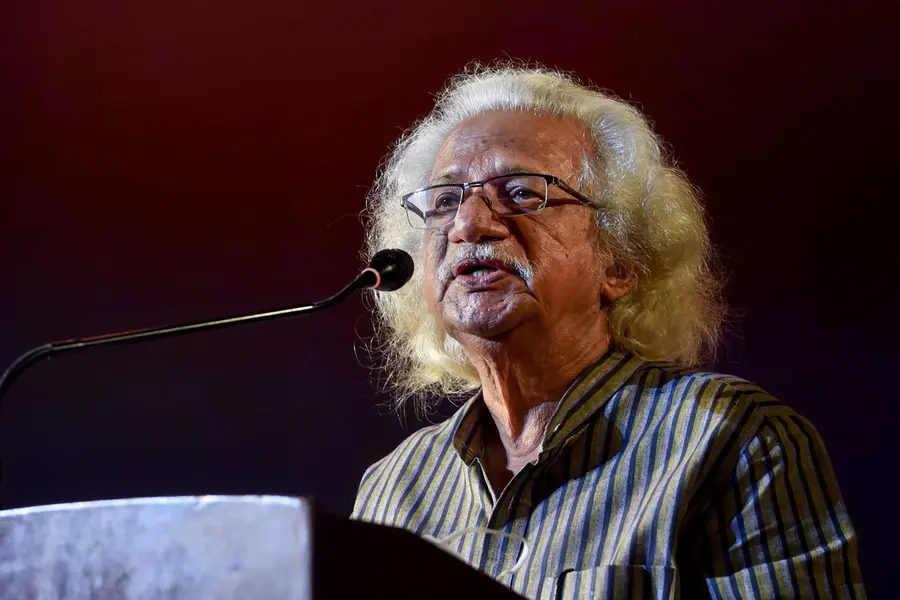
Adoor Gopalakrishnan was 26 in 1965, 60 years back and was trying to find a place under the sun of freshly developing Indian films, armed with a three year diploma in Screenplay and Direction from the newly started Film Institute of India at Pune. Unlike his Institute colleagues Mani Kaul, Subash Ghai and Asrani, who had their eyes fixed at Mumbai film world, Adoor chose to get back from Pune to Thiruvananthapuram to pursue a career in Malayalam films, as he was already active in the theatre groups of the city.
Adoor happened to have a well chalked out plan with his Malayalee colleagues at the Institute itself on his film career. As early as his second year at the Institute, Adoor, proactively organised a film unit with his classmates and named it Chitralekha. Their intention was to collaborate as a team upon their return to Kerala. His plans were clearly focused on the Malayalam film scene. The core team of the Chitralekha initiative consisted of himself, sound engineering student Devadas, cinematography student Abdul Latheef, and film editing student Melatoor Ravi Verma (the last two dropped out later to pursue job opportunities elsewhere). Fortunately, Mankada Ravi Varma, a senior alumnus of the Institute of Film Technology, Madras joined the unit later. Public Relations were assigned to Kulathoor Bhaskaran Nair, a colleague and classmate of Adoor’s from Gandhigram Rural Institute, Madurai.
The group was considering a three-pronged approach to a film movement in their future plans. At the forefront of the plan was the establishment of the Film Society Movement in Kerala, aimed at presenting international classics and the finest Indian films to cultivate a fresh appreciation for the art of cinema.

When asked recently, whether his plans for a better film culture worked out as foreseen his initial plans, Adoor, who turns 86 on July 3, 2025, quipped; “I never thought I will live to see this day, not to speak about the plans we had”. But he was happy that July 5, 2025 a group of film societies are felicitating him at Thiruvananthapuram on the occasion of 60th anniversary of the first film society of Kerala.
Chitralekha got off to an impressive start when the then Governor Bhagawan Sahay inaugurated the Film Society on July 5, 1965.The opening celebration took place at the Sreekumar Theatre in Thiruvananthapuram and was attended by the city’s cultural elite. Typically, English films were shown at this theatre. The inaugural film of Chitralekha film society was the Hungarian film, The Land of Angels. Veteran writer and venerable journalist K Balakrishnan, renowned theatre and cultural personality CI Parameswaran Pillai, and notable playwright TN Gopinathan Nair, addressed the gathering at the inaugural where Adoor welcomed the audience; his colleague, Kulathoor Bhaskaran Nair, delivered the vote of thanks. The society’s membership fees was Rs 10 per month, while the admission fee was Rs 5.
The way Chitralekha Film Society was conducted was quite unique, as it consistently maintained an academic approach in its operations. This was evident through its practice of distributing programme notes to members in advance and organising post-screening discussions, similar to what one would find in a film school. The Film Society movement elevated the status and significance of viewing important films from around the world, bringing a new level of seriousness and insight to the art of film viewing. The films selected for the screening were obtained from various international embassies, the Federation of Film Societies of India (FFSI), and a handful of private sources. Though there was a club in the city those days, they never had access to such film sources or structured viewing like Chitralekha.
“Adoor himself prepared the briefs about the films, which others cyclostyled and made copies to be distributed to the members, well before the film. Sometimes Adoor introduced the film and after the films there was always a discussion on the film”, recollected Meera Sahib, who joined the film society as a PG student.
First major touring film festival of Kerala
The Film Society movement in Kerala received a significant boost when the Fifth All India Writers Conference was convened in December 1965 and January ’66. The organisers had meticulously curated a diverse array of performing arts from Kerala, encompassing both classical and folk traditions, to infuse the event with vibrant cultural richness. The leading luminaries of the event, modernist poet M Govindan, public sector fertiliser company FACT’s Chairman MKK Nair, playwright CN Sreekantan Nair and artist MV Devan expressed their belief that an International film festival could be organised alongside the literary festival, with Adoor taking on the responsibility.
Sensing a golden opportunity to promote meaningful films Chitralekha which received full financial support from FACT, the conference’s sponsoring public sector company, 21 outstanding films from across the globe were procured from various sources, to mount the first international film festival in Kerala. These films were screened for a week concurrently in nine district headquarters of Kerala and adjoining Nagercoil. It exerted a profound impact on the intellectual and cultural community of Kerala, challenging its perception of films as mere entertainment while highlighting their artistic value. This event shattered misconceptions about cinema being a mere commercial venture, akin to gambling or horse-racing. “The effort was to make films on par with other arts like literature and theatre, which had an honourable place in the society”, Adoor recalled. Thanks to few senior officers of the FACT and their handling of the logistics across the district headquarters, the festival was a big success. “In the festival brochure I had written that we hoped that after the festival, there will be a film society organised by enthusiasts in each of these district headquarters”, Adoor explained.
“The films which were shown at the festival included Soviet-made, Cranes are Flying (directed by Mikhail Kalatozov), Ballad of a Soldier (by Gregory Chukhrai), Roman Polanski’s Knife in the Water, Jerzy Kawalerovicz’s Polish film, Night Train, Henri-Georges Clouzot’s French film, La Verite, Laszlo Ranady’s Hungarian film, Skylark, Roberto Gavaldón’s Mexican film, Macario, Satyajit Ray’s Devi, and Ritwik Ghatak’s Meghe Dhaka Tara. These films nicely jelled with an already flourishing radical literary movement in the state. That paved the foundation stone for a wide spread film society movement across Kerala in 1966 itself.
“The festival, also, gave a new vigour to the budding film society movement in Kerala. In about a decade, the State had about 110 Societies (the largest number in any region, a record previously boasted by West Bengal)” noted Gautaman Bhaskaran in his biography on Adoor (3).“The scientists of the Indian Space Research Organisation (ISRO) who had assembled from all parts of the country at the capital city of Kerala, bank employees, Central and State government officials, University professors, the medical engineering college students, and theatre activists, writers and artists of the city, were the initial members of Chitralekha film society,” mentioned MF Thomas, its General Secretary in the 1970s. Thomas achieved great success as a film writer, playing a pivotal role in shaping the film culture in Kerala. Throughout his career, he also authored numerous books on film aesthetics.
The 16 mm films were screened in the YMCA hall next to the Kerala secretariat, with Adoor himself operating the portable projector. Over the years, Chitralekha had a 35 mm projector installed at the Tagore Centenary Hall at Thiruvananthapuram. This Hall was generally used for showcasing the theatre arts and hosting public meetings. It has since been converted into a regular film screening venue. Tagore Theatre has been the main venue for the annual International Film Festival of Kerala (IFFK) for the past three decades.
Sourcing films was very difficult those days. Adoor, as a Film Institute student, had an excellent rapport with the National Film Archive (NFAI), headed by Mr P K Nair, which was housed in the same campus during the early days. The embassies of various countries in New Delhi maintained a diverse selection of films from both Eastern and Western Bloc countries, thanks to the intense cold war of the decade. The film society movement and its national federation, the FFSI, experienced a surge in activity during the 1960s and 1970s, which greatly influenced the growth of Kerala film societies and Chitralekha.
The films sourced by Chitralekha were subsequently shared with numerous film societies in Kerala before being returned to its original distributors. In response to the challenges faced by the State from the FFSI at the time, Chitralekha formed the Association of Film Societies of Kerala in 1970, which later was recognised by FFSI, as unit FFSI Keralam. The Kerala unit of FFSI, though gone under political shadows still is a force to reckon as the only active film societies in India in 2025 also.
In the 1970s, Chitralekha gained patronage from the powerful people of Thiruvananthapuram thanks to its enthralling flicks. The then-chief minister of Kerala, C Achutha Menon, and the newly-established public sector company Keltron, Chairman, KPP Nambiar, and his wife, former Delhi University Vice Chancellor Dr KN Raj, who had relocated to the city to found the Centre for Development Studies (CDS), began attending the screenings on a regular basis. The public relations department of the state took notice and promptly installed its own 35 MM projector at the Tagore Hall, displacing Chitralekha. During that time, Chief Minister Achutha Menon would discreetly reserve a seat at the back of the Hall and quietly attend the screenings, slipping away without drawing much attention. “One of the unique features of Chitralekha screening was the cyclostyled background material about each film and sometimes a running commentary about the film by Adoor himself”, Vijayraghavan, a retired Akashvani Director, fondly recalled his days as a Rs 15 paying member of the film society in the early 1970s.
Chitralekha had commemorated the 25th anniversary of the release of Pather Panchali before fading into obscurity. “We celebrated the 25th anniversary of Ray’s first film with a seminar. We had regular viewers from the Centre for Developing Societies, headed by its scholar Dr Thomas Isaac, who later became the finance minister of Kerala. Architect Shanker was another regular in the 1980s,” the society’s last secretary, late CG Philip, a retired Canara Bank officer recalled. Chitralekha film society was active in 1985, even after Adoor left the Chitralekha film cooperative, the sister organisation of Chitralekha film society in 1980 and became a full time independent filmmaker.
(The article is an edited and updated version of the Chapter on Chitralekha Film movement from V K Cherian’s book-Noon Films and Magical Renaissance of Malayalam films)
Published: 04 Jul 2025, 12:23 pm IST
Disclaimer: Kindly avoid objectionable, derogatory, unlawful and lewd comments, while responding to reports. Such comments are punishable under cyber laws. Please keep away from personal attacks. The opinions expressed here are the personal opinions of readers and not that of Mathrubhumi.