

At the Mathrubhumi Festival of Letters 2026, writer Inez Baranay and scholar Dr. Kalyani Vallath reflected on how memory, displacement and imagination shape storytelling
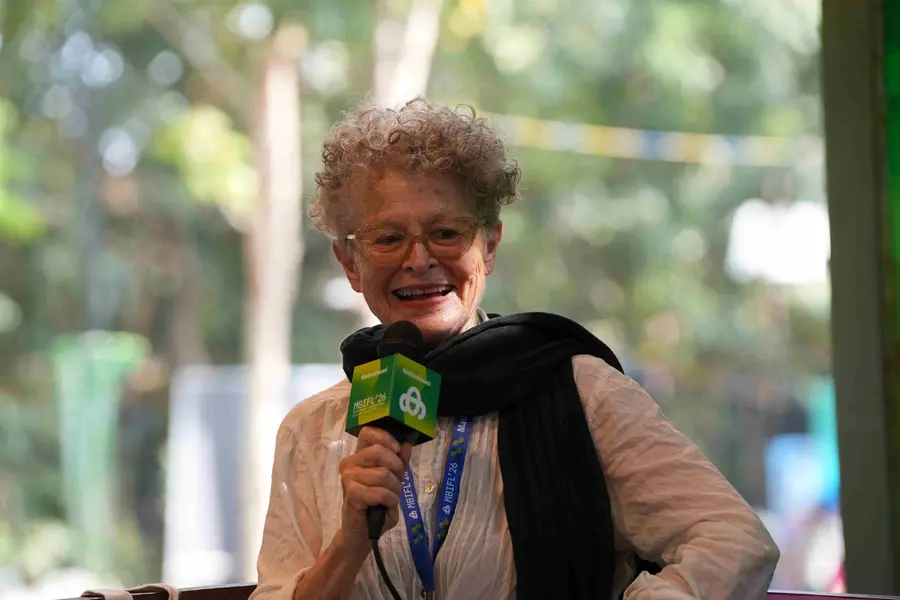
At a time when nations are increasingly defined by borders and binaries, literature offers a quieter but deeper inquiry: how does a nation feel? At the session “Soul Climate: Nation, Memory And Imagination”, Australian writer Inez Baranay and scholar-educator Dr. Kalyani Vallath explored how memory, displacement and imagination shape the inner landscapes from which stories emerge.
The dialogue unfolded less as a formal literary discussion and more as a shared reflection on belonging, marginality and the responsibility of writing across cultures.
Writing Beyond Borders
Introducing Baranay, Dr. Vallath described her as “a writer who defies definitions,” shaped by life across continents and cultures. Though Australian, Baranay’s work has been deeply influenced by her long engagement with India and Turkey, reflecting what Vallath called a transcultural citizenship of the world.
Responding to a question on how she blends personal experience with a transnational voice, Baranay resisted fixed explanations.
“I write how I must write,” she said. “Every writer has to find their voice and their subject, and each time that has to be found freshly again.”
For Baranay, writing does not offer answers so much as it opens new questions. Life experience, reading, and ethical awareness quietly combine to shape the work, often beyond the writer’s own conscious understanding.
Neem Dreams And Writing From Engagement
The discussion turned to Neem Dreams (2003), Baranay’s acclaimed novel that uses the neem tree as a metaphor for Indian culture, ecology and relationships. Vallath asked where Baranay positioned herself—as an outsider or participant—while writing about India.
Baranay described the novel as one of the most intensive and transformative projects of her life.
“I wanted a reason to be deeply engaged with India,” she said, “not just to be a tourist.”
Her entry point came through the neem tree itself—an ancient symbol of indigenous knowledge—at a time when multinational corporations were attempting to patent neem-based products. This conflict between traditional wisdom and global capitalism became central to the novel.
Through research, village visits, and her time as writer-in-residence at the University of Madras, Baranay’s relationship with India deepened. The novel, initially rejected by Australian publishers, eventually found a home in India.
“If you read Neem Dreams today,” she noted, “the issues feel even more urgent.”
The Western Gaze And Conscious Writing
Dr. Vallath raised the inevitable question of the Western gaze, postcolonial writing, and representation—especially in works like With The Tiger, which reimagines Somerset Maugham’s The Razor’s Edge.
Baranay acknowledged the complexity without defensiveness.
“I have an enormous awareness of that,” she said. “I grew up in an Anglo-dominated Australia as the child of post-war refugees. There was always a sense of foreignness.”
That early awareness, she explained, made her sensitive to the idea that some worldviews are treated as universal, while others are marginalised. Rather than “negotiating” the gaze, she allows that awareness to inform her writing instinctively.
“That understanding becomes part of the being who creates—and then creates the work.”
The conversation moved towards marginality and voice. Baranay was clear that she does not claim to speak for the margins but writes from her own marginal position.
“There’s no other position I can talk from,” she said.
Beginning her career in the 1980s, Baranay emerged alongside feminist, experimental and multicultural writing movements. Labels, she joked, offered a place on the shelf—but never captured the whole work.
“A little of all of them,” she said. “But not entirely.”
Women, Memory And Forgotten Histories
The session closed with a discussion on women’s histories and Baranay’s engagement with Halide Edib, a Turkish writer and freedom fighter who travelled to India in the 1930s. Fascinated by the intersections between Turkey and India, Baranay fictionalised Edib’s journey and her interactions with leaders of India’s independence movement.
“The drive for independence and self-determination of women has always been constant in my writing,” Baranay said.
Through Edib’s story, Baranay revisits a moment of shared idealism—when visions of freedom, unity and justice felt possible across nations.
What emerged from the session was not a theory of nationhood, but a shared understanding of soul climate—the emotional and imaginative weather shaped by memory, movement and lived experience
In a world increasingly defined by noise and certainty, the conversation reminded listeners that literature thrives in ambiguity, empathy and questions that refuse easy answers.
Published: 03 Feb 2026, 09:48 pm IST
ABOUT THE AUTHOR
Related Topics
Disclaimer: Kindly avoid objectionable, derogatory, unlawful and lewd comments, while responding to reports. Such comments are punishable under cyber laws. Please keep away from personal attacks. The opinions expressed here are the personal opinions of readers and not that of Mathrubhumi.