

Senior journalists Anjana Sankar and Stanly Johny examined the Gaza war, media narratives, and the unresolved Palestinian question
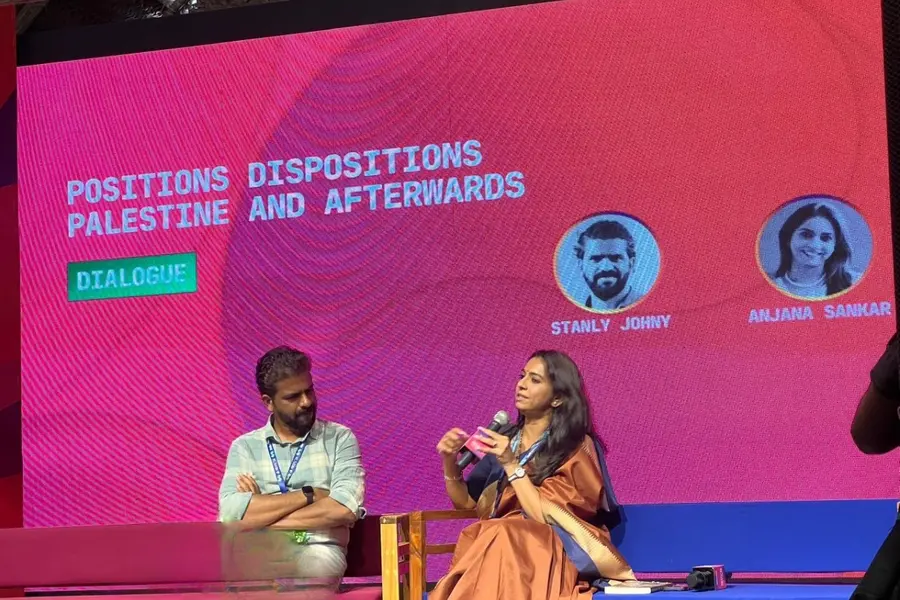
Award-winning international journalist Anjana Sankar and The Hindu’s International Affairs Editor Stanly Johny came together at Mathrubhumi International Festival of Letters 2026 (MBIFL 2026) for a wide-ranging discussion on Palestine, Gaza, and the future of West Asia, stressing that the conflict can no longer be treated as a marginal or “frozen” issue in global politics.
Opening the session, Anjana Sankar described Palestine as one of the world’s most polarised and misunderstood subjects, noting that decades of reporting have often flattened its historical and political complexity. She said recent events had exposed deep fractures not only in the region, but also in international politics, media narratives, and the application of international law.
Also Read
Stanly Johny stated that “History did not begin on October 7.” And continued that before October 7, 2023, the Palestinian issue had been pushed to the background, even as Israel normalised ties with several Arab states. That illusion, he said, collapsed after the Hamas attack that killed around 1,200 people in Israel and Israel’s subsequent military assault on Gaza, which he said had killed more than 34,000 people, including nearly 20,000 children. The scale of devastation, he stressed, showed that peace in West Asia cannot bypass Palestine.
Also read: Jaya Ekadashi 2026: Date, timings, rituals and spiritual significance
Discussing regional politics, Stanly Johny said economic engagement and normalisation had failed to influence Israeli policy. He pointed out that Saudi Arabia had made clear there would be no normalisation without a Palestinian state based on 1967 borders, with East Jerusalem as its capital. Yet, he added, there was no serious commitment to a two-state solution across Israel’s political spectrum.
Responding to Johny’s question on Arab public sentiment, Anjana Sankar said “Living in the Arab world, I see how central Palestine remains to Arab politics.” Added there was no single Arab position. While governments maintained diplomatic and security ties with the US and Israel, public anger had intensified across the region, especially among young people. She said the Gaza war had reopened historical wounds and exposed growing frustration with both Israel and Arab governments.
Stanly Johny outlined the core argument of his book ‘Original Sin: Israel, Palestine and the Revenge of Old West Asia’, emphasising that “history did not begin on October 7”. While condemning attacks on civilians, he said the Palestinian question remained unresolved despite repeated international promises of statehood, leaving Palestinians without sovereignty even decades after the 1947 UN Partition Plan and the 1967 war.
Both speakers sharply criticised media coverage of Gaza. Anjana Sankar said information from Palestinian doctors and humanitarian agencies was often treated with suspicion, while Israeli military claims were frequently accepted at face value. Stanly Johny added that language choices in Western media often avoided naming Israel as the perpetrator, stripping Palestinian victims of agency. “After two years of war, refusing to name who bombs Gaza is no longer neutrality — it’s distortion.”
On Gaza’s future, Stanly Johny said Israel had failed to eliminate Hamas despite massive destruction and displacement. He described current proposals involving international forces and technocratic governance as unrealistic, noting that Hamas had no incentive to disarm and Israel showed little willingness to withdraw. “Hamas has offered to hand over governance, but not weapons.” And Anjana Sankar warned that ideology could not be bombed out of existence and that mass civilian suffering risked entrenching extremism further.
Answering audience questions, Anjana Sankar said she had never witnessed killing of children on the scale seen in Gaza, citing medical testimonies of direct gunshot wounds. Stanly Johny added that regional support for Palestine had weakened, leaving Israel with overwhelming power. And stated “Over 34,000 deaths cannot be justified as self-defence.”
Closing the session, Anjana Sankar said international law demanded proportionality and warned that selective application of legal principles undermined their legitimacy. Without justice and sovereignty for Palestinians, both speakers concluded, the cycle of violence in West Asia would continue.
Published: 29 Jan 2026, 12:46 pm IST
ABOUT THE AUTHOR
Related Topics
Disclaimer: Kindly avoid objectionable, derogatory, unlawful and lewd comments, while responding to reports. Such comments are punishable under cyber laws. Please keep away from personal attacks. The opinions expressed here are the personal opinions of readers and not that of Mathrubhumi.