
She recalled attending the very first edition of MBIFL years ago and shared a moment that had stayed with her far more vividly than any professional recognition
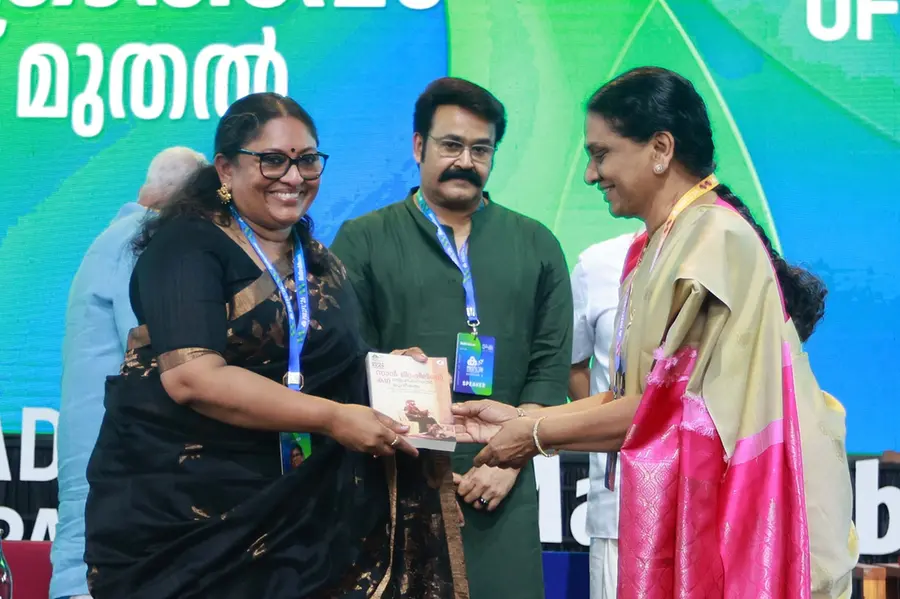
Compassion, writer KR Meera reminded the audience at the Mathrubhumi International Festival of Letters (MBIFL) 2026, is not an instinct one simply stumbles upon—it is a faculty that must be consciously cultivated.
“Compassion is another version of wisdom,” Meera said. “It does not come on its own. It can be attained only through effort.” Neither classrooms nor the streets, she added, can teach it; compassion must be practiced deliberately and persistently, guided by individual will.
My first MBIFL
She recalled attending the very first edition of MBIFL years ago and shared a moment that had stayed with her far more vividly than any professional recognition. That session was attended by the late M. P. Veerendrakumar, then Managing Director of Mathrubhumi, who stood throughout the programme because there was no chair available. “Big accolades are not what make life meaningful,” Meera reflected. “It is moments like these that stay with us.”
Speaking of compassion—kanivu—Meera highlighted two figures India cannot afford to forget: Sree Narayana Guru and Mahatma Gandhi. For both, she emphasized, kindness and love were not moral embellishments but essential for human survival, qualities that must be consciously acquired.
Drawing on Guru’s philosophy, Meera explained how arul, anpu, and anukamba—often translated as grace, love, and compassion—are deeply interconnected. Arul can mean word, love, or God; anpu signifies joy, kindness, or devotion; and anukamba reflects compassion or the feeling evoked by witnessing extreme suffering. Together, they form a moral vocabulary rooted in action rather than abstraction.
It is impossible, Meera said, to speak of Gandhi without speaking of Mathrubhumi. The newspaper was launched on March 18, 1923—exactly one year after Gandhi’s imprisonment—explicitly as an act of solidarity. Its first issue even carried a special Gandhi page, including Vallathol’s poem Ente Gurunathan. Gandhi’s association with Mathrubhumi went beyond symbolism: during his fourth visit to Kerala on January 13, 1934, he personally visited the newspaper’s office.
Recalling Gandhi’s later visits to Kerala, she spoke of his insistence that freedom must be measured by everyday dignity—especially for women. “If my sisters cannot walk freely at any time of the day,” Gandhi once asked, “is that freedom really freedom?” On another visit, when Gandhi asked the Dalit leader Ayyankali how he could help, Ayyankali’s response was strikingly pragmatic: “Just give me 100 BA graduates for my community.”
For Meera, these moments underscore a larger truth: India’s freedom struggle is not a closed chapter. “It is continuing,” she said, adding that Mathrubhumi has no option to remain distant from it.
Published: 29 Jan 2026, 10:11 pm IST
Related Topics
Disclaimer: Kindly avoid objectionable, derogatory, unlawful and lewd comments, while responding to reports. Such comments are punishable under cyber laws. Please keep away from personal attacks. The opinions expressed here are the personal opinions of readers and not that of Mathrubhumi.
