
Meenakshi Krishnan`s `Shore Symphonies` explores love, care, and the human experience with lyrical beauty and heartfelt sincerity.
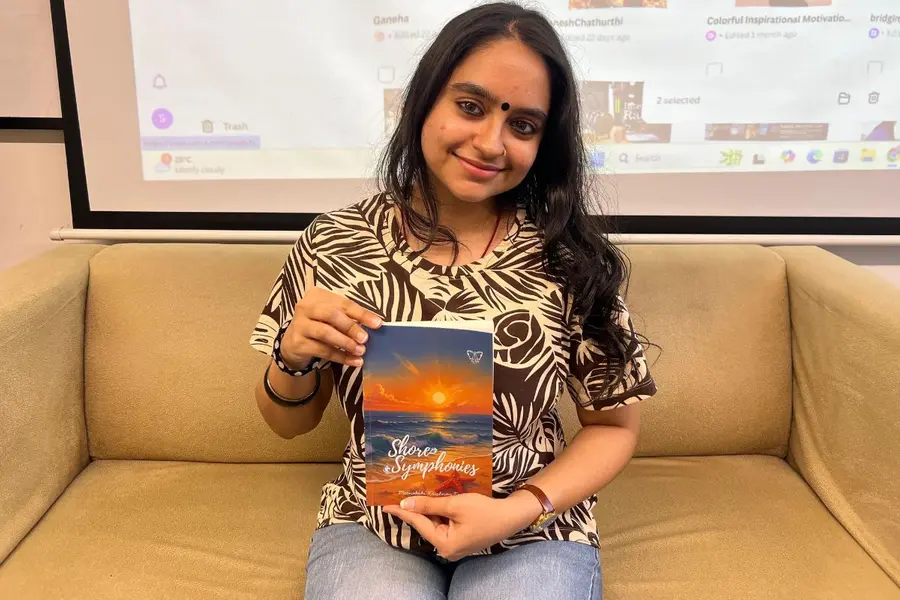
Shore Symphonies by Meenakshi Krishnan is a work that confirms poetry's potential to grasp human emotion with beauty and sincerity. It is her third work of verse following ‘Maiden Blooms’ in 2022 and ‘Peepal Euphonies’ in 2024, and demonstrates a poet who is gradually improving in voice, confidence and maturity. Through forty poems composed in free verse, Meenakshi examines love, care, yearning, and the fleeting workings of the human mind and intertwines them into a rhythm that is both intensely personal yet sufficiently open to allow readers to locate themselves in her words. Her own background contributes to the depths of this work.
Born in Kerala, raised in Muscat and Mumbai, and now a student of the PG Diploma in Journalism at Mathrubhumi Media School, she has within her sensibility the gentle touch of foreign worlds, alien landscapes, and alien cultural beats. The cosmopolitan upbringing combined with the rootedness of Kerala gives her eyes an outward-looking gaze, as well as an inward-searching quality. Her initial choice to study literature in English provided her with a language background that can be seen in her poems, not only in their vocabulary mastery but also in the manner in which she deals with subtlety. But she does not write like a scholar or a critic; she writes with the heart of one who sees, feels, and brings emotions into words.
The Author's Note to the book gives an insight into her experience and presents the tone of what is to come. She remembers being a Class Three student in the "A" division of a coastal nation when her baby cousin was born. The birth was the inspiration for her first poem, "My Baby Brother," in which she wrote of the twinkle of mischief in her brother's eyes. That simple poem, written with the innocence of a child, was shown to her teacher but received no encouragement. Instead, it was her mother who quietly preserved the little poem in her diary, and continues to keep it there even today. This gesture becomes significant not only as a personal memory but also as a metaphor for the act of care and preservation that runs through Meenakshi’s poetry. At times, it only takes one person's belief to keep the flame burning with creativity. The anecdote also reminds readers that poetry may not start with recognition but with closeness, not with acclaim but with silent protection. ‘Shore Symphonies’ is a product of that awareness, it is composed not to establish credibility but to preserve, not to impress but to express.
In the book appraisal, Dr Somanatha Pillai points out that ‘Shore Symphonies’ is written in free verse, and this is not mere chance. Free verse permits Meenakshi to transcend the compulsive strictures of rhyme and meter and concentrate instead on the organic rhythm of feeling and thought. But free verse is also challenging since it demands that each word matter, that the rhythm of words themselves offers song in the absence of form. What is impressive in this book is the poet's control over vocabulary and phraseology. She picks her words carefully, not for show but for meaning, so each line has a separate rhythm. Her words tend to echo the rise and fall of waves—sometimes long and winding, almost meditative, and short and crashing and insistent at others. The title of the book perfectly encapsulates this. Shores are borders, where land and sea meet, stability and uncertainty intersect, permanence and transience converge. They are transition metaphors, and in this book, the poet appears to reside in such transitional zones. The term "symphonies" indicates an orchestration of such transitions, varied experiences blending harmoniously. Every poem thus becomes a note, and all together they form a greater music that is textured and resonant.
Its major themes are love, care and romantic imagination. Love in the book is not limited to the traditional concept of romance, though romantic factors permeate most poems. It is also about sibling love, the love of friendship, the parent-child bond, and the greater longing for human connection. Love is reimagined as an anchor, that keeps the individual grounded against the turbulent vagaries of life. Care is another dominant thread, more typically represented in minor acts of remembering and keeping safe. Even as her mother kept her earliest childhood poem, these poems keep ephemeral moments safe from the passage of time. A smiling look remembered, the memory of a breeze, the flavor of a goodbye—all are kept neatly in the lines so they do not fade. Romanticism also takes the form of expression not just in relationships but in the poet's interaction with landscapes. Having grown up between coastal Muscat, metropolitan Mumbai and the verdant beauty of Kerala, Meenakshi’s relationship with nature is complex and multi-layered. The sea appears again and again, sometimes as confidant, sometimes as metaphor, sometimes as mystery. Nature, in her poems, is not a backdrop but participant—it feels, breathes, and speaks.
Reading ‘Shore Symphonies’ also invites comparison with her earlier works. Maiden Blooms in 2022 retained the innocence of a first bloom, brimming with hope and awe, the thrill of a person discovering her voice. Two years on, Peepal Euphonies, released in 2024, showed an intensifying thought. The peepal tree symbolized roots, resilience, and silent endurance in the face of change. ‘Shore Symphonies’ is now a reconciliation of the two strands. It retains the spontaneity of the first book and the meditative power of the second, but also a fresh confidence derived from maturity. It is as if a threshold has been reached, where the poet finds a balance between youthful exploration and mature insight.
One of the most compelling aspects of the book is its musicality. Even without rhyme, the poems have sound and rhythm. Reading them aloud calls forth cadences that remind one of the waves she writes about so frequently. Her application of poetic devices – metaphor, alliteration, and repetition – is understated but well used. Words are as much selected for their sound as for their sense, and this provides the book with a lyrical texture. At a moment when much of modern poetry is going either towards the speech-like or the wildly abstract, Meenakshi finds a middle path. Her poetry is available, but not dull. It's lyrical, but not confusing. She writes in straightforward language, but leaves leeway for the imagination.
Maybe the most impressive feat of ‘Shore Symphonies’ is that it can take moments that are personal and turn them into shared observations. Her own childhood tale in her first poem, for example, is hers alone, but it speaks to anyone who has ever wished to be encouraged or encouraged by someone who surprised them. Her poems about love might be drawn from her own experience, but they speak for the reader's own unspoken heart. That is the magic of poetry at its finest—it is a mirror in which both poet and reader can find themselves.
There are a few standouts in the book. A few poems regard the sea as a confidant, an immense listener to unspoken longing and dread. Some capture the tactility of touch, the manner in which a simple touch is unforgettable. Others weigh the pain of distance and the strength of memory. Each poem stands on its own, but together they form a larger narrative of emotional growth. The cumulative effect is that of a symphony—different notes, different moods, but all tied together in harmony.
No review is complete without acknowledging areas for growth. At times, the richness of Meenakshi’s vocabulary can feel too lush, risking the possibility of overwhelming the simplicity of the underlying emotion. Free verse is most effective when each word reads as required, and sometimes a tighter cut might have heightened the effect. But these are quibbles, the sort of excesses to be expected of a poet still developing her style. Based on her track record from Maiden Blooms to ‘Shore Symphonies’, one can anticipate her subsequent works to be even more streamlined, even more confident.
In the larger context of Indian English poetry, ‘Shore Symphonies’ is significant. Contemporary poetry in India is witnessing a resurgence, with many young writers using both digital and print platforms. Yet much of it struggles either with over-simplicity or over-experimentation. Meenakshi’s voice stands out for its balance, its sincerity, and its refusal to sacrifice beauty for trend. She is not afraid to be lush, and yet her poems are accessible. She shows us that poetry can be personal and universal, musical and meaningful.
In the end, ‘Shore Symphonies’ is a book that should be read slowly and reread frequently. Its forty poems provide not only stories and thoughts but also rhythms and moods that linger. As with the sea it so frequently summons, the book encourages the reader to go back, to hear again, to discover new interpretations every time. Meenakshi Krishnan has penned a book that testifies to the abiding strength of poetry to capture the essence of life. Although still in early youth, she writes gravely, sincerely, and with a feeling of mission. As she proceeds on her academic path in journalism and her concurrent path in literature, the voice is likely to deepen even more. For the time being, ‘Shore Symphonies’ is a well-deserved testament to her evolution as a poet and to the music that words can make when written with attention, conviction, and love. It is a volume that should grace the bookshelves of anyone who loves poetry not as decoration but as utterance, not as flight but as embrace, not as stage but as reality. As with the diary in which her mother kept her earliest poem, so with this volume too, there is a sense of preservation, holding down the momentary feelings and making them permanent sound. And maybe that is poetry's ultimate success.
Published: 18 Sept 2025, 05:49 pm IST
Related Topics
Disclaimer: Kindly avoid objectionable, derogatory, unlawful and lewd comments, while responding to reports. Such comments are punishable under cyber laws. Please keep away from personal attacks. The opinions expressed here are the personal opinions of readers and not that of Mathrubhumi.
