
Han has said she writes out of questions, about whether humans are fundamentally violent, about how to live with that knowledge, about what tenderness is for
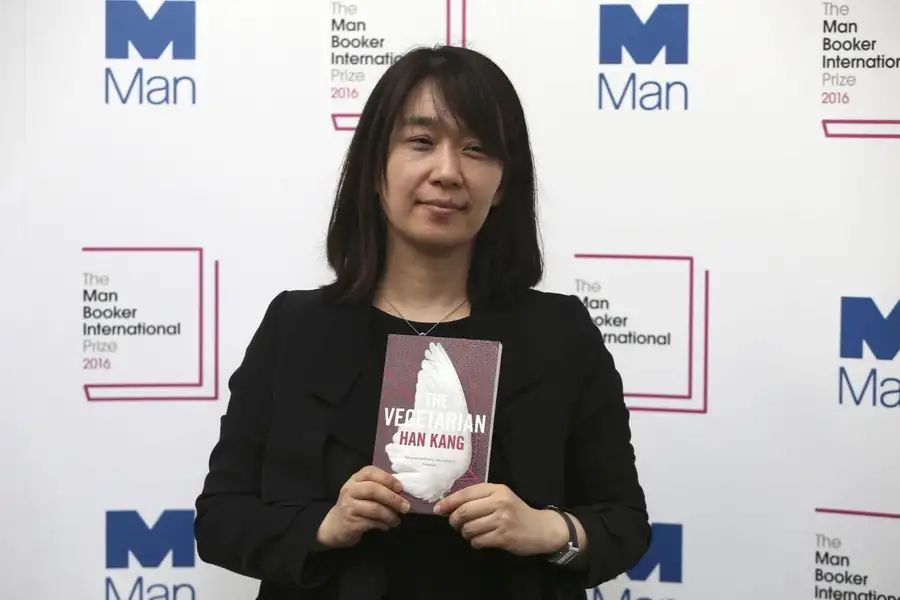
Han Kang turns 56 today. Two years after the Nobel Prize in Literature made her the first South Korean to win it, she has published Light and Thread, her first nonfiction book in English. Han herself tends to explain her books through questions rather than messages, and she has asked the same questions with striking consistency for a decade.
Before the beginning- the golden thread
Her Nobel Lecture, delivered at the Swedish Academy in December 2024, begins with a small discovery. While packing for a move, she found a notebook of poems she wrote at age eight, in 1979, just before her family left Gwangju for Seoul. One poem described love as a golden thread connecting human hearts, an image she says she still recognises in herself. According to the Asia Business Daily, she spent about half an hour tracing the origins of her novels and closed by thanking everyone connected to that thread of language.
Also Read

That image gave Light and Thread its title. The collection opens with the lecture and gathers essays, poems and photographs, including reflections from the small courtyard garden at her home, which she keeps alive with light reflected from mirrors.
(im)possibility of innocence
Ask Han what links her novels and she gives a version of the same answer. In 2016, speaking to NPR as The Vegetarian reached English readers, she described a "long-lasting question about human violence" and whether it is possible to refuse it. She told the Korean newspaper JoongAng Ilbo that year that she wanted to ask whether a person could reject every kind of violence and become wholly innocent. Talking to Lit Hub, she called this the "(im)possibility of innocence."
She told The White Review that the range of human nature, from the sublime to the brutal, had felt like a difficult homework problem since childhood. Her books, she said, are "variations on this theme of human violence," and each leads to a second question: what can we do in the face of it? Later, in the Guardian, she framed it as a test of limits: "how far humanity can go and still be human."
The photographs from Gwangju
The question has a specific origin. Han was born in Gwangju and moved to Seoul in January 1980, months before the May uprising and the army's violent suppression of it. In her Nobel Lecture, as reported by the Asia Business Daily, she recalled finding a photo album of the massacre when she was twelve and wondering, "Can humans do such things to other humans?" That question collided with another, about the dignity and warmth she associated with human life. The two, she said, became a riddle she has been working on ever since.
The riddle became Human Acts. According to Gulf News, its young central character grew out of photographs she had seen as a child. She has told the Guardian that writing it brought extreme physical and mental pain, and that she was surprised to learn readers felt pain reading it too.
‘I use my body’
That physical cost runs through how she describes her work. "When I write, I use my body," she says in the Nobel Lecture, and she has spoken of debilitating migraines since childhood. In an interview on the Booker Prize website, she said she wants her sentences to carry "vivid senses like hearing and touch," like an electric current running through them.
‘Can we really separate the personal from the political?’
When she turned to the Jeju 4·3 massacre in We Do Not Part, she told the Guardian she had not set out to take on another atrocity. The idea came instead as a recurring dream of snow, which she described to NPR's Scott Simon. She has described the book's starting point as a question about why we feel pain together in the face of violence, and the possibility that the answer is love.
She sees the novel as a pair to Human Acts. In a Herald Corporation interview in July, she said that although it deals with history, it focuses closely on inner lives, and that political and interior writing cannot be neatly divided. Asked in September in Berlin whether she is a political writer, she answered with a question of her own: "Can we really separate the personal from the political?" She was on stage at the Philharmonie reading from Light and Thread, newly published in German, and from We Do Not Part, according to the Korea Times.
Opening a bookshop
If her early books are about violence, she has said her thinking has been moving elsewhere. In a World Literature Today conversation, she said that after Human Acts she wanted to explore human dignity and strength more deeply. She told the Christian Science Monitor in 2016 that she believes in human dignity and wants to remember that whenever she faces painful questions about humanity.
Fame has not changed the plan. Shortly after the Nobel, she told a Korean outlet that she was trying to return quietly to a life of writing. This year, the Herald reported, she opened a bookshop, which she said had been a dream since her twenties.
Where to start Han Kang
There is no single correct way in, but a few paths are reliable:
-
For the book that made her name: The Vegetarian, short and unforgettable.
-
For history told through people: Human Acts, harrowing but extraordinary.
-
For her poetry: The White Book, which can be read in an afternoon.
-
For her most recent novel: We Do Not Part, widely acclaimed and a good sense of what the Nobel committee saw.
-
For the writer herself: Light and Thread, a gentle introduction that includes her Nobel Lecture.
Han herself points newcomers to We Do Not Part. In a Nobel Prize interview recorded in Stockholm, she recommended it to anyone curious about her work and unsure where to begin.
What her books ask of us
Han has said she writes out of questions, about whether humans are fundamentally violent, about how to live with that knowledge, about what tenderness is for. Her books do not answer these. They hold them open, and ask the reader to do the same.
That is why the work lingers.
It does not tell you what to feel.
Published: 27 Nov 2026, 07:57 am IST


ABOUT THE AUTHOR
Related Topics
Disclaimer: Kindly avoid objectionable, derogatory, unlawful and lewd comments, while responding to reports. Such comments are punishable under cyber laws. Please keep away from personal attacks. The opinions expressed here are the personal opinions of readers and not that of Mathrubhumi.