
Nobel Prize contender Haruki Murakami received two major honors in Manhattan for his celebrated career in fiction, essays, and translation
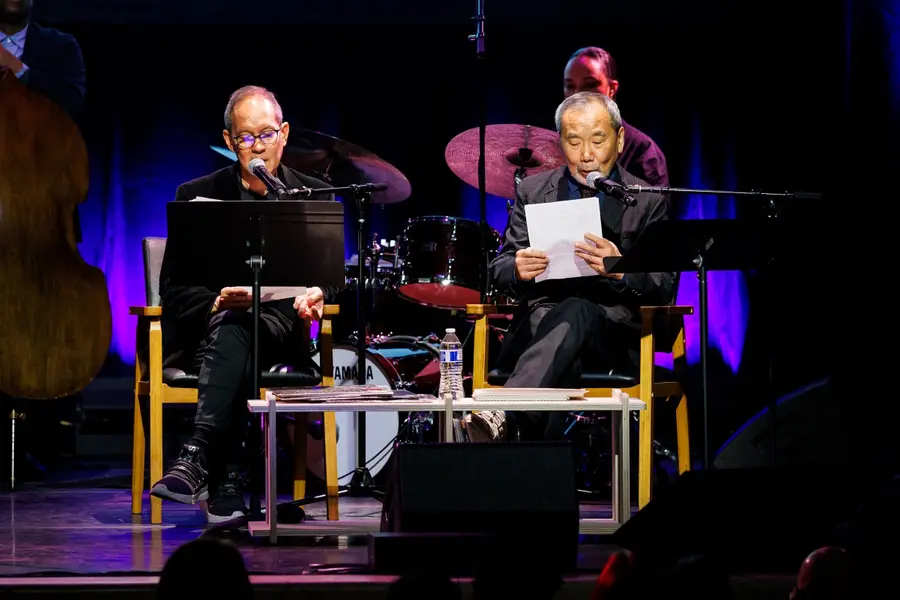
Japanese author Haruki Murakami was honoured in New York last week, where his writing was celebrated through awards, music and readings, with admirers quite literally singing his praises.
The 76-year-old Tokyo-based writer and long-time Nobel Prize contender received two major recognitions in Manhattan for his work as a novelist, translator, critic and essayist.
What honours did Murakami receive in New York?
On Tuesday night, the Center for Fiction presented Murakami with its Lifetime of Excellence in Fiction Award at a gala held at Cipriani 25 Broadway in downtown Manhattan. The award has previously been given to acclaimed writers including Nobel laureates Toni Morrison and Kazuo Ishiguro.
Two days later, the Japan Society co-hosted a musical tribute titled Murakami Mixtape at The Town Hall. During the event, Murakami was also presented with the Society’s annual prize recognising “luminous individuals (including Yoko Ono and Caroline Kennedy) who have brought the U.S. and Japan closer together.”
How was Murakami celebrated at the Center for Fiction gala?
At the gala, musician and poet Patti Smith, a long-time admirer of Murakami, introduced him by performing her ballad Wing, including the lines, “And if there’s one thing / I could do for you / You’d be a wing / In heaven blue.”
Smith recalled discovering Murakami through his debut novel Hear the Wind Sing. Holding up an old copy, she read its opening line: “There’s no such thing as perfect writing, just like there’s no such thing as perfect despair.”
She told the audience, “I was hooked, immediately.”
What was ‘Murakami Mixtape’?
The Murakami Mixtape event at The Town Hall was a sold-out, bilingual evening of music, readings and reflections. The programme featured Murakami’s opening and closing remarks and was led by jazz pianist Jason Moran, translator and publisher Motoyuki Shibata, and author-scholar Roland Nozomu Kelts.
The evening combined entertainment and literary insight, even featuring a makeshift bar on stage. It highlighted Murakami works that are less familiar to English-language readers.
Kelts read passages in English, while Shibata read in Japanese, selecting excerpts from novels such as Hard-Boiled Wonderland and the End of the World and the memoir What I Talk About When I Talk About Running. They also presented rarer works, including the short story The 1963/1982 Girl from Ipanema and an early essay about New York written before Murakami had ever visited the city.
What did Murakami say about New York?
Reflecting on the city, Murakami questioned its very existence, saying, “Does New York City really exist? I don’t believe, one hundred percent, the existence of the city. Ninety-nine percent, I would say. In other words, if someone came up to me and said, ‘You know, there’s actually no such thing as New York City,’ I wouldn’t be that surprised.”
Murakami also spoke about arriving in New York in 1991, during a period of strong anti-Japanese sentiment in the United States. His comments were read in English by Japan Society President and CEO Joshua Walker.
“Back then was the height of Japan bashing,” Murakami said. “You could find events, where, for a dollar, they hand you a hammer and let you take a whack at a Japanese car.”
He recalled being advised to stay home on December 7, 1991, the 50th anniversary of the bombing of Pearl Harbor, “just in case there was any trouble.”
How did jazz feature in the tribute?
Murakami’s long-standing love of jazz was a central theme of the evening. Kelts recalled asking the author about his favourite international cities, noting that Murakami often chose places such as Boston and Stockholm for their used jazz record shops.
Murakami’s passion for jazz began in 1963, when he heard Art Blakey and the Jazz Messengers tour Japan. That connection was revived during the event when Jason Moran invited 88-year-old bassist Reggie Workman, the last surviving member of that band, on stage. Workman joined the musicians for a performance of Ugetsu, ending with an extended solo.
What did Murakami say about writing and identity?
Murakami appeared briefly at the end of the evening to read a passage in Japanese from Kafka on the Shore. He told the audience that he might have become a musician rather than a writer, but he could not face rehearsing every day.
He also reflected on the challenges of being a Japanese writer abroad. “You often hear that Japan has no real face, no identity. I almost never came across contemporary Japanese fiction in American bookstores. As a Japanese writer, I couldn’t help but feel a real sense of crisis,” he said.
Looking to the present, Murakami expressed optimism about cultural change. “And now I see young Japanese writers venturing abroad, earning recognition, their books being picked up by readers as a matter of course, in music, film, anime and more. The advances have been remarkable. Economically, people talk about Japan’s three last decades, but culturally, I think it’s fair to say that Japan’s face has finally emerged.”
Published: 14 Dec 2025, 08:43 pm IST
Related Topics
Disclaimer: Kindly avoid objectionable, derogatory, unlawful and lewd comments, while responding to reports. Such comments are punishable under cyber laws. Please keep away from personal attacks. The opinions expressed here are the personal opinions of readers and not that of Mathrubhumi.
