
From Jaane Bhi Do Yaaron and Khandhar to Photograph and Ko, Shoma A Chatterji explores how Indian cinema has portrayed the still photographer as witness, voyeur, artist and storyteller.
This article has been triggered by two things. The first inspiration is a recent Bengali film called Chhobiwalla and the second is that August 19 is celebrated the world over as World Photography Day.
Still photography as a creative art, or the still photographer as a character unto himself who keeps a story moving, is a rare occurrence in Indian cinema now.
This neglect is perhaps traced back to our entry into the digital world, where even press photographers mostly use their advanced cell phones to record interviews and press conferences, and cell phones with stands to record reels for their paying clients.
Even so, in this ambience of relative invisibility, a journey into the past through cinema reveals an interesting mix of films that have featured a photographer as an important character and his camera as a significant catalytic agent in unfolding a story or becoming a character unto itself.
World cinema has no dearth of unforgettable celluloid photographers.
A few examples show how still photography is not just about recording visual history but also a revelation of the versatility of the camera within the larger screen space created, manipulated and controlled by a character within the film.
The first film that comes to mind in world cinema is the unforgettable classic Roman Holiday (1953), starring the smashing Gregory Peck and the debutante Audrey Hepburn, where the camera of Gregory Peck is used as a twist in the climax of this sweet love story between a runaway princess and a press photographer who do not know each other when the film begins, but the love story ends when the hero reveals his true identity.
Take Alfred Hitchcock’s Rear Window (1954), for instance.
A nail-biting thriller that reveals how the still camera in the hands of an intelligent photographer, though temporarily trapped in a wheelchair, can unravel a cold-blooded murder by freezing moments in time and space through an open window.
The photographer is no detective but becomes one when he discovers the magic of his camera while under forced confinement.
Italian filmmaker Michelangelo Antonioni’s Blow-Up (1966), a cult film and his first English-language film, is also a murder mystery but distanced from Hitchcock’s style and approach. Antonioni focuses his narrative almost exclusively on Thomas (David Hemmings), a fashion photographer who is rude and nasty with his models.
His chance ‘adventure’ with his camera in a neighbourhood park makes him suspect that he has uncovered a murder.
From then on, the creativity of Antonioni comes to the fore as he moves the script into the darkroom of the photographer and the negatives of the photographs he has clicked as he blows them up to find out exactly what he has seen.
The murder remains vague and becomes vaguer as the prints are enlarged and the photographer becomes uncertain about what he has really seen.
Focusing on the still photographer as the active subject, the protagonist or driving force of the narrative, shifts the camera from a mere prop to an extension of the character’s psyche, ethics, and social standing.
In Indian cinema, the photographer as a subject generally falls into three distinct, highly text-heavy archetypes: the Accidental Archivist/Political Witness, the Struggling Working-Class Voyeur, and the Intermediary of Human Desires.
The first Indian film that comes to mind which fits into the category of the still photographer as “the Accidental Archivist/Political Witness” is Jaane Bhi Do Yaaron.
Made in 1983, when the audience did not notice it, the film has now become a cult film. Its cast, directly out of FTII, Pune, desperately trying to establish themselves in cinema, became very famous later.
The film is a dark satire on the rampant corruption in Indian politics, bureaucracy, news media, and business, and has an ensemble cast.
Professional photographers Vinod Chopra (Naseeruddin Shah) and Sudhir Mishra (Ravi Baswani) open a photo studio in the prestigious Haji Ali area of Mumbai and hope to make enough money to keep it running.
But the two are bumbling idiots doomed to fail in their ventures because they are too naïve to understand the complexities of the world. After a disastrous start, they are given some work by an editor of a publication that exposes the scandalous lives of the rich and the famous.
These two characters, portrayed brilliantly by Shah and Baswani, define a milestone in the history of satiric characters in Hindi cinema.
In Shyam Benegal’s Mandi (1983), Benegal uses burlesque as a mode to examine the dynamics of a whorehouse.
He tempers the film with black comedy, allowing a certain amount of crude voyeurism in keeping with the socio-economic backdrop of the film’s narrative.
A novelty of the film is its introduction of three male characters that crowd the brothel. One of them (Om Puri) is a photographer.
His scenes are set up in a way as to render the thrill of Peeping Toms by creating a character who actually functions as a Peeping Tom.
The small-time photographer walks in and out of the brothel to click dirty pictures for his daily bread.
The photographer who uses voyeurism as his way of earning a livelihood is a unique character in Indian cinema. He represents “the struggling, working-class voyeur.”
Dijo Jose in Photographer (2006) is a Malayalam-language drama directed by Ranjan Pramod. Mohanlal plays a wildlife and still photographer.
The character transitions from an artistic observer to a political subject when he documents a real-world tribal crisis inspired by the 2003 Muthanga incident.
His lens archives police brutality and institutional marginalisation, turning his artistic pursuit into a dangerous, urgent document of state violence.
Mani, who played the role of a tribal boy, won the Kerala State Film Award for Best Child Artist.
The Muthanga incident was a violent police eviction on February 19, 2003, of hundreds of landless Adivasi families who had occupied the Muthanga Wildlife Sanctuary in Wayanad, Kerala.
In the Tamil political thriller Ko (2011), Jiiva plays a dynamic photojournalist.
His camera becomes a high-stakes tool that unmasks political conspiracies, turning the photographer into an active agent of state-level democracy.
KV Anand directed the film based on his first-hand experiences of having been a press photographer. The narrative unfolds the story of a photojournalist who, while covering the Tamil Nadu State Election, uncovers a conspiracy involving Naxalites.
The film was a big commercial success and also went on to bag awards such as two Filmfare Awards South, three Vijay Awards, two SIIMA Awards, and four Tamil Nadu State Film Awards. It was remade in Bengali as Kanamachi (2013).
In Nimir (2018)—the Tamil remake of the acclaimed Malayalam film Maheshinte Prathikaaram—Udhayanidhi Stalin plays a small-time digital studio photographer.
The narrative masterfully dissects a rural photo studio not just as a business, but as a community hub where local identities, family pride, and everyday human vanities are archived. Directed by cinematographer Prem Kumar, the Tamil romance masterpiece 96 (2018) follows Ram (Vijay Sethupathi), a travel photographer.
His profession perfectly mirrors his psyche: he is a man frozen in his past, capturing beautiful landscapes because he struggles to emotionally come to terms with the moving, unfolding present.
One important film where photography plays a pivotal role is Anand Gandhi’s Ship of Theseus.
In this anthology, the first story starts with Aaliya Kamal (Aida El-Kashef), a celebrated Egyptian photographer who is blind and is in the process of undergoing a cornea transplant in India that will restore her vision.
In the film, she undergoes a successful surgery but later struggles to cope with her photography after regaining her eyesight.
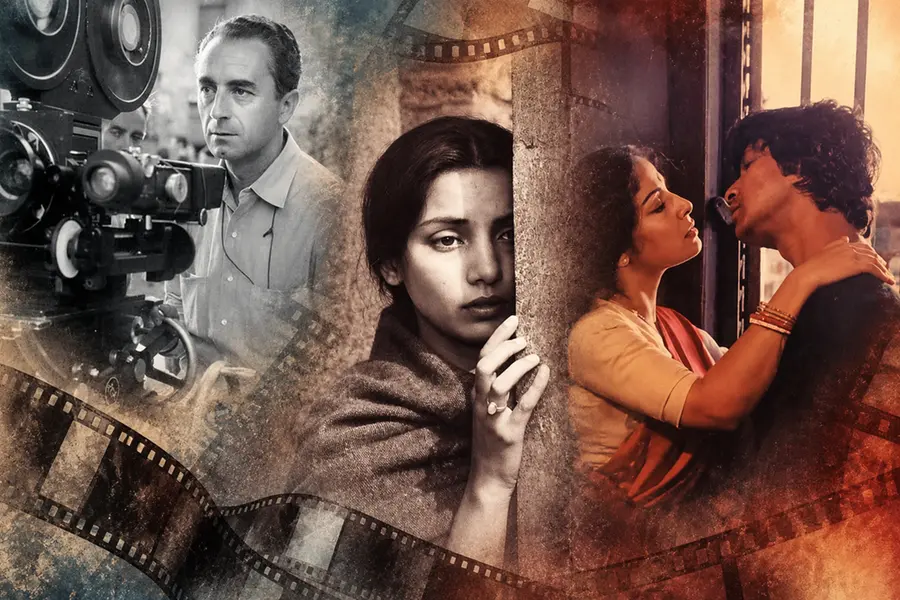
In Mrinal Sen’s Khandar (1984) in Hindi, we are witness to a professional photographer, Subhash (Naseeruddin Shah)’s clever manipulation of a young, unmarried girl (Shabana Azmi) taking care of her blind and bedridden mother in a dilapidated mansion.
Subhash and his two friends are on a brief holiday. While the young girl Jamini imagines he might be interested in her, in the final sequences of the film, the camera pictures him in his dark room, hanging the photographs of Jamini he slyly clicked back in the small town, beside some scantily clad city models in his studio.
The International Film Guide (1983-84) listed Khandhar among the top ten films of world cinema.
His character highlights the moral ambiguity of the photographer: is he deeply empathetic, or is he merely diabolically manipulating a tragic situation to further his own artistic excellence?
Obviously, it is the latter he was seeking to explore at the cost of the young woman’s faint hope.
In Aparna Sen’s Parama (1984), a visiting expatriate photojournalist, Rahul (Mukul Sharma), chooses a traditional Indian housewife, Parama (Rakhee), as the subject for his photo essay on "The Indian Woman".
Here, the photographer is a catalyst. His lens forces the protagonist to look at herself outside of her domestic identity, though his ultimate exploitation of her images highlights the voyeuristic, sometimes destructive power of the gaze.
But in this case, it makes the ‘model’ Parama realise her own position within her family through her affair with Rahul, mainly after the photographs are published in an international journal and her husband happens to pick it up from the letterbox.
Among recent outstanding films, one must mention Nitesh Batra’s Photograph (2019).
It unfolds the tale of a street photographer, Rafiq, who persuades tourists near the Gateway of India to get themselves photographed for posterity, which is his struggle for sheer existence.
In the modern era of smartphones, he carries a DSLR and an instant photo-printing machine along with him and strives to earn a living by clicking pictures of tourists.
During these jaunts, he makes friends with a young girl named Miloni who belongs to a slightly upper-middle-class Hindu family and is studying for her Chartered Accountancy exams.
He also manages to persuade her to pretend to be his fiancée for his grandmother, who lives in a different city but is constantly nagging him to get married.
Photograph is perhaps the most subtle and understated story of a love we are not sure happened or was about to happen but did not till the end, when they part ways after watching a film together in a dilapidated theatre.
The brilliant performances of Nawazuddin Siddiqui as Rafiq and Sanya Malhotra as Miloni enrich the aesthetics of the film.
The most surprising film featuring a still photographer as the protagonist is Aa Dekhe Zaraa (2019), which features Neel Nitin Mukesh as a photographer who finds it difficult to make ends meet.
Then one day, he discovers that a still camera bequeathed to him by his late grandfather has magical qualities, it clicks pictures of what is going to happen to the one photographed, including his death.
This could have turned the tide in favour of films that play around with magic realism, but the film flopped on its face, and the photographer in the film was forced to get rid of it.
Published: 12 Sept 2026, 04:33 pm IST
Related Topics
Disclaimer: Kindly avoid objectionable, derogatory, unlawful and lewd comments, while responding to reports. Such comments are punishable under cyber laws. Please keep away from personal attacks. The opinions expressed here are the personal opinions of readers and not that of Mathrubhumi.
