

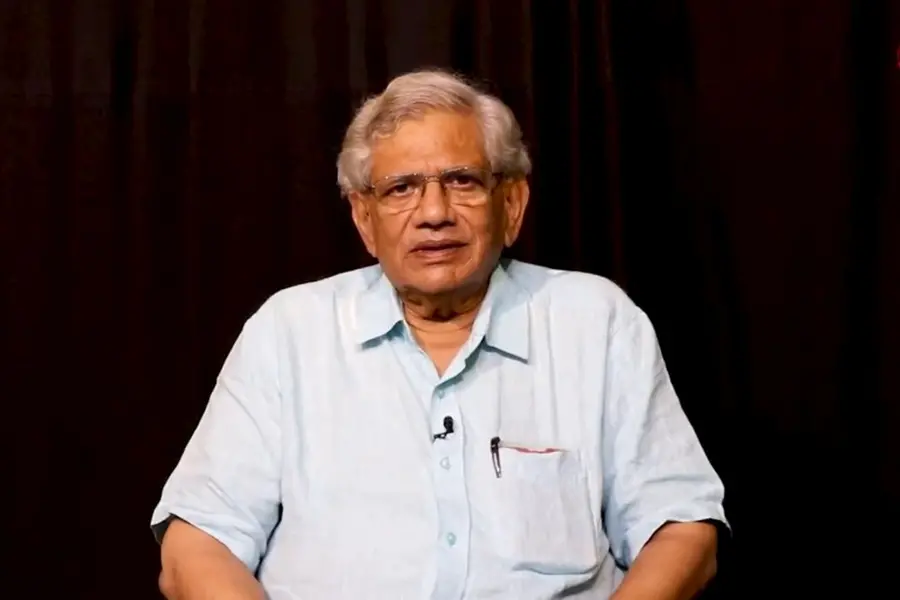
An enlarged and beautifully framed cartoon adorns the wall in Sitaram Yechury’s Delhi home. The cartoon that belonged to the 1990s depicts CPI(M)’s four top leaders, all very old, doddering and crouching, limping towards the new millennium. Yechury, the only youngster among them, is seen following his geriatric leaders with a bitter expression.
It is unambiguously a searing sarcasm against Yechury's party, the CPI(M). That it adorned his wall also conveyed an unambiguous message about Yechury’s sense of humor -- and, even more significantly, his capability to laugh at himself, a rare faculty among political leaders, especially Communists.
Also Read
Yechury, who died recently, was seen as a “young” leader even after he reached his seventies, probably because he had walked into CPI-M leadership directly from the student movement. Yet, he belonged to the school of Gandhian leaders, now almost extinct, known for their knowledge, selflessness, dedication, integrity, and articulation. They willingly gave up their comfortable lives and chose the thorny path of public service, as they believed in giving rather than taking.
Yechury could not have left at a more inopportune moment for the Indian Left and CPI-M. It was like losing the Field Marshal when the army was on their last legs. The Left lost its leader, perhaps the last one who enjoyed respect across the political spectrum, when it was reduced to almost a vanishing point in Indian parliamentary history. But, the loss is for the country's entire democratic and secular forces.
Yechury was one of their most uncompromising leaders when democracy, secularism and the very idea of India faced their gravest threat since independence. Yechury belonged to the pantheon of Communist stalwarts, respected and keenly heard by the nation irrespective of their electoral strength.
The Indian Left has had leaders of greater brilliance, erudition, and articulation, and they have endured superior sacrifices and sufferings compared to Yechury. Yet, it's doubtful if it had anyone so versatile as him who was equally adept on multiple fronts. Proficient in theory and praxis, Yechury was an intellectual, pragmatist, tactician, hard negotiator, and orator. Even when he was mired in bourgeois parliamentarism, which Lenin called a "pig sty", Yechury never compromised on personal integrity or principles. He held no office of power outside his party except for one tenure in the Rajya Sabha.
By refusing him another innings in the Upper House in the name of organisational inanity, CPI-M denied the Parliament and the nation the brilliance and insightfulness of a leader when they were most needed. Unlike most of his comrades, even when he was critical of the “bourgeois media”, Yechury never dismissed it or ran away from it. He was willing to engage with them even when he was on the back foot as he considered the media an essential pillar of democracy with all the warts.
He also would go down in history as one of the few Communists who wasn't arrogant or boorish and knew how to smile even to his adversaries. Hence, Yechury was one of the last Communists who proved relevant, accessible and articulate when visual media held hegemony and “optics” were vital for practical political discourse. No wonder many of his hard-core comrades privately sneered at Yechuri’s “bourgeois weaknesses”!
During the 1980s, Prakash Karat and Yechury brought the first generational shift in the CPI-M, which, like most Communist parties, was known until then as a geriatric club at the top. It was the first time student leaders directly walked into the party’s central committee. Simultaneously, many young turks in West Bengal, groomed by Pramode Dasgupta, entered the state leadership. They included Buddhadev Bhattacharya, Anil Biswas, Biman Basu and others who led the party subsequently. The young generation was rewarded for their brave resistance against Indira Gandhi’s emergency and for staying with the party when many youngsters gravitated towards the Naxalite movement.
The generational shift marked a paradigm change in the party, which was, until then, led by people who spent most of their lives struggling against feudalism, royalty, and colonial masters. For the first time, a generation born after independence who were "natives" in CPI-M came to the top, unlike their predecessors who came from the unified CPI. The shift triggered snide remarks about the CPI-M's "campus recruits" who helped the Left win at least the university campuses, though the country remained out of their grasp.
When they were elected to the CPI-M Politburo in 1992 at the 14th Party Congress, Karat was just 44, and Yechury was barely 40. This was unprecedented, as their other colleagues in the CPI-M’s supreme body were in their seventies and eighties. The 1990s marked a significant shift in Indian politics, as coalition politics was back at centre stage. It was also when the BJP and politics of religion emerged as the most decisive players, with "Mandal and Masjid" defining the political and social discourse.
The Left was beleaguered by a classic dilemma: "Who is our chief bourgeois adversary? BJP or Congress?" By then, Congress had abandoned Nehruvian Socialism and embraced the market. The storm unleashed by the Mandal report gave rise to identity politics, spelling another challenge to the Left.
Having discarded the path of armed revolution, the Left was entirely into parliamentary politics, and the age of coalition gave it a golden opportunity to play a significant role. Unlike most of his elderly comrades, a Communist proved a master in the hurly-burly of coalition politics. He was Harkishen Singh Surjeet, who became CPI-M General Secretary in 1992, succeeding EMS. Surjeet’s tenure as general secretary from 1992 to 2005 witnessed him leading in the twists and turns in the checkered coalition game. Naturally, CPI-M's new-gen leaders were baptised in this Surjeet School and proved competent enough.
For the first time, CPI-M joined hands with its bete noir, the Congress, to keep BJP away from power. The efforts paid off well, with the CPI-M’s Lok Sabha seats jumping from 32 in 1996 to an all-time high of 43 in 2004. The party, which had been only a marginal player for the first time, came near even the prime ministerial position when Congress offered the venerable Jyoti Basu the top seat. But for the opposition of the few puritans in CPI-M, Basu would have certainly become India’s first Communist Prime Minister.
But, alas, 2004 also proved to be the Left’s high noon. With Surjeet’s tenure ending in 2005, Karat took over, and ideology was back in place of pragmatism.
Unlike his predecessor, Karat, notwithstanding his youth, belonged to the old Communist school of ideological puritans. In 1996, he had led the party central committee’s shooting down Basu’s prime ministerial chance. He was restive about the alliance with the Congress-led United Progressive Alliance (UPA-1) and led its withdrawal in 2008, protesting against the Indo-US nuclear deal. It is metaphoric that Surjeet passed away in the same year at 92. The same year saw CPI-M leader and widely respected Lok Sabha speaker Somnath Chatterjee being expelled from the party for disobeying the party whip to vote against the UPA government on a no-confidence motion tabled by the BJP.
However, the UPA survived without the Left's support and returned to power in 2009. The Left’s downward slide began, and CPI-M’s seats tumbled from 43 to 16 and 9 in 2014. In 2011, the Left lost its strongest bastion, West Bengal, to Trinamool Congress and its other citadel, Tripura, followed suit soon. The Narendra Modi-led BJP juggernaut became all-powerful, with the Congress crashing to unprecedented depths.
Yechury succeeded Karat in 2015 as general secretary, and his fate was to lead the party in this darkest period. Yechury, more pragmatic than Karat, was not quite agreeable to withdrawing support to the UPA or expulsion of Chatterjee. However, the BJP had already turned the nation into a unipolar polity, marginalising all other parties.
Yechury served thrice as general secretary but had to pass away without seeing any sign of his party’s recovery, except in Kerala, where the Left had an unprecedented consecutive victory in 2021. However, its tally in Lok Sabha crashed from 9 in 2014 when Yechury took over to 3 in 2019 and 4 in 2024.
It's absurd to blame Yechury alone for the CPI-M's present pathetic state, though much of it occurred during his tenure. There are many global and national reasons for the plight. Yet, Yechury’s integrity and gravitas ensured relevance and respect for the Left even during these dark times.
Yet, history is a merciless judge. It may ask Yechury whether he did enough when his party was sinking. The prime reason for the Left’s collapse in the Parliament was its stunning retreat in West Bengal. Clearly, the Bengal disaster was entirely the state party's making. The nearing apocalypse was visible to all except the party leadership. Even Jyoti Basu had warned the party to be cautious. But what did the party's central leadership, including Karat and Yechury, do to effect a course correction by Chief Minister Buddhadeb? Precious little. As those belonging to Buddha's generation, Karat and Yechury could have done more to correct their comrade than the elders.
Now, let’s discuss Kerala CPI-M. Despite its impressive electoral performance in the past two decades, the party faced its worst factional war during this period. Did Yechury and Karat do their due to stem this? Why did they allow the party to suffer the unprecedented embarrassment of changing its decision twice to deny candidature to VS Achuthanandan? They were even accused of playing partisan roles in the strife.
When the Pinarayi faction pulverized the Achuthanandan camp, Karat didn’t do anything to go by bureaucratic organisational rules. Yechury, however, was more considerate to the humiliated veteran. When Pinarayi Vijayan emerged unquestioned in the party, leading to unending controversies, the central leadership stood like a mute spectator. With the party enjoying power only in Kerala, the central leadership became dependent on the state unit and remained helpless even when things went out of control.
However, to this writer, Yechury's most serious failing is none of the above. Given his strengths, none could have reimagined and reinvented the Indian Left more than Yechury to step with the time. Like the Left elsewhere in the post-Soviet era, Indian Left could have integrated into its core a whole lot of contemporary issues: environment, gender justice, rights of the Dalits, tribals, religious minorities, sexual minorities etc. Unfortunately, his potential was squandered away by the compulsions of parliamentarism to which he and other youngsters were pushed from the day they entered national politics. The result: Yechury and the Indian Left missed a historic opportunity.
Published: 24 Sept 2024, 09:25 am IST
ABOUT THE AUTHOR
Related Topics
Disclaimer: Kindly avoid objectionable, derogatory, unlawful and lewd comments, while responding to reports. Such comments are punishable under cyber laws. Please keep away from personal attacks. The opinions expressed here are the personal opinions of readers and not that of Mathrubhumi.