

Haven't India’s leading tycoons openly vied for the privilege of sponsoring and donating at temples and religious festivals? So why not at Sabarimala, which is Kerala's shrine that attracts the largest number of devotees from across the country?
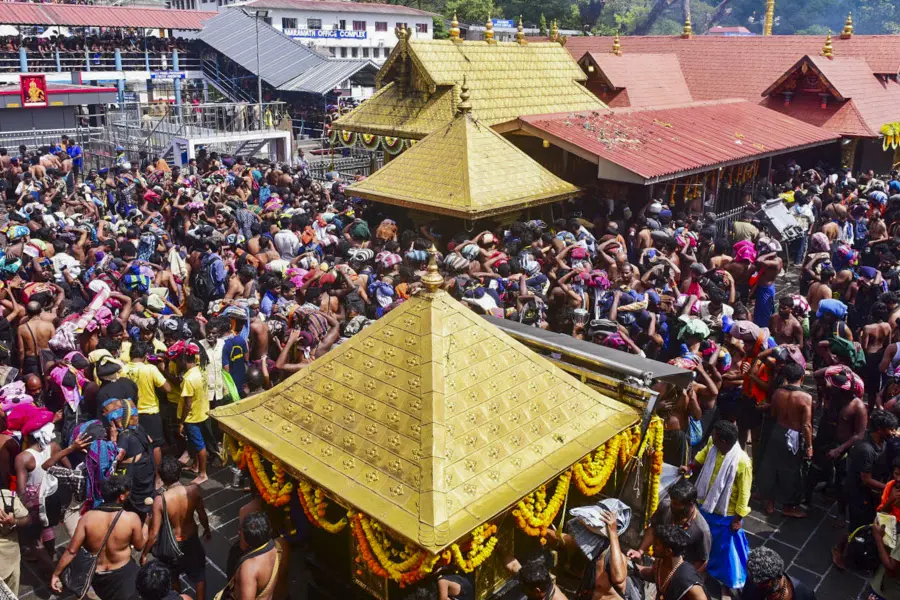
It is absurd to question the right of the Left Democratic Front (LDF) to hold the proposed Global Ayyappa Sangamam (GAS), if it is genuinely intended—as claimed—to be a conference of Ayyappa devotees for planning infrastructure development at Sabarimala. Who else but successive governments, through the Travancore Devaswom Board (TDB) they appoint, have always borne responsibility for both the shrine’s development and the administration of thousands of temples in Kerala?
To argue that a Communist-led government, elected for a second time in a row, has no right to hold such a meeting because it has atheists in it is equally undemocratic. No Communist-led government in Kerala has ever shirked its administrative and financial responsibility for running the state's over 1000 temples. Last Sabarimala festival, which attracted over 50 lakh pilgrims, including 10 lakhs who came through spot booking and a record revenue of Rs 440 crore, was noted for its exceptionally smooth conduct with no significant complaints. The TDBs constituted by them, like those by any other government, have always included declared believers. True, some appointees have on occasion been accused of graft or incompetence. But were those nominated by “god-fearing” non-Communist governments any better?
It is also well known—acknowledged even by the Communists—that much of their rank and file are practising believers. The late E.K. Nayanar’s wry remark still rings true: if the CPI(M) installed a donation box en route to Sabarimala, it would fill faster than the temple’s own hundi.
Equally misplaced was the Kerala High Court’s recent “shock” at the TDB seeking sponsorship for GAS expenses, though the judges’ insistence on transparency of its conduct deserved appreciation. Surely, the honourable judges cannot be unaware that the sanctum sanctorum’s golden roof at Sabarimala was funded by none other than the liquor baron Vijay Mallya in 1998, who is now charged with massive financial crimes, or that Guruvayur’s facilities were lavishly built by Mukesh Ambani, who has now pledged ₹56 crore for a hospital there.
Haven't India’s leading tycoons openly vied for the privilege of sponsoring and donating at temples and religious festivals? So why not at Sabarimala, which is Kerala's shrine that attracts the largest number of devotees from across the country? Corporate donors at the recent Maha Kumbh 2025 -attended by a record 45 crore devotees - included brands like the Adani Group, which partnered with ISKCON for Mahaprasad Seva, providing meals to devotees; ITC and Hindustan Unilever participated in brand activations and distributed branded items like salt thalis; Dabur promoted its products through consumer activation. Other companies involved in marketing and branding included Reliance, Coca-Cola, Bisleri, Emami, Axis Bank and Bank of Baroda.
And what about contemporary India's largest religious construction —the Ayodhya Ram Temple, consecrated in January 2024? Its construction, at a total cost of Rs 2,150 crore, was led by Larsen & Toubro (L&T) and Tata Consulting Engineers (TCE). At the same time, consumer brands such as Coca-Cola, ITC, and Dabur ran on-ground campaigns and sponsorships around the inauguration. Corporations are also involved in the economic boom, with firms like Paytm providing digital payment solutions and hospitality businesses hiring for anticipated tourism increases, which is projected to boost the regional and national economy. So one wonders: were the judges truly concerned about sponsorship—or about who was conducting GAS?
That said, does this writer endorse the LDF government conducting GAS? No. In my view, the exercise carries grave risks for Kerala’s Left in general and the CPI(M) in particular. Four reasons stand out.
First, the GAS is likely to prompt the Left to jettison yet another of its foundational values—gender justice. The CPI(M)’s wavering on women’s entry into Sabarimala, diluting its original position, despite the Supreme Court’s historic judgment, is already evident. Leaders now dodge the question of whether the government will withdraw its supportive affidavit, preferring instead to accuse critics of “fomenting trouble.” The soft-pedalling after the 2019 electoral debacle, the continued denial of entry to women between 10 and 50 despite the apex court’s ruling, and the evasive remarks of leaders such as Devaswom Minister VN Vasavan and party secretary MV Govindan, all signal a retreat. If the Left indeed buries its stand on gender equality, egged on by its new comrades like Vellappally Natesan and the TDB chief, it will go down as another of its historic blunders—stripping it of the moral high ground it once claimed. Even if it is not made to withdraw the affidavit formally, the Left will be interrogated forever for its pathetic prevarications.
Second, even the political gains the CPI(M) hopes for may prove illusory. Despite its proclaimed intentions, the LDF’s political objectives behind holding GAS are not far to seek. Clearly, GAS is meant to woo back Hindu believers who have deserted it, stem the BJP’s rise, and counter the Congress’s gains among devotees. But the logic seems to be: if you can’t beat them, join them. That is a losing strategy. Voters who want a party of faith will always prefer the “A team” (BJP or Congress) over a “B team.” As Marxists’ original Guru warned, religion is the opium of the masses—and no party has ever successfully outperformed the peddlers of opium on their own turf.
Third, even if GAS delivers short-term dividends, its long-term effect will be disastrous. By further deepening religiosity, even among its own ranks, the Left risks nurturing forces that thrive on faith, ritualism, and ultimately communalism. Kerala’s cherished traditions of harmony and diversity could erode irreversibly. Once unleashed, the genie of heightened religiosity cannot be put back in the bottle.
Fourth, the Left’s greatest asset—its secular credibility—will be compromised. At a time when the BJP trumpets Hindutva and the Congress indulges in “soft Hindutva,” the Left has remained India’s lone unambiguous secular force. By diving deeper into religious affairs, it risks forfeiting that unique standing—and with it, the very rationale for its existence.
The CPI(M)’s recent tendency to dabble in several Hindu religious festivals and rituals, its ovation for someone like Vellappally Natesan, who frequently foulmouths Muslims, is likely to antagonise the Muslim community, which had been coming closer to the Marxists for some time. Coupled with intensified criticism against Muslim outfits, they have already earned the CPI(M) a soft-Hindu or Islamophobic cap.
What is most dispiriting is the bankruptcy of imagination, which reflects. The Left once thrived on new ideas born from grassroots struggles and vibrant inner-party debates. Overcentralisation and intolerance of dissent have now dried up that well. Otherwise, why would the CPI(M), facing a looming election, scramble for short-term, sectarian fixes instead of building on its progressive legacy with steps which are ideologically, ethically and even electorally tenable?
Why not alter the agenda and reclaim the narrative before the election by re-energising Kerala with the spirit of renaissance—an impulse that had gained ground through the CPI(M)’s correct initiatives like the Navothana Samiti of backward-caste leaders and the nationally noted ‘Women’s Wall,’ but was left abruptly unfinished? Instead of creating circumstances for bringing back archaic and exclusionary rituals, isn’t the Left’s bounden duty to carry forward the state’s progressive legacy of launching historic movements that made religion more democratic and inclusive, such as the satyagrahas at Vaikom, Guruvayur, and Paliyam, or even the RSS-led Paliyam Declaration of 1985? Why not launch a second Land Reform, as VS Achuthanandan once dreamed, or a second Temple Entry Proclamation by ending caste-based priesthood in temples like Sabarimala and Guruvayur? Why not craft a campaign around the deepening inequality in Kerala, where the “backward sections” still outnumber others?
The Left once reshaped Kerala by expanding the horizon of the possible. Today, it seems content to narrow that horizon in the hope of short-term survival. The Global Ayyappa Sangamam may well turn out to be less a show of strength than a symptom of its decline.
Published: 07 Sept 2025, 10:39 am IST
ABOUT THE AUTHOR
Related Topics
Disclaimer: Kindly avoid objectionable, derogatory, unlawful and lewd comments, while responding to reports. Such comments are punishable under cyber laws. Please keep away from personal attacks. The opinions expressed here are the personal opinions of readers and not that of Mathrubhumi.