
Launched in August 2016 with 21 participating banks, the Unified Payments Interface (UPI) has grown into a major part of India’s everyday financial life. With average daily transactions crossing 800 million in September 2026, its next challenge is to sustain growth, address fraud and outages, and build a financially viable system without undermining access for small merchants.
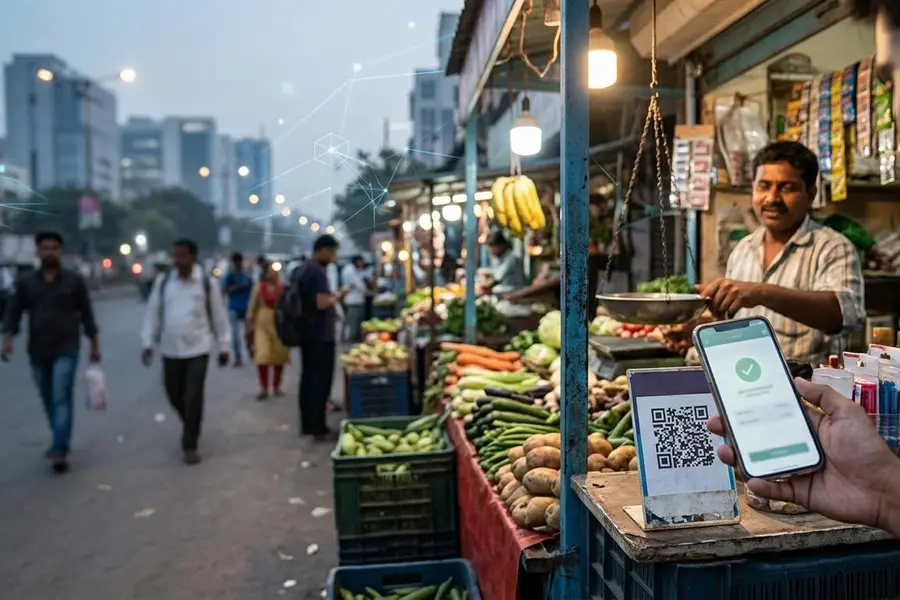
The Payment Revolution India Built From a little-known banking experiment to a platform processing more than 800 million payments a day, UPI has made digital transactions accessible for millions of people and merchants. Its open, practical design and reach across banks and apps set it apart globally.
India’s Unified Payments Interface (UPI) began as an effort to make digital payments work across the country’s fragmented banking system. In August 2016, 21 banks went live on a platform few people outside India’s financial establishment had heard of.
A decade later, it is part of daily life: people use it to split a bill, buy vegetables, pay a utility account or transfer money to family. Average daily transactions crossed 800 million for the first time in September 2026. The story is less about a cashless India than about giving millions a fast, low-cost way to pay alongside cash.
The groundwork was laid by the National Payments Corporation of India (NPCI), set up in 2008 by the Reserve Bank of India (RBI) and the Indian Banks’ Association to run retail payments. India already had NEFT, RTGS and IMPS, but these were bank-centric and clumsy for small payments, and they needed account numbers and IFSC codes.
Cash still dominated, which meant leakage in welfare delivery, a large informal economy outside the tax net, and heavy costs of printing and moving currency. Jan Dhan accounts, Aadhaar and cheap smartphones created the base for something simpler: pay anyone through a single virtual address, without sharing bank details.
UPI was a team effort, not one person’s invention. NPCI’s leadership under M. Balachandran, A.P. Hota and later Dilip Asbe drove the product, and chief operating officer Praveena Rai is widely credited with delivery. Nandan Nilekani and Pramod Varma, the minds behind Aadhaar and India Stack, supplied the philosophy of open, interoperable public digital infrastructure, and RBI Governor Raghuram Rajan backed the project. The pilot began in April 2016, and the public launch followed on 25 August 2016. The BHIM app, based on UPI, arrived that December.
The cash crunch after demonetisation in November 2016 was a powerful accelerant, giving people a reason to try digital payments. Early scale was modest: NPCI recorded just over 90,000 transactions in August 2016. UPI crossed one billion monthly transactions in October 2019 and five billion in March 2022. In September 2026, it processed about 24.1 billion transactions worth Rs 29.4 lakh crore, with 756 banks live on the system.
COVID-19 stressed the system in two phases. The April 2020 lockdown dented volumes, which fell from roughly 1.25 billion in March to about a billion, because commerce itself stopped. Recovery was swift. Contactless payment became a habit. Small shopkeepers who had never accepted cards put up QR stickers, and monthly transactions crossed 2 billion by October 2020. Digital rails also helped governments move relief money quickly to bank accounts.
UPI has become a major alternative to cash, but it has not displaced it. Cash remains essential for people without reliable internet or smartphones, for some rural and informal transactions, and when digital systems or electricity are unavailable. UPI accounted for approximately 70% of India’s digital payment transactions in FY2023-24. UPI use has grown alongside the amount of currency in circulation. Cash still serves as a store of value and a payment method, while UPI increasingly handles frequent, smaller transfers and merchant payments.
UPI has pulled millions of small merchants into formal finance, giving them digital transaction records that help them qualify for credit. It cut the costs of handling cash, made subsidy transfers cleaner and fuelled a fintech ecosystem of payment apps, lending platforms and QR-device makers. UPI processed Rs 29.37 lakh crore in September 2026, roughly Rs 98,000 crore a day.
Other countries have comparable systems. Britain’s Faster Payments dates to 2008, and there are Singapore’s PayNow, Thailand’s PromptPay, Brazil’s Pix (2020), Europe’s SEPA Instant and the United States’ FedNow (2023). UPI’s distinction is its scale and open, multi-app design. As of 2024, it accounted for about 49% of global real-time payment transactions. Pix is probably the closest rival in everyday adoption.
Features have broadened well beyond simple transfers. UPI 2.0 added overdraft linking and mandates, and 2020 to 2022 brought AutoPay, UPI 123PAY, UPI Lite and credit-card integration. Credit Line on UPI followed in 2023, and UPI Circle allows delegated payments. Abroad, UPI is live in 11 countries. Greece went live in June 2026 and the Maldives in July, and in September NPCI International Payments Limited (NIPL) signed an agreement to extend UPI merchant payments to Uzbekistan.
Growth continues, though it is moderating. UPI volume rose 27% to around 145 billion in the first half of FY27, but year-on-year growth slowed to 23% in September from 31% a year earlier. The biggest policy change concerns money.
The government has proposed a merchant discount rate (MDR) on high-value digital payments to keep the system financially sustainable. A zero-MDR policy since 2020 drove unprecedented adoption, but the surge in volumes has placed a heavy financial burden on the underlying banking and payment infrastructure. The proposed MDR of 0.4% on person-to-merchant payments above Rs 2,000, due from October 15, has been deferred until after Diwali in November following appeals from traders.
Projections are bullish. A PwC report anticipates UPI reaching 1 billion transactions a day in FY28, and NIPL aims for rollout across 20 countries by FY29. The challenges are real, though. Fraud, outages and privacy risks around biometric authentication need constant attention, and the new MDR will test whether free-to-use economics can give way to a sustainable business model without hurting small merchants.
The views expressed in this article are personal to the author and do not necessarily reflect the views of the publication.
Published: 18 Oct 2026, 09:51 am IST
Related Topics
Disclaimer: Kindly avoid objectionable, derogatory, unlawful and lewd comments, while responding to reports. Such comments are punishable under cyber laws. Please keep away from personal attacks. The opinions expressed here are the personal opinions of readers and not that of Mathrubhumi.
