
Shah Rukh Khan turns 60; India celebrates with a film festival honouring his award-winning Bollywood legacy.
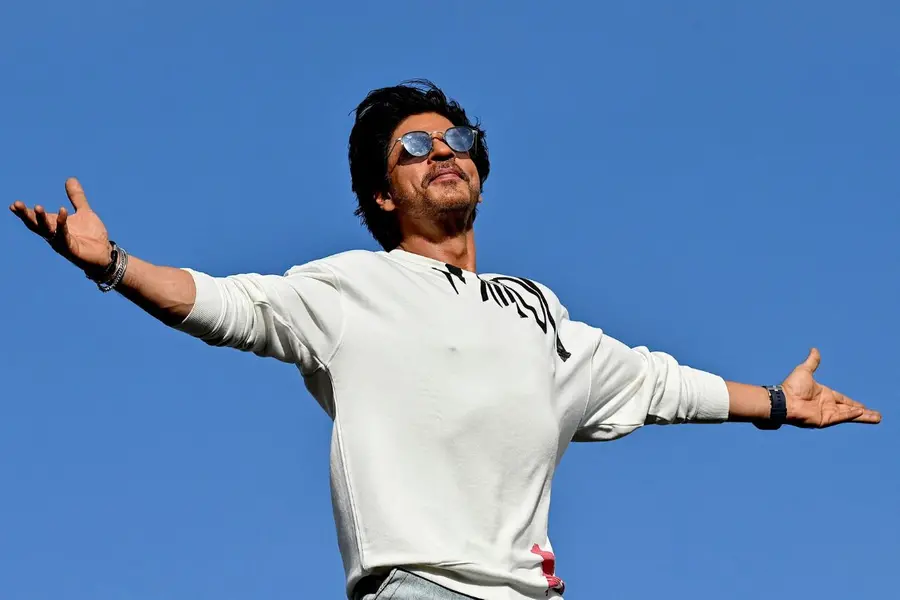
Shah Rukh Khan is stepping into 60 on November 2 (today). There is a series of screenings of his films in theatres across India in the shape of a festival of Shah Rukh Khan films. This is in the wake of the National Award for Best Actor he won after 32 years in the industry as an international star and actor whose screen presence outshines those of his peers, namely Salman Khan and Aamir Khan.
Do you know what Shah Rukh means? It means “face of the king.” This is one ‘king’ who hosts television shows with a grace so natural that it charms you and takes you by surprise at the same time. It is the same man who tamed his unruly lock of thick black hair with a mix of homemade glue and water when he began his career in films. This is one ‘king’ who loves to dote on son Aryan, 28, and daughter Suhana, 23, who think “I am the best dad in the world because they do not have much of a choice.” Shah Rukh insists that he never crosses a red light and is a law-abiding citizen. But after this, he lights up his cigarette, unable to stick to the new law of not smoking.
The festival of Shah Rukh Khan films kicked off across 30 Indian cities on October 31 in 75 theatres for two weeks. Among films chosen are – Kabhi Haan Kabhi Naa, Dil Se, Devdas, Main Hoon Naa, Om Shanti Om, Chennai Express, Jawan and many others. The festival is being organised by the PVR Inox group. Happy with the way his 60th year in the world is being celebrated, Shah Rukh said, “The audience has given its love to these films for over 30 years and bringing these films back into the theatres seems like a reunion for me and for my audience.”
Typical of the strange idiosyncrasies of the Bollywood box office, his best films did not churn out the kind of miraculous moolah his entirely escapist films did, making everyone around in and outside Bollywood happy as the films became a wake-up call for Bollywood either as freeing itself from the clutches of the Southern masala films or joining forces with them in any way. Which Jawan has done and how!
The three feature films in which Shah Rukh stripped himself of his typically ‘Shahrukhi’ school of acting, complete with mannerisms and stylisations that threw up his true potential as one of the best performers in world cinema, are Swades, My Name Is Khan and Chak De India. The star actor has not taken on assignments in these kinds of films.
The respective directors, namely Ashutosh Gowariker, Shimit Amin and Karan Johar, should be credited for bringing the best out of this versatile and talented actor and steering him away from his cliché performances in his hits with and without an attractive stutter. Swades and Chak De India did not hitch up his ranking as one of the best actors that came out of Bollywood.
Time magazine has defined him as probably the most recognisable actor in the world. The Guardian newspaper once described him as the world’s biggest film star on the assumption that Bollywood has a global audience of 3.6 billion as compared to 2.5 billion for Hollywood. National Geographic featured him on their cover in 2005 for their feature Inside Bollywood. Since March 2007, his wax figure stands along with Amitabh Bachchan and Aishwarya Rai at Madame Tussauds wax museum in London. Shah Rukh is, without doubt, the toast of Bollywood today, arguably its most saleable actor and perhaps its most powerful personality. All this without any connections with the Indian film industry, known for its nepotism.
Shah Rukh was born on November 2, 1965, and raised in New Delhi though his roots are from Peshawar, now in Pakistan. He attended St. Columba’s School where he was awarded the prestigious Sword of Honour for his all-round accomplishments in academics, sports and drama. Having graduated from Hansraj College in Delhi with honours in Economics, he followed up with a stint at Barry John’s theatre group TAG and joined Jamia Millia Islamia University for a Master’s Degree in Mass Communications. However, he didn’t complete the course. Meanwhile, he first got noticed as an actor in 1988 with TV serials Dil Darya and Fauji where he played the role of Commando Abhimanyu Rai, followed by a small role in In Which Annie Gives it Those Ones. The death of both his parents prompted Shah Rukh to shift base to Mumbai.
It was easier for this critic to catch him on the phone way back in 2008 from Changi Airport in Singapore than it was to nail him down in India. Shah Rukh, the unquestioned Badshah of Bollywood, opened up a side of himself not easily seen in film glossies. This quote-centred profile offers a glimpse of this mega-successful star, producer, television anchor and businessman, son of the late Meer Taj Mohammed Khan and Lateef Fatima, whose greatest regret in life is that his parents are no longer around to share his success.
Few remember that he wooed his wife Gauri for eight years before they tied the knot three decades ago. “Gauri has known me for almost 34 years now and she understands me perfectly. I would not call her my pillar of strength simply because we have not known life separate from each other. What has sustained the relationship is the tremendous faith we have in each other. I have never looked inside her purse or even glanced into her wardrobe,” says Khan.
His roles have been a veritable rainbow ranging from the psychopathic killer in Darr and Anjaam to the star incarnate in Om Shanti Om, to the sickeningly melodramatic adopted son in Kabhi Khushi Kabhie Gham... to the stern but determined Kabir Khan in Chak De. “I am a lot like the no-nonsense hockey coach Kabir Khan in Chak De minus that stern stuff,” he confides.
Did you know that Shah Rukh finished reading Gregory David Roberts’ Shantaram much before the book hit Indian bookstores and recommended it to some of his producer friends? “I asked them if they would want to make a film based on the book but there was no response. Now Hollywood has taken it,” said the star whose home library has a collection of more than 5,000 books, of which there are at least three he wants to turn into films. “The other two I have really enjoyed are Mark Haddon’s murder mystery, The Curious Incident of the Dog in the Night-Time and Yann Martel’s fantasy adventure Life of Pi. Right now, my reading priorities are focused on biopics about people who have led interesting lives.”
Though he admits that the Indian film industry has a lot to learn from Hollywood “in terms of organisation, technology, and its distribution network, the stories are right here with us, in Bollywood. Our fantasies are attainable. Our fantasies are smaller. They are about having a house, perhaps a small car. Unlike Hollywood, we are not bothered about aliens,” obviously referring to Hollywood blockbusters like Deep Impact and Independence Day.
And he has every right to make this statement because most of his fantasies sell extremely well both in the national and the international market.
Om Shanti Om (2007), produced by Red Chillies Entertainment, his own production house, was the highest-grossing Hindi film of the year, earning $45 million across the world. Some of the biggest hits in Bollywood over the past 30 years have Shah Rukh starring in them. Among these are – Dil To Pagal Hai (1997), Kuch Kuch Hota Hai (1998), Kabhi Khushi Kabhie Gham (2001), Chak De (2007) and Om Shanti Om (2007).
Those who watched Pathaan in Kolkata theatres woke up much before the break of dawn to catch the 6.30 am show at Kolkata’s Menoka cinema, bringing garlands with them to decorate Shah Rukh’s huge cut-outs and even the posters of the film before the show began. The same was the scene at Basusree, one of the city’s oldest single-screen theatres with a cultural history of its own. The city has millions of SRK fans who are not a bit bothered that houseful Bengali films like Projapoti, featuring Mithun Chakraborty in the lead, and Kaushik Ganguly's edge-of-the-seat thriller Kaberi Antardhan had been pulled out quite unceremoniously from all theatres that ran them. The media stated that some theatres were even running a 12.30 pm show at midnight because the demand was beyond imagination. The Bengali industry was very angry, but the exhibitors laughed all the way to the banks. And so did the producers and SRK.
In Jawan, perhaps for the first time, one got to watch SRK in all his cinematic and visual glory. We see a completely head-shaven Vikram, Vikram with a scraggy beard, Vikram with his hair standing out around his head, the younger SRK in a police uniform, with a moustache, without a moustache, with his unkempt head of hair shaking this way and that, dancing away to glory with 6,000 women inmates of the women’s prison which was once a heritage mansion and is almost as clean and as well-equipped as a well-looked-after guest house, sorry, mansion. These women prisoners, led by six extremely attractive and well-shaped young ladies, form the hidden “army” of Vikram and then of both father and son. The huge prison does not seem to have a warden but a lady officer/jailor who adopts the little Azad when his father (Vikram) is jailed and his mother (Deepika Padukone) is hanged for being traitors to the nation!
Things he will never do on screen are – riding a horse and kissing a girl. “I am extremely shy of women and perhaps that is why I romance them so well when we are just playing make-believe characters on screen,” is his surprising comment. “I have been fortunate to have worked with some of the most beautiful and talented women in Indian cinema and at least half of my success goes to their credit. They have contributed to my dance numbers and to my appearance by teaching me how to look good. I am what I am because of what they have helped me to become,” says Shah Rukh with a modesty that belies the public image his publicity machinery has carefully constructed for him over the years.
Published: 02 Nov 2025, 01:23 pm IST
Related Topics
Disclaimer: Kindly avoid objectionable, derogatory, unlawful and lewd comments, while responding to reports. Such comments are punishable under cyber laws. Please keep away from personal attacks. The opinions expressed here are the personal opinions of readers and not that of Mathrubhumi.
