
In the three decades since this award was first given in 1996, it has honoured most of the great names of Malayalam letters, from Unnikrishnan Puthoor to Alankode Leelakrishnan
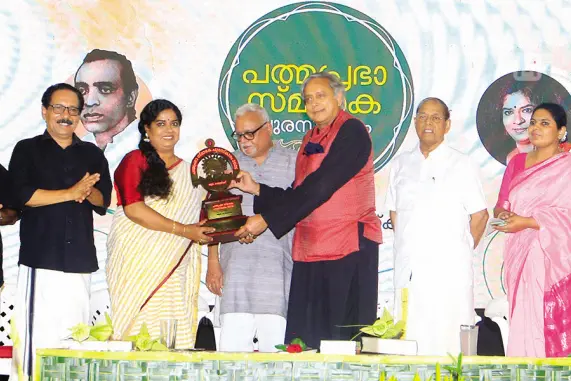
I had the great honour of travelling to Wayanad recently to present this year’s Padmaprabha Book Award to author Rajasree, and to do so in the land of the man for who it is named, M.K. Padmaprabha Gowder.
Born in 1915, he died in 1962; he lived only forty seven years. But Padmaprabha Gowder shone for all he did for society. Born into a wealthy janmi family, he could have lived a very comfortable life. He chose a harder road. Most relevantly, he was a reader, who built one of the finest private libraries in Wayanad district.
Also Read

From his reading he came to socialism, not as a slogan, but as a way of looking at other human beings. He stood with the plantation workers, with the landless farmers, with the deprived people (leading a celebrated agitation at Noolpuzha). In 1952 the people of Wayanad sent him to the Madras Legislative Assembly.
His house in Kalpetta was not a quiet one. Jayaprakash Narayan, RamManohar Lohia, and George Fernandes, among others, came to it. The great arguments of Indian socialism was carried on under this family's roof, far away from Delhi. Think of the Wayanad of those years: Colonial landlords. Janmis. Labour recruiters. Bonded workers. Settlers arriving from the plains. Adivasi families losing ground under their own feet. In that Wayanad he spoke for equality. He never asked a man his caste or his religion first. Sixty four years after his death, we are still saying his name. That is not a small achievement.
The family’s association with literature has a personal connection for me. I had enjoyed many conversations with M.P. Veerendra Kumar over the years, as a political leader, a parliamentarian, and a writer of real seriousness. He belonged to that school of politicians who read. (There are fewer of them now, in every party, and all of us are poorer for it.) Some years ago I spoke to him, and to Shreyams, about my desire to see a festival of literature in the state capital. Thiruvananthapuram had no such festival then. I confess I pressed them hard, but they needed far less persuasion than I had expected. Today the Mathrubhumi International Festival of Letters fills the Kanakakkunnu Palace every year, and I have the honour of serving as its Patron.
In the three decades since this award was first given in 1996, it has honoured most of the great names of Malayalam letters, from Unnikrishnan Puthoor (the first recipient) to Alankode Leelakrishnan (the most recent, who addressed this year’s gathering in a memorable speech). On the way it embraced such giants as Akkitham and O.N.V. Kurup, both of whom went on to receive the Jnanpith after first receiving the Padmaprabha award. The jury clearly has a habit of prescience!
Wayanad has given Malayalam a great deal. Wayanad has also borne a great deal. This land has known losses in recent years that no words can measure. It has also shown a strength that deserves to be recorded. Literature is one of the ways a place refuses to be forgotten. Padmaprabha Gowder understood that.
The Padmaprabha Prize’s association with its founders’ land has also been reaffirmed. In 2005 the award went to P. Valsala, who went to Thirunelli, who lived close to the Adiya families there and wrote Nellu, giving Wayanad its place in the Malayalam novel. That year, Wayanad honoured the writer who had honoured Wayanad. In 2018 the award literally came home: it went to Kalpatta Narayanan, who was born in a village just outside the eponymous town. A son of the Wayanad soil, honoured in the name of a man who served the Wayanad soil.
This year the jury was chaired by M. Mukundan. Its members were Dr. K.S. Ravikumar and Smt. Gracie. A novelist, a critic and a story writer: three people who have spent their whole lives reading Malayalam with care. When they agree on a name, that name carries weight. For 2026, they chose Dr R. Rajasree.
She was born in Parassinikkadavu, in Kannur district, and teaches Malayalam at Government Brennen College, Thalassery. Before she wrote fiction she wrote criticism: on detective stories, and on how Malayalam literature has built its heroines. Brennen College is where Kalpatta Narayanan began his own teaching life. This award has a long friendship with that college, and with the kind of teacher who writes literature and does not merely teach it.
Then came Kalyaniyennum Dakshayaniyennum Peraya Randu Sthreekalude Katha. Remarkably, it did not begin as a book but as a series of posts on Facebook. Readers found it there first and embraced it. A teacher in Thalassery wrote in the spoken language of her own village. She did not wait for anyone's permission. She did not smooth her words for the reader in the city. And the whole of Keralam came to her. The book appeared in 2019 and is now in its twenty-fifth edition.
The novel is about two friends, Kalyani and Dakshayani. They are just six years old when a schoolmaster puts his hand where it has no business going. Dakshayani abuses him and walks out of the school. Kalyani walks out with her. The rest of the book is their life. Marriage, work, desire, loss, laughter, and each other.
The women of that village are taught that they have no native place. The father's house is not theirs. The husband's house is not theirs. What they have is one another.
The Kerala Sahitya Akademi honoured the novel in 2021. Prof Devika J. then translated it into English, bravely refusing to “straighten” the dialect. The English title reads: The Sthory of Two Wimmin Named Kalyani and Dakshayani. The misspelling is on purpose: readers who have never heard a word of the Kannur dialect have now met Kalyani and Dakshayani.
Her most recent novel is Aathreyakam. Here she walks into the Mahabharata, but she does not go to the palace. She goes to a place the epic never bothered to name. Aathreyakam is where the kingdom sends whatever it wants to forget. The sick. The unclaimed dead. The traitor. The one with nowhere to go. The air there carries the smell of medicine. Into that place comes Niramitran, who does not fit the kingdom's idea of a man. Through his eyes, Rajasree asks the oldest question again: Who decides what is dharma? Who gets to tell the story, and who is left out of it?
These two novels sum up for me why I believe this award and this writer belong together. Padmaprabha Gowder's politics rested on one simple idea. No human being is surplus. The worker on the estate is not surplus. The farmer without land is not surplus. The Adivasi is not surplus. R. Rajasree's fiction rests on the same idea. The woman with no native place is not surplus. The dialect of a Kannur village is not a lesser Malayalam. The character the epic forgot still has a voice.
Politics says this in the language of rights. Literature says it in the language of persons, one at a time. We need both. A right can be granted on paper and ignored in practice. But a person you have truly read stays with you for life.
I was all the more pleased to honour Rajasree. She wrote in the language she was given at home, trusted it and it has rewarded her. Kalyani and Dakshayani will outlive every one of the two thousand people who packed the hall to applaud her.
Published: 15 Oct 2026, 09:00 am IST
Disclaimer: Kindly avoid objectionable, derogatory, unlawful and lewd comments, while responding to reports. Such comments are punishable under cyber laws. Please keep away from personal attacks. The opinions expressed here are the personal opinions of readers and not that of Mathrubhumi.