

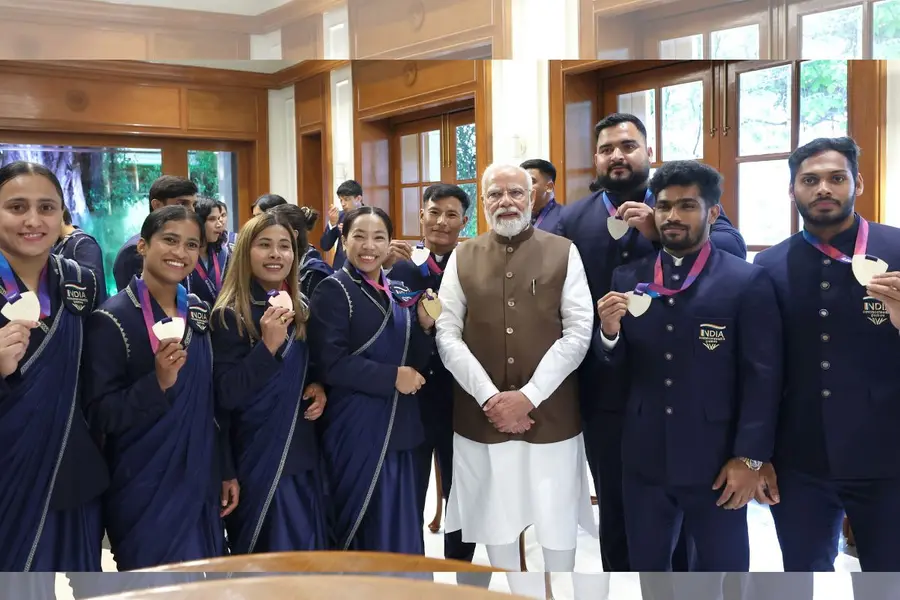
With 39 medals overall, including 13 gold, the show depicted a certain depth in India’s sporting field.
Cape Verde or Cabo Verde as it is officially known did not seem a name that would easily fit into the tongue at one time. Until the recent World Cup football made it a household name thanks to the country’s football team that showed pluck, skill and a determination that in short was a revelation. A small nation, smaller than even a state in India, came up with big deeds that today when a discussion is on football Cape Verde’s heroics can never be sidelined. An unknown country in Africa till then to many, Cape Verde proved that it was not the size of the nation that reflected sporting success but the aspirations and eagerness to do well. A notable show of this tiny nation was the way it held the ultimate World champion Spain to a goalless draw in the initial group phase. The country which had started participating in the Olympics since 1996 has even an Olympic medal to show which it won at the last edition in the field of boxing. So, it is not football talents alone that Cape Verde perhaps abound in but a few others as well.
What lesson India can have from this or the thoughts that arise are on the various ways our large country too could have shone in the field of sports. But then India too had its date with history particularly looking at the way hockey ruled supreme and the very many gold medals that this sport had brought the country. But the trend changed. As it did for football too. Once the top nation in Asia, Indian football today lives on the past essentially. Change is the need in all aspects and the recent happenings have triggered hopes that the country is inching ahead with renewed vigor, aspirations and rising level of performances. True we have had over the years two individual gold medals in the Olympics through Abhinav Bindra (shooting in 2008) and Neeraj Chopra (athletics in 2020) aside from several silver and bronze medals. Still, there was something special about the effort in the latest happening, the Commonwealth Games recently held in Glasgow. Originally slated to be held in Victoria in Australia, the latter withdrew and it was a truncated version comprising just 10 disciplines that were held in Glasgow. Yet, India by the final day had jumped to the fourth spot for a creditable show overall.
With 39 medals overall, including 13 gold, the show depicted a certain depth in India’s sporting field, something that augured well as the country looked ahead to bring in some top notch Games to the country before long. Already the 2030 edition of the CWG is to be hosted by India and the aim was to get the 2036 Olympics too! While it is true that medals haul at the CWG in particular may not be a true reflection as such of the country’s sporting prowess still the Glasgow show should certainly be considered a step forward considering the latest edition had no competition in shooting, wrestling, archery, hockey, badminton and even squash, core events which had brought in medals all this while. What truly had to be underlined is the improved standards achieved in athletics. Where the lookout was for Neeraj to keep raising the Indian flag, the great man did it but with a silver medal this time, but there were others. Gulveer Singh’s double, winning both the 5000 m and 10000 m events, something considered the preserve of the Africans, was indeed heartwarming. There was Tejaswin Shankar who had the mortification of withdrawing from the high jump event, coming back to win a historic bronze In the decathlon. While Neeraj settled for silver in the javelin, there was another, Yash Virsingh winning the bronze to give a new light to Javelin prospects in the days ahead.
Not just that, the dominance of the boxers (seven golds came from them) was outstanding even as the judokas made history. Weightlifter Mirabai Chanu once again showed her class, winning the gold and in the process becoming the first woman to win three consecutive CWG gold medals. Indeed could there have been a better advertisement for the Ahmedabad 2030 edition than this golden triumph of this strong hearted lady. With the Asian Game slated for next month in Japan, the Glasgow show could well be a benchmark for the task ahead. More such top notch performances is the need to give India the image of a sports-centric nation. Here it must be mentioned that the role of Government has to be acknowledged. The Khelo India programme and the initiative in it to expand the talent pool are all positive steps. What is more, the overall budget for sports in the country today stood at over a massive Rs 36000 crore for the period 2026-31. The intentions from the government are clear.
Yet one big impediment that seems to be posing a huge danger is the growing dubious distinction of becoming a doping hub. To say that India leads the world in doping violations for the third consecutive year is not happening. But the fact remains as of April this year India is bracketed along with Russia and Kenya as high-risk countries in the context of dope-testing. Even prior to these Glasgow games, doping menace struck the Indian contingent that forced a few key contenders in judo and weightlifting to withdraw. How this menace can be tackled and tackled effectively would be the key to the future, considering India’s ambition to host major Games. Truth can be painful.
Published: 11 Aug 2026, 07:30 am IST
ABOUT THE AUTHOR
Disclaimer: Kindly avoid objectionable, derogatory, unlawful and lewd comments, while responding to reports. Such comments are punishable under cyber laws. Please keep away from personal attacks. The opinions expressed here are the personal opinions of readers and not that of Mathrubhumi.